
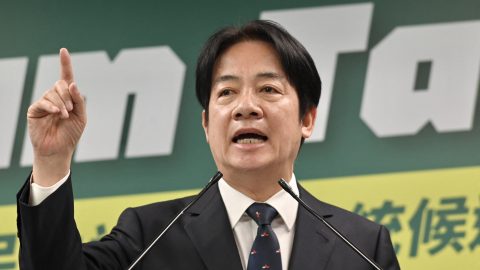
When Taiwanese president Lai Ching-te (賴清德) speaks, he has an audience of three.
Like any leader, he speaks to the citizens of his country, Taiwan.
Like any leader, he speaks to international listeners, who wish to understand the direction that Taiwan will take. But unlike most leaders, Lai’s international audience is sharply divided in two.
When Lai speaks, Beijing listens. Lai’s task is to persuade or deter China from attacking Taiwan. In an ideal world he would also be trying to improve relations beyond this, but there is little current hope of that.
When Lai speaks, Washington listens, too. The U.S. would be crucial to any credible defense of Taiwan against Chinese aggression. Lai must maximize the prospect of American support and in doing so has to walk a narrow line, simultaneously reassuring the U.S. that he won’t accidentally trigger a Chinese invasion while also demonstrating that Taiwan is preparing well for exactly that eventuality.
Lai is relatively popular in Taiwan. His approval rating is currently 51% and has not fallen below 40% since he was inaugurated in May. To be sure, he faces numerous domestic challenges, both systemic and political. One might easily look ahead and imagine that in three years when Taiwan next elects its president he will be seen less favorably.
Lai is hated by the Chinese Communist Party in Beijing. He is seen as a separatist, like all Democratic Progressive Party (D.P.P.) politicians, but somehow different from his predecessor Tsai Ing-wen (蔡英文). This might be related to “less cautious” comments he has made in the past about supporting de jure independence, but in winning a third term for the D.P.P. he also revealed to the C.C.P. that the strategies they deployed during eight years of Tsai presidency were largely ineffectual to impact Taiwanese public opinion.
In Washington, Americans perceive Lai cautiously. Again and again, one hears and reads that Lai is seen as less risk-averse than Tsai and so more likely to “provoke” a major crisis or even war with China that the U.S. would be dragged into. There is less on-the-record evidence of this that one would assume, but there is no doubt it is perceived wisdom in the American capital and beyond.
Why then, did Lai make remarks in the fall that appeared both “likely to anger China” and likely to puzzle or even concern the U.S.?
The first set of comments were made at the beginning of September when Lai said in an interview that “If it is for the sake of territorial integrity [that China wants to control Taiwan], why doesn’t it take back the lands occupied by Russia that were signed over in the Treaty of Aigun? Russia is now at its weakest, right?” In the 1858 Treaty of Aigun the Qing dynasty signed over a large swathe of territory to Imperial Russia. Some Chinese nationalists still perceive this as injustice even though the People’s Republic of China has subsequently recognized Russian sovereignty of the territory in question.
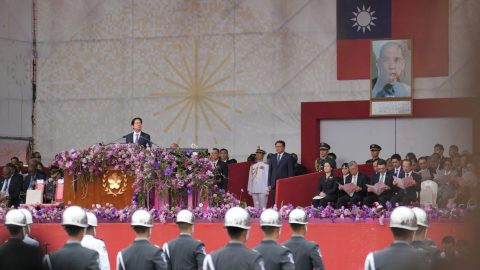
The second remarks were made at a concert on October 5 that preceded Taiwan’s National Day on October 10. Lai said “that in terms of age, it is absolutely impossible for the People’s Republic of China to become the ‘motherland’ of the Republic of China’s [R.O.C.] people. On the contrary, the Republic of China may be the motherland of the people of the People’s Republic of China who are over 75 years old.” He made these remarks in the context that the P.R.C. had just celebrated the 75th anniversary of its founding, whereas the R.O.C. was about to celebrate the 113th.
Although Lai is commonly referred to as the president of Taiwan, by title and name the state he governs is called the Republic of China. In 1945 after the Second World War, the R.O.C. controlled most of the territory the P.R.C. now rules. After Japan’s defeat, the R.O.C. gained control of Taiwan, too. The Chinese Nationalist Party (K.M.T.), who then ruled China, promptly lost the Chinese Civil War to the C.C.P. and retreated to Taiwan. From 1949 when the P.R.C. was founded, it and the R.O.C. have coexisted in a state of physical and diplomatic tension.
The K.M.T. ruled the R.O.C. as an authoritarian state until 1992, when free elections were held and what might be termed “the modern Taiwanese state” came into being. But this state, which is commonly called Taiwan as a shorthand, is still the R.O.C. and has all the institutions, trappings and baggage of the Republic of China.
Lai’s party, the D.P.P., was born out of the democracy movement that opposed the K.M.T.’s dictatorship. Because Taiwan’s democratic transition was achieved with relatively little bloodshed and in an organized manner, the K.M.T. remains a political force and the main opposition to the D.P.P.
What’s interesting about Lai’s comments is that they directly or indirectly cast aspersions on the legitimacy of the government of the P.R.C. Needless to say, this is something that the C.C.P. will not appreciate, and whether the U.S. welcomes it is an interesting question. Historically speaking, and in contrast to the K.M.T., D.P.P. presidents have not wanted to appear to contest the C.C.P.’s rule for fear of looking Chinese or even legitimizing the P.R.C.’s narrative that it has a right to Taiwan.
So again, why does Lai appear to do just that? Is he trying to take shots at the Chinese government or even at President Xi Jinping’s (習近平) administration directly, perhaps to appear more assertive or to genuinely damage the C.C.P. in China?
Not really.
Taiwanese scholars that Domino Theory spoke to agreed that Lai was targeting the domestic audience with these comments, and in fact a relatively narrow slice of the electorate.
National Chengchi University professor of diplomacy Chen Ping-kuei (陳秉逵) said that Lai’s strategy is to take the R.O.C. away from the K.M.T. “He wants to show that he embraces the historical view of the R.O.C., the historical view of [the] K.M.T., and this will help him to attract the K.M.T. voters.”
Chen pointed out that if someone supports the idea of the R.O.C. (Taiwan) as a state distinct from the P.R.C. (China), it’s difficult for them to accept that R.O.C. (Taiwan) exists prior to 1949 when the de facto split with the P.R.C was realized. He said that for Lai to admit that the R.O.C. starts in 1911 and goes all the way to 2024 means a lot. It means “[his] government is willing to accept the history” of the R.O.C. “interpreted by the K.M.T.”
Chen advanced an interesting theory as to how Lai can appeal to K.M.T. voters without aggravating his D.P.P. base, who typically do not identify as Chinese or with the R.O.C. at all. “The aggressive or provocative nature of the statement will make D.P.P supporters or green voters believe that this is a move targeting China.”
Chinese Culture University Professor of marketing Niu Tse-hsun (鈕則勳) said that Lai often mentions the Republic of China in speeches to the country. “It’s indeed strategically minded. He is trying to appropriate the K.M.T.’s discourse on the Republic of China, especially when the K.M.T. doesn’t dare to touch cross-strait issues. From an electoral perspective, he’s directly targeting swing voters, even the K.M.T.’s voters, pushing the K.M.T. into a corner.”
Niu emphasized that the K.M.T. is weak on cross-strait issues right now. He pointed out that 2028 K.M.T. presidential hopeful and Taichung Mayor Lu Shiow-yen (盧秀燕) was asked about Chinese students visiting Taiwan and she said it was a central government matter. From Niu: “If you want to run for president in 2028, you should get ahead on the K.M.T.’s weakest cross-strait aspects. The K.M.T. is really weak on cross-strait issues and doesn’t dare engage. This allows Lai to easily claim the Republic of China discourse, pushing the K.M.T. to the edge.”
By invoking the R.O.C for this K.M.T. voting demographic, Lai is reaching far beyond the median voter into the core of the K.M.T.’s support. In this writer’s opinion, it is unlikely to gain him many votes from that group directly, but other voters who are more peripheral and care less about the R.O.C. are likely to notice both the attempt to reach out across the aisle and the inability of the K.M.T. to push back. That is where Lai will need to win in 2028.
Professor Niu does feel that Lai is also speaking to Beijing. He said that the motherland discourse is Lai “testing Beijing’s bottom line,” but the strategy is still to benefit his domestic image. However, this might also be “showing loyalty to the U.S., highlighting he’s on the anti-China front line.”
Outside of Taiwan, though, others have their doubts. Stephen Hartnett is a professor of communication at the University of Colorado Denver. About the motherland remarks, he said “That cannot possibly earn him goodwill, either in Beijing or Washington or London. No one wants to hear that rhetoric.”
After Lai spoke about the motherland on October 5, all eyes were on the National Day event five days later. Would he say something else controversial? In the end Lai played it very safe with a speech described as “measured.”
Did Beijing respond well to this restraint? It did not. Three days later the People’s Liberation Army launched the Joint Sword 2024B military exercises. If the intent was to teach Lai a lesson, it’s not obvious what he will have learned.


Leave a Reply