
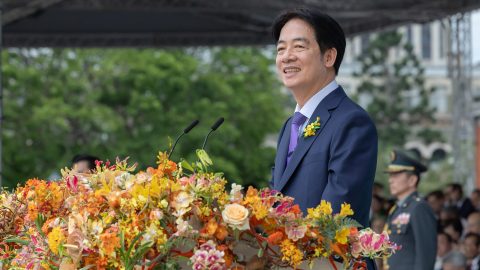
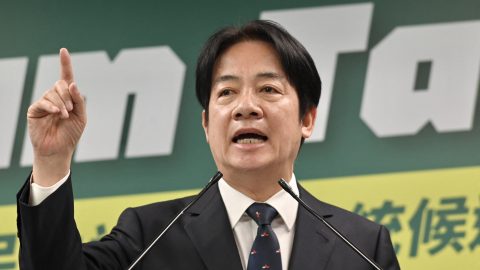
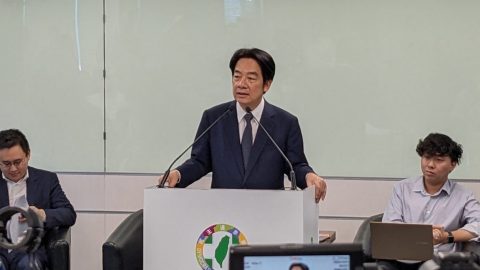
Following Taiwanese President Lai Ching-te’s (賴清德) National Day address this week, observers counted the numbers of times (11) he referred to Taiwan as the Republic of China (ROC). The precise number of mentions could apparently be used to gauge Lai’s commitment or resistance to the idea of a “one China framework.” However, prior to the speech, Taiwanese officials sought to undermine the idea that what Lai would say would actually matter in that regard, by correctly predicting that China would launch military exercises in “response” to it regardless.
For anyone wondering how this slightly farcical web of interpretations and counter interpretations tie together, the new book “Revolutionary Taiwan: Making Nationhood in a Changing World Order” offers an introduction to the context.
Taiwan sits “suspended” between a “lost ROC past” and an “unrealized international normalization,” according to authors Catherine Lila Chou (周怡齡) and Mark Harrison. It straddles a line between “being” and “becoming” a full nation state with diplomatic recognition. It is a “ghost” in the international machine, visible only when delegations visit it directly and act as “mediums.” And a fundamental dynamic lies behind this “spectral” positioning.
On the one hand, for Chou and Harrison, the post-World War II international system is partly rules based but increasingly compromises with power. Thus, an increasingly powerful China that can neither accept Taiwan as the ROC nor accept any shift away from that name is able to threaten the use of force should Taiwan outright refute the idea that there is one China.
On the other hand, the lack of recognition for Taiwan within the international system helps obscure its actually existing politics and lived experiences from the “global community,” which in turn limits the support it is offered.
For Chou and Harrison, the culprit for both of these is a limited framing of history. The view that Taiwan “split with China in 1949,” following the Chinese Nationalist Party’s (KMT) retreat from China to Taiwan, is both misleading and unhelpful, they argue, because in reality Taiwan is a kind of palimpsest of overlapping and competing histories.
Chou and Harrison’s more complete and complex picture of that history is this: Taiwan became a part of the ROC after 1945, when it was handed over by the Japanese in the Cairo Declaration. It became the sole inheritor of the name in 1949, when the KMT lost the Chinese Civil War and retreated to the island of Taiwan. But prior to that, it had been inhabited by indigenous people for 6,000 years, partially invaded by various colonial forces, and fully colonized by the Japanese in 1895. After that, Taiwan democratized and became a fundamentally different polity — albeit this was less visible because it happened over decades rather than in one moment of revolutionary action.
Through the latter part of this history, Chou and Harrison ultimately draw out a democratic seam that can be traced from 1920s revolts against Japanese rule, to the February 1947 uprising against the ROC government, to the 1987 lifting of martial law, to peaceful transfers of power in the 2000s, to the 2014 Sunflower Movement, to the 2016 apology for four centuries of mistreatment to indigenous people. (Alongside many more key moments.)
From this perspective, the authors argue that the idea that “unification” with China is inevitable or automatic is undermined. They argue, in fact, that “unification” would not resolve questions about Taiwan’s future. Rather, the violence unleashed on Taiwan when the KMT took it over would be replayed again.
The parts of this that may be contested by some are in the analysis, rather than the history. The idealized view that the post-World War II rules-based international order has increasingly compromised with power rather than has always been composed of power is by no means universally held. Nor is the resultant idea that if Taiwan’s history and politics of self-determination was better understood then its democratic future would be more secure. Do states become convinced by fair arguments or their material interests and calculations?
Most controversial, perhaps, will be the view presented here that “It is the Taiwanese desire for democracy and for the recognition by the global community that has so far put off unification,” rather than the hard power of the U.S.
For some, there may be too much belief in the power of ideas in this book. And, at times, even Chou and Harrison hint at limits. They write that the ROC name “constricts” Taiwan — in giving us the misleading history — but also acknowledge that it in some ways “protects” it — presumably because Taiwan declaring independence is considered a red line by both China and the U.S. It’s just that perhaps some of the points that go all the way to centering Taiwan entirely seem to rely on a different view.
Nevertheless, this is a comprehensive and useful account of Taiwan’s history — and an account that wears its politics openly, positioning itself explicitly as centering Taiwanese subjectivity. The details of democracy movements and internal battles for fair treatment are important interventions for anyone who cares about the truth of Taiwan’s history, present and future.
“A Revolutionary Taiwan: Making Nationhood in a Changing World Order” is available here.


Leave a Reply