
1. U.S.: Trump Comments on Paying for Protection, New AIT Director, Vice Presidential Picks’ Rhetoric on Taiwan and China
Republican Party presidential candidate Donald Trump said Taiwan should “pay [the U.S.] for defense” and that it had “take[n] about 100% of [the U.S.’ chip business]” in an interview with Bloomberg last month.
China froze the China-based assets of six U.S. defense manufacturers after they were a part of the $360 million ($11.8 billion New Taiwan dollars) sale of drones and missiles to Taiwan approved in June.
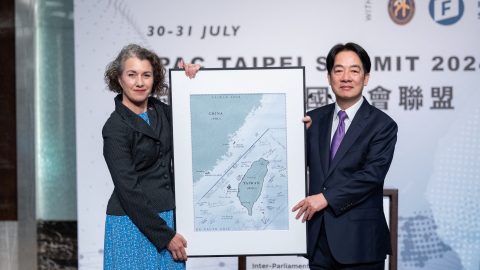
Taiwanese President Lai Ching-te (賴清德) presented outgoing director of the American Institute in Taiwan (AIT) Taipei Office, Sandra Oudkirk, with an award to mark the end of her tenure on July 3. He then welcomed her replacement, Raymond Greene, a week later, noting Greene’s continuity credentials.
At the start of August, the U.S. Senate failed to pass a bill offering relief from double taxation for Taiwanese citizens or businesses receiving income from the U.S. The issue might be returned to after November’s election.
There have been mixed reviews of Republican vice presidential candidate J.D. Vance’s positions on Taiwan. Those suggesting he will have a strong commitment to defending Taiwan have focused on consistent statements about deterring China and prioritizing Taiwan over Ukraine. Those suggesting the opposite have focused on the idea that “abandoning” Ukraine would erode confidence in Washington’s commitment to Taiwan.
With fewer public statements to go off, the Democratic Party’s new vice presidential candidate Tim Walz has had his brief experience working in China and experience working with Taiwanese companies as a governor of Minnesota flagged as a plus for Taiwan.
2. Japan: Hosting War Games and Track II Diplomacy With National Taiwan University and Taiwan’s National Palace Museum
Japanese think tank the Japan Forum for Strategic Studies held its 4th Taiwan Strait Crisis Policy Simulation on July 13. Democratic Progressive Party (DPP) Legislator Yuan Kuan-Ting Chen (陳冠廷) attended the event. Lai I-chung (賴怡忠), president of Taiwanese think tank the Prospect Foundation, who played the role of Taiwanese president during the simulation, noted that responding to “gray zone tactics” is already an “increasingly prominent theme in discussions between Taiwan and the United States.”
National Taiwan University signed a memorandum of understanding with the Japan-Taiwan Exchange Association on July 18, with the latter agreeing to provide funding to three of the university’s colleges to “cultivate more scholars in Japanese studies.”
A delegation from Taiwan’s prestigious National Palace Museum visited Tokyo National Museum, Tokyo Fuji Art Museum and Kyushu National Museum. The trip was designed to discuss institutional cooperation.
3. Europe: EU Challenging Taiwan at WTO and New British Prime Minister’s Past Pressure
The EU has requested dispute settlement at the WTO over Taiwan’s offshore wind regulations, which privilege local manufacturers.
Keir Starmer’s election as U.K. prime minister at the beginning of July was notable for the fact that he has visited Taiwan twice, in 2016 and 2018 respectively. The purpose of those visits was to advocate for the removal of the death penalty — an issue the European Union has also taken up in its diplomacy with Taiwan.
On July 22, Johnny Chiang (江啟臣), the Chinese Nationalist Party’s (KMT) deputy speaker of the Legislative Yuan, led a cross-party delegation to the Czech Republic’s Chamber of Deputies. They met figures including Deputy President Vera Kovarova.
Taiwan’s Ministry of Foreign Affairs congratulated Ursula von der Leyen on her re-election as president of the European Commission on July 19.
A program for enhancing artistic links with France was announced by Taiwan’s Ministry of Culture on July 22. Via a cooperative agreement, artists from France and French-speaking countries will be able to take part in artistic residencies in Taiwan. As the result of a similar agreement, two Taiwanese artists were selected for a residency program in Lithuania at the start of August.
4. India: Supply Chains Switching From China
In July, the chairman of the Taiwan External Trade Development Council said Taiwanese firms were shifting supply chains away from China toward India, pushing Taiwan’s foreign direct investment in India beyond $665 million in the five years leading up to 2023.
On July 11, an agreement to allow organic Taiwanese products to be sold more easily in India, and vice versa, came into effect.
This week, Taiwan’s representative in India awarded over 100 scholarships to Indian students, allowing them to travel and study in Taiwan.
At the end of July, the India Taipei Association participated in a discussion over the future of Taiwan’s aerospace industry at the Legislative Yuan. Director-General Manharsinh Laxmanbhai Yadav welcomed the participation of Taiwan’s private sector in Indian aerospace projects, a project that is already underway.
5. Diplomatic Allies: Guatemalan Flooding Support
In mid-July, a Guatemalan delegation led by Congress President Nery Abilio Ramos y Ramos visited Taiwan to speak with President Lai. As well as asserting that bilateral ties should be strengthened, Lai offered help with flooding in Guatemala.
6. Additional Developments: IPAC and Olympic Medals Mixed With Flag Disputes
On July 30, Taiwan joined the Inter-Parliamentary Alliance on China (IPAC) after its summit was held in Taipei. Various attendees said they were pressured not to attend by China.
At the Olympics, Taiwanese athletes competing under the name “Chinese Taipei” have so far won one gold and four bronze medals. Highlights include Taiwanese gymnast Tang Chia-hung (唐嘉鴻) winning bronze in the men’s artistic gymnastics horizontal bar and badminton players Lee Yang (李洋) and Wang Chi-Lin (王齊麟) becoming the first athletes to win gold in the men’s doubles twice in a row.
Two disputes have played out around Taiwan’s athletes. Taiwanese boxer Lin Yu-ting (林郁婷) has been caught up in an international debate around eligibility requirements for women’s boxing, while there have been several incidents of Taiwanese spectators having flags removed for referencing the name “Taiwan,” rather than the “Chinese Taipei” designation. Numerous groups have called for the name of the team to be changed to Taiwan.

Leave a Reply