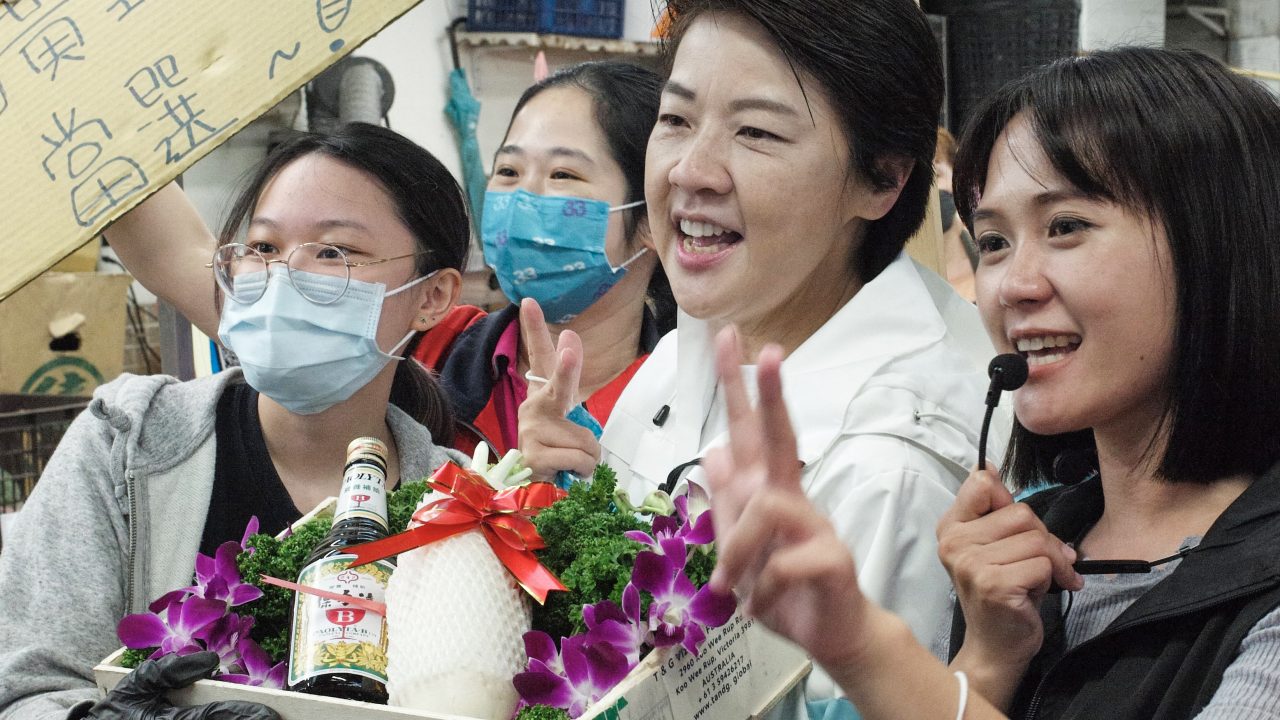
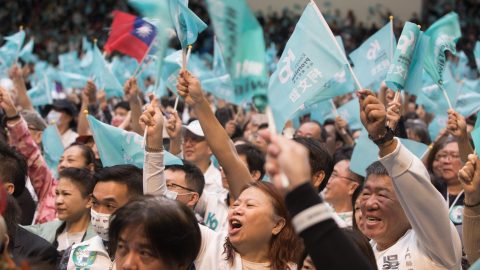
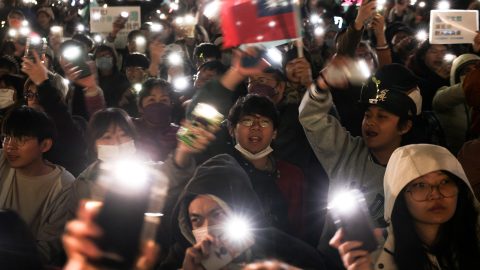
Among Taiwan’s election results, the rise of the Taiwan People’s Party (TPP) appears to be the standout new development. Driven primarily by young people, it’s a third party that now holds a powerful position in a Legislative Yuan where no party has a majority on its own. Moreover, it’s often characterized as being in that position off the back of a campaign that attempted to focus on socio-economic issues more than cross-strait ones. And where it did talk about relations with China, it pitched itself as a pragmatic middle road between the Democratic Progressive Party (DPP) and the Chinese Nationalist Party (KMT).
However, now, there is debate about the party’s significance going forward. There are some who suggest the TPP has drawn more attention than it merits because the media prefers to talk to young people in its vox pops. And as always in news coverage, there is a danger of conflating what is most new with what is most important. Thus, having acquired a “decent platform to build on,” with 22.07 percent of the party-list vote and eight seats in the Legislative Yuan, plus 26.46 percent of the presidential vote for its leader, Ko Wen-je (柯文哲), the next test for the TPP will be its staying power.
Two immediate challenges are widely discussed.
The first is the idea that Ko is a “one-man party.” For those who might subscribe to this view, the disparity between the party’s vote in the national party-list vote and Ko’s presidential vote is a sign of the issue. Those results “[point] to the fact that there’s still more support for him as an individual [than] as a party,” Sara Newland, assistant professor of government at Smith College, told Domino Theory by email.
If this does limit the TPP, then it could be even more of a problem in the next four years. Ko is “going to be less important, and maybe less visible in day-to-day politics, than the most important TPP legislators (Huang Kuo-chang [黃國昌] and Huang Shan-shan [黃珊珊]),” according to Newland. He will not be a member of the legislature and nor, as previously, will he be an elected official as a city mayor. “So it’s possible there will be some significant growing pains for the TPP as it tries to transition from a focus on Ko to trying to be a major player in the legislature.”
That point bleeds into a second challenge. The TPP’s focus on “pragmatism” means it now has a variety of legislative candidates from different points on Taiwan’s political spectrum, in particular the blue-green axis (representing closer or more distant relations with China.) Huang Kuo-chang, one of the lead figures of the Sunflower Student Movement and former member of the deep-green New Power Party, and Huang Shan-shan, a former member of the deep-blue People’s First Party (PFP), are two examples of this. The TPP today named Huang Shan-shan as its candidate for president of the Legislative Yuan and Huang Kuo-chang as chief convenor of the party caucus. Some believe it could be difficult for them to hold together.
“The TPP has to think about how to make [the party] more coherent and nurture their own politicians or party members in the future,” said Tsai Chia-hung ( 蔡佳泓), a research fellow at the Election Study Center of National Chengchi University in Taipei, speaking to Domino Theory via video call. He noted the vote for the position of speaker of the new legislature is the first test of this unity.
A third, even more fundamental challenge could be added to these, too. Ko Wen-je’s “ability of having people project whatever [they want] onto him” by putting forward the rhetorical blank canvas of being a “pragmatist” may be more difficult to maintain as the TPP is tied down to making concrete decisions in parliament, Sie Da-wun (謝達文), a PhD candidate specializing in political sociology at National Taiwan University, told Domino Theory on a phone call.
So, can these challenges be overcome? Or, as has previously happened with another party known for its charismatic leader, the PFP, will this third force in Taiwanese politics fall back again quite quickly?
The case for it continuing as a substantial force, or even growing, might look like this.
Firstly, the diagnostic value of the gap between Ko’s vote and his party’s vote could be overstated. National Chengchi University’s Tsai, for instance, pointed out that the DPP has also had significant gaps between party vote and presidential vote at the previous 2020 elections. Within this view, the raw figures could say less than they appear to and, for what it’s worth, that is backed up anecdotally by interviews Domino Theory conducted with young TPP voters. Those we spoke to all placed the abstract need for a third force in Taiwan’s democracy near the top of their reasoning, while only one of five directly praised Ko’s personality.
Secondly, the day-to-day difficulties of navigating parliamentary politics may occupy the thoughts of political commentators, but may not be as directly important to young voters. For instance, Sam Huang (黃詠恩), a 19-year-old student who we previously interviewed before the election, said via written message that he felt it “mattered a lot” if the TPP could successfully influence decisions in the Legislative Yuan, but that he would only follow day-to-day political events “if someone makes a huge blunder.”
What both of these arguments in the TPP’s favor are ultimately getting at is the idea that the party has been propelled into its current position by forces that are fundamental enough to overpower more short-term hurdles it faces. The point here would be that the TPP’s position reflects some fundamental need in Taiwanese politics and, in the words of Tsai, that adds up to it gaining “a different social base” from the other two parties, which means it can stay around longer.
This view might be supported by the fact that a non-partisan block has existed in Taiwan long before the current election. Sie Da-wun pointed out that the party votes for the DPP and KMT at the legislative elections remained relatively steady between 2020 and 2024. He said the existence of a non-partisan block can be traced back to 2012. He noted that places where the TPP has now done well are “townships where the KMT mobilization machine had already failed a decade ago, but where the DPP failed to ‘absorb’ those votes.” Into that gap, “surrounded by older cousins and uncles and aunties” who have had their own doubts about the two traditional parties, a group of young people have grown up who Sie said “never identified with the KMT to start with,” but were also “never really convinced by the DPP.” He added that a particularly significant rise in presidential votes for President Tsai Ing-wen back in 2020 can be accounted for by the same group offering a “borrowed” vote under the “perceived threat from China” but noted “that didn’t even extend to the legislative race back in 2020, let alone this time around.”
However, if that characterization is correct, it by no means suggests the TPP’s task is simple or its growth is inevitable. It suggests what looks like a surge for the TPP is more like capturing an existing form of political energy rather than one it owns outright, and that means it’s not a given that the block will always give its support to the TPP. “There are different possible scenarios. I don’t think it’s predetermined,” Sie said.
Guessing where the block goes next may be difficult because the fundamental need the TPP is speaking to may actually be very flexible. Having conducted his own interviews with TPP voters, Sie said he believes the non-partisan energy “has a very distinct Taiwanese twist.” Despite some narratives, Sie does not believe the consistent through line between these people is a material divide of lower wages and access to housing, because better off younger people have still shown support for the TPP. Rather, he said the non-partisan block is made up of people “who the KMT party machine cannot reach, who still subscribe to a certain worldview that politics is petty and ideological and [who] distrust the DPP.”
Within that loose connection, Sie can foresee scenarios where some younger people are politicized by events and move to the DPP. Or they could move to a fourth party. Or the TPP could hold onto them. “It comes down to finesse, it comes down to skills,” Sie said.
The real test for the TPP, then, becomes whether it can build up grassroots to continually capture the political block it grabbed hold of so successfully this time. To do that, Ko needs to “build up a stronger party organization to control his policies and to control his members,” Tsai suggested. And the TPP needs to “distinguish themselves” from other parties on policy. “Right now they just have some core principles, but I don’t think they have already proposed social democracy or something more progressive. But if they want to be a viable party, I think they really have to do something maybe a little bit risky [regarding policy],” he said.
Those are major tasks for a party currently full of members who have previously been in other parties, with less money to spend than the KMT and DPP. But success or failure will be judged over months and years rather than weeks.



Leave a Reply