
China showed the world a comprehensive set of antidrone systems during its September 3 World War II parade. Taiwan is slowly implementing more modest efforts. If Taiwan falls too far behind its neighbor, it may be completely outclassed.
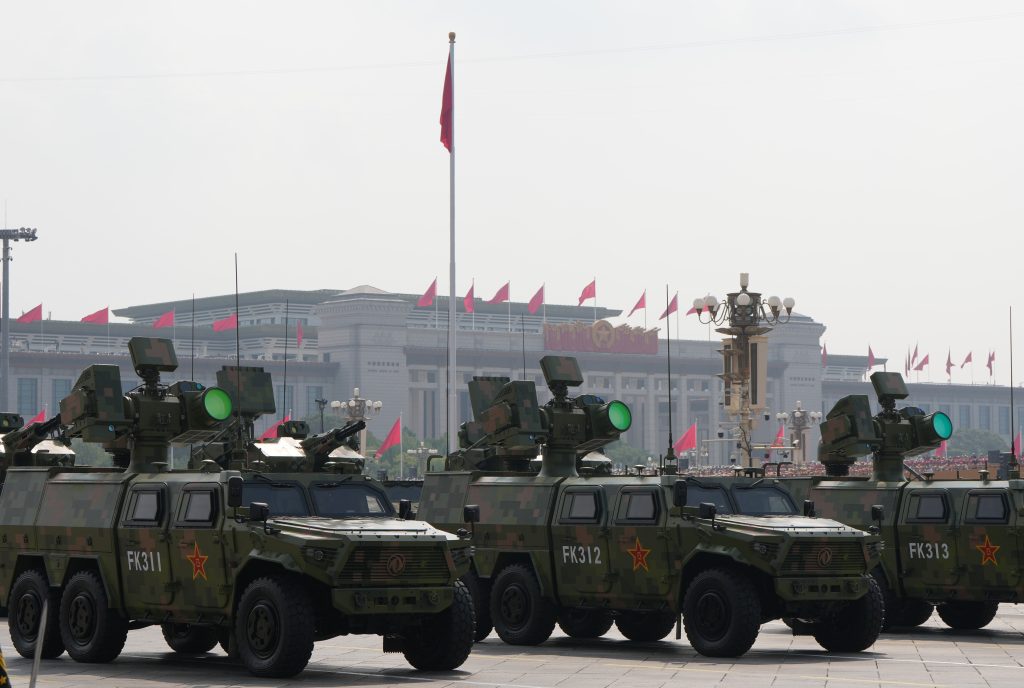
During the parade past Tiananmen Square, an entire formation was dedicated to counter-uncrewed aerial system (counter-UAS) weapons. China showed off three distinct modes of attack. There were two different high-energy laser-based systems, a high-powered microwave system, and two different surface-to-air gun and missile systems. It is not clear which of these have entered full service, but China has existing gun-and-missile short-range air defense systems.
Taiwan is currently bringing into service an anti-drone system based on electronic warfare or jamming concepts, as well as a kinetic interceptor, effectively an anti-drone drone. Taiwan has existing modern Stinger missile-based short-range systems in widespread use with its army, and the Taiwanese air force operates some near-obsolete gun-and-missile based systems on air bases.
Taiwan needs to really “keep pushing forward with counter UAS and just a whole spectrum of air defense,” Bryce Barros, an associate fellow at GLOBSEC, a self-described global thinktank, told Domino Theory.
Barros was impressed by the integration of the different Chinese counter-UAS capabilities into one formation at the parade, but said he wants to see how they will be used during exercises. “They’re going to start to hone in on how a counter UAS-capability could be integrated into a sort of amphibious landing battalion or a ground force mechanized infantry battalion.”
The three different types of systems that China exhibited have different strengths. Laser weapons can damage sensitive parts of drones, but have to be targeted precisely. Microwave weapons can fire with a wide-spread, damaging the electronic systems and potentially taking out drone swarms. Both lasers and microwave weapons are powered by electricity, making them extremely efficient in terms of cost per drone disabled.
Gun-and-missile air defense systems are tried and true. Missiles have longer range, but are much more expensive. Gun-based systems had been relegated to the close-in last-ditch defense role, but the rise of cheap drones has made them more attractive simply because they are cheaper than missiles. It is hard to do a more comprehensive comparison across all three types because laser and microwave systems are so new and thus poorly understood.
Taiwan is developing its own drones, but those programs have barely started, and meanwhile China has already “presented a whole range of solutions against such systems,” Xu Tianran (徐天然), a senior analyst focusing on Northeast Asian security and missile systems for Open Nuclear Network, a nuclear risk reduction nonprofit in Austria, told Domino Theory. Xu pointed out that Taiwan has done little work on its own counter-UAS systems.
Xu has written separately about how a Taiwanese Stinger missile costs $800,000, whereas “a Shahed-type One-Way-Attack drone domestically produced in Russia or a Russian Lancet loitering munition costs only about $35,000.” This price differential suggests “an attacking side may be able to quickly deplete Taiwan’s valuable SAM stocks.”
Ukrainian President Volodymyr Zelenskyy pointed out yesterday on X that Patriot missiles cost $2 million to $3 million, while Russian Shahed drones cost up to $100,000. Given the hundreds of drones Russia is using daily, “using such missiles against them is simply not a solution,” he said. “Only a comprehensive, cost-effective approach can bring results.”
So far, China has not started mass-producing military drones. Xu told Domino Theory that the Taiwanese army may think it “still has some time” because of this, but said that China would be able to do so quickly due to military-civil fusion, the strategy to repurpose civilian capabilities like manufacturing for military purposes.







Leave a Reply