
Since the Covid-19 pandemic, China has doubled down on an economic strategy that prioritizes high-tech manufacturing and export dominance. Investment has flooded into geopolitically significant industries like green energy and robotics, even as ordinary wages have stagnated and consumer demand has failed to recover.
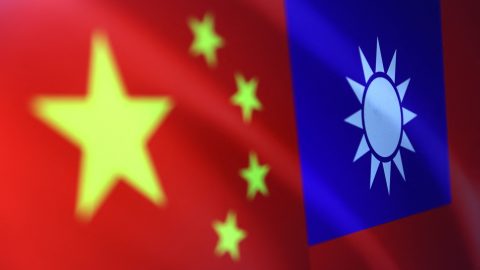
This growth strategy could become a major problem for Beijing if it attacks Taiwan, according to a report released Monday by the German Marshall Fund, a U.S. think tank.
Beijing’s economy is heavily reliant on foreign customers for its exports, many of whom live in developed countries likely to align with the U.S. in the case of a conflict. Chinese industries also benefit from $3.6 trillion in inward foreign direct investment, which the report’s authors, Logan Wright and Charlie Vest, both analysts at the Rhodium Group, say would be at risk from disruption to corporate relationships.
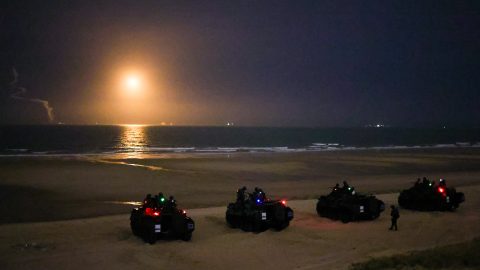
The report analyzes two potential conflict scenarios over Taiwan: a brief gray-zone conflict with no clear winner, and a protracted all-out war that attracts U.S. intervention and leads to a decisive defeat for Beijing.
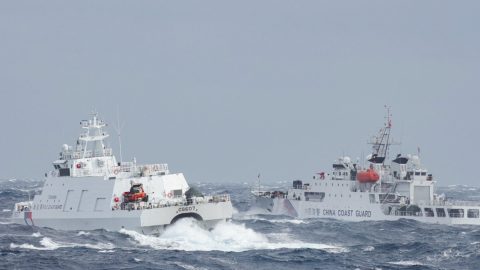
In the milder scenario — in which Beijing trades fire with Taiwanese forces and attempts to quarantine major ports before backing down once the U.S. gets involved — it may be possible for China to avoid the worst of the economic backlash.
But for a limited operation to achieve the intended effect of bringing Taiwan to the negotiating table, the report says, China must be able to credibly threaten more aggressive actions. That’s where the weak points in its economy would come into play.
“In military signaling under such a scenario, China would attempt to make credible its actions and willingness to escalate to achieve political aims. But for its economic interests, China would need to send credible signals of a quick return to normality,” say authors Logan Wright and Charlie Vest, both analysts at the Rhodium Group, an independent economic research firm.
The threat of economic sanctions, or even a complete embargo, have always been part of Beijing’s calculus over Taiwan. But the recent shifts in China’s economy — from an ailing property sector to what the report calls “an unprecedented credit and investment bubble” — have only made the prospect of economic pain worse.
“A threat to global demand for China’s exports is now far more salient to the underlying health of its economy than even five years ago because domestic demand has weakened so sharply,” the report says.
In the more extreme scenario — in which the Chinese military establishes a foothold on Taiwan, but fails to transport reinforcements across the strait under sustained U.S. assault — the economic costs would be world-shaking.
The authors imagine an outcome in which the U.S. and its partners impose a near-total embargo on trade with China, leading to a world in which export-heavy economies are left with too much to sell and import-heavy economies are left with nothing to buy.
Such an outcome would inevitably lead to a recession in China, but also around the world. If China does pursue this path, the report concludes, it would indicate that no economic pain would be bad enough to dissuade them from pursuing Taiwan at all costs.




Leave a Reply