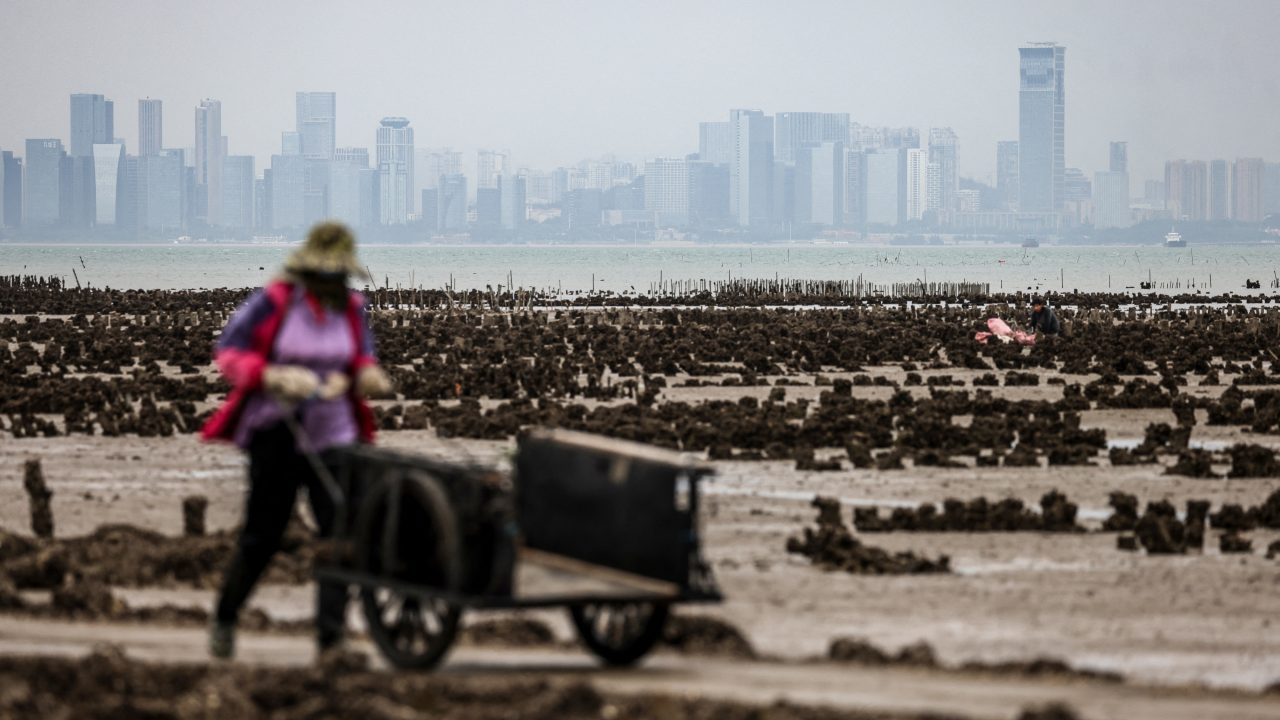
In 2023, Taiwan’s food self-sufficiency rate fell to 30.3%, the lowest figure in 18 years. That figure represents the proportion of food consumed in Taiwan which is also grown in Taiwan, and it’s regularly touted as a national security issue — for a number of reasons.
Taiwan’s food stockpiles are estimated to be enough to last around six months, with larger rice stocks expected to be able to last a bit longer. But there is an overt threat of a Chinese blockade over Taiwan and that, combined with uncertain trade patterns and fluctuating crop yields due to climate change, increasingly makes this a cause for concern.
“While such stock levels may sustain Taiwan in a rapidly evolving kinetic conflict with China, they could fall short during a prolonged naval blockade,” one 2023 report from the U.S. Army War College argued.
A number of solutions have been proposed. There have been moves to improve stockpiling. There have been efforts to secure existing external supply lines. Emergency backup plans have been put in place for more farmland to be used to grow basic foods during any potential crisis scenario. And the Army War College report mentioned above suggests developing a victory garden program like those used in World War II — private gardens converted to grow fruit and vegetables.
However, what none of these do is raise internal food production ahead of a crisis. And what many reports fail to fully tackle is why Taiwan’s food self-sufficiency rate has fallen so low, when from the early 18th century to the mid-20th century, it was a net exporter of food.
The most common explanation is this: Larger disposable incomes following Taiwan’s “economic miracle” in the 1960s and 1970s meant Taiwanese consumers demanded more options, and already limited arable land was taken over by rapid industrialization. But that alone is insufficient. One of the steepest drops in self-sufficiency occurred from 1985 to 2005, when it fell from 47.7% to 30.2%.
The missing factor here is joining the World Trade Organization in 2002. During the period leading up to that, Taiwan lowered tariffs on agricultural products, opened its market and cut down some agricultural subsidies, and it helped fundamentally change how Taiwan gets its food.
“Taiwanese consumer preferences for food changed, leading to increased consumption of flour (wheat) and decreased consumption of rice. Additionally, the rise in meat consumption indirectly increased the demand for feed crops such as corn,” Yu-Hui Chen (陳郁蕙), a professor at National Taiwan University’s Department of Agricultural Economics told Domino Theory.
But on top of that, “In order to join international trade organizations, Taiwan liberalized its agricultural market and reduced import tariffs. For example, feed crops were allowed to be imported tariff-free, and in 2005, pork and chicken imports were liberalized.” The bottom line: “WTO accession deepened Taiwan’s agricultural trade deficit.”
This process went deep into crops that had been staples of Taiwanese agriculture. Chen noted that even rice imports were opened up and both the quantity and value of fruit imports increased. In addition, Taiwan eliminated subsidies for crops such as corn and soybeans which led to a decline in the production of these crops.
Taiwan’s government at the time was open about what these shifts meant for its agricultural sector. “[T]he accession to WTO had exposed Taiwan to large amount[s] of low-price imported foreign agricultural products,” a Taiwan Ministry of Agriculture summary said in 2004, “it also aided export of Taiwan’s quality agricultural products.”
The belief was that the benefits outweighed the costs.“Taiwan can make use of its advanced technology to develop high-value agricultural products, or use inexpensive imported agricultural raw materials and employ our superior processing technology to develop high value-added processed goods that can be marketed overseas,” Taiwan’s Ministry of Agriculture said at the time.
Agricultural job losses were built into this calculation. And the fundamental equation has remained steady since then. “Taiwan faces challenges competing in international agricultural markets due to relatively high production costs and difficulties ensuring stable supply,” Yau-Huo Shr (石曜合), an assistant professor in the Department of Agricultural Economics at National Taiwan University told Domino Theory.
The end result is that Taiwan’s food currently relies on a variety of sources. The U.S. is the largest supplier, exporting $3.9 billion per year, accounting for 21 percent of all imports. That makes Taiwan the tenth largest export market for U.S. agricultural produce. Then there is Brazil ($1.7 billion, 9 percent), China ($1.4 billion, 7 percent), Japan ($1.1 billion, 6 percent) and New Zealand ($1 billion, 5 percent).
Of course, the importance of accession to the WTO should not be overstated. “Taiwan’s current low food self-sufficiency rate reflects a complex interplay of structural and economic factors,” Min-Fang Wei (魏敏芳), an assistant professor at the National Taiwan University’s Department of Agricultural Economics told Domino Theory.
“Trade liberalization has contributed to increased reliance on food imports by lowering tariffs and expanding import quotas. At the same time, evolving dietary preferences have driven a decline in rice consumption, where Taiwan remains highly self-sufficient, and a rise in the import of meat products, feed grains, and other dietary components.”
No single decision explains everything.
But it’s also useful to note that some political decisions have been made to reach the point we are at now. Because that acknowledgement opens up the possibility of making different political choices should they prove necessary.
In a world in which trade was far more frictionless, climate change was less rampant and Taiwan’s relationship with China was better, food self-sufficiency may not have been a priority. Now there is at least a question about whether that should be reassessed.



Leave a Reply