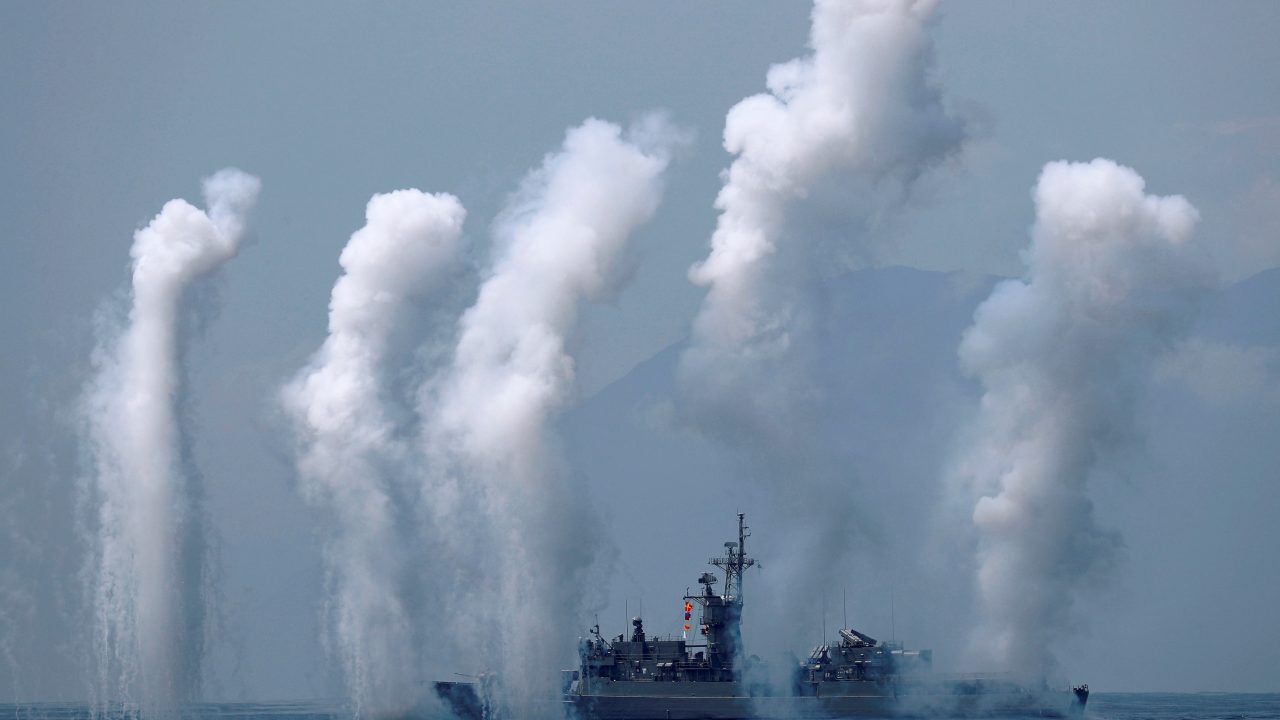
Taiwan’s youngest frigate is older than the youngest ratings who sail on it. The oldest is more than twice their age. The navy needs new ships, but what is it planning to do about this?
Last week Taiwanese media, including the Liberty Times and Up Media, reported that Taiwan’s navy has relaunched its stalled guided missile frigate program, intended to replace part of its aging fleet.
The initial plan was to build a large number of a single frigate class, with a displacement of 4,500 tons. However, due to numerous delays, this was abandoned in 2022 and a new light frigate program was launched.

The intention behind that 2,500-ton program was to get a capable ship in the water soon, without further delays. Construction work has already started on the first two vessels, at the Jong Shyn Shipbuilding Company (中信造船) yard in Kaohsiung.
Now the navy intends to complement the new light frigate with a more advanced, high-end option. Citing unnamed “senior government sources,” the Liberty Times reports the guided missile frigate will be much larger, at 6,000 tons. It will have a more powerful radar and air defense missiles with greater range, allowing it to perform area, rather than just local, defense.
These programs are a matter of some urgency. Taiwan’s frigate force is now two decades behind its peers due to mismanagement of replacement programs, the Taipei Times reported, citing a news release from the Control Yuan in December last year.
One of the most interesting pieces of information about the new ships was not mentioned last week at all. This is the number of guided missile frigates intended to be built.
Knowing this number would allow us to make some reasonable inferences about the future of other ships in Taiwan’s fleet. However, the reverse is also true. We can make some pretty good guesses about the number that Taiwan is likely to build.
First, let us briefly recap the current makeup of the Taiwanese navy’s escort fleet (escort here is a catch-all term encompassing frigates, destroyers and cruisers). Taiwan has 22 frigates and four destroyers.
The destroyers are the U.S.-built Kidd-class, which Taiwan operates as the Kee Lung-class. They are over 40 years old and have been in service in Taiwan for more than 20 years. They are significantly larger than the Taiwanese navy’s frigates and currently the only Taiwanese ships that can provide long-range air defense.
The frigates are divided into three classes. There are six Knox-class frigates, called the Chi Yang-class by Taiwan. These were purchased second-hand from the U.S. and are now over 50 years old. They are in many ways obsolete.
There are ten Cheng Kung-class frigates. Eight of these were built in Taiwan 30 years ago. Two were purchased from the U.S. as the Oliver Hazard Perry-class, which the Cheng Kung-class is based on, and then refitted. These are ten years older than the others but only entered Taiwanese service recently.
Finally, there are six La Fayette-class frigates from France, operated by Taiwan as the Kang Ding-class. These are also 30 years old, having entered service in the 1990s. However, while the Kang Ding-class are a similar age to most of the Cheng Kung-class, they are built to a much more modern design. Furthermore, they are currently undergoing extensive upgrades.
According to Curtis Lee, citing unnamed Taiwanese media sources in Naval News, Taiwan will build 12 of the new light frigates — six as anti-air warfare ships and six as anti-submarine warfare ships. Both variants will be armed with Hsiung Feng II (雄風二型) and Hsiung Feng III (雄風三型) anti-ship missiles and Sky Sword II (天劍二) TC-2N anti-air missiles. The anti-air warfare ships will have more of the latter and less of the former. The anti-submarine warfare ships will also carry torpedoes and sonar.
These light frigates are somewhat smaller than the current classes in service but will be more capable due to their modern weapons. However, the Taiwanese navy will classify them as “Second Class” ships, suitable for all manner of missions but not intended to go toe-to-toe with larger Chinese navy escorts. In this they will fill a gap between larger frigates and destroyers (First Class) and smaller corvettes and missile boats (Third Class).
It is obvious that the Chi Yang-class frigates will be retired and replaced. It seems likely that the same is true for the outdated Cheng Kung-class as well, even though they are also due to receive new missiles. If that is the case, 16 retiring frigates would be replaced by 12 incoming light frigates.
It’s been normal since the Cold War that a navy would choose to replace older ships with fewer but more capable newer ones. However, most navies do not face as pressing an adversary threat as Taiwan does. Moreover, we are now informed that the guided missile frigate is coming.
The new guided missile frigate design features the advanced AN/SPY-7 radar, as used by the Japanese and Spanish navies. The ships would be armed with Taiwan’s indigenously developed Sky Bow III (天弓三型) surface-to-air missiles, giving it much greater range than the TC-2N of the light frigates and allowing it to perform the fleet defense role the Kee Lung-class destroyers currently occupy.
At a minimum, we can assume that Taiwan will build at least four of these larger frigates to maintain current escort numbers. However, it’s likely there will be more. It makes financial sense to spread the cost of development and maintenance support across more hulls.
If the Taiwanese navy intends to keep the Kang Ding-class in service for a while longer, as the refits suggest, then it’s plausible that the plan would be to retire the Kee Lung-class destroyers and replace them with a comparable number of the new guided missile frigates. Apart from anything else, it’s very unclear where Taiwan would get ships of another large escort class to replace them from, especially ones that are not already decades old.
It’s also possible that Taiwan intends to build even more guided missile frigates, or buy another ship class and expand the number of escorts. Apart from anything else, it might be politically difficult to go from 26 “First Class” ships to 14. However, if this is the plan the navy would either need to recruit more sailors or reduce the number of crew the new ships need, which is also a worldwide trend.







Leave a Reply