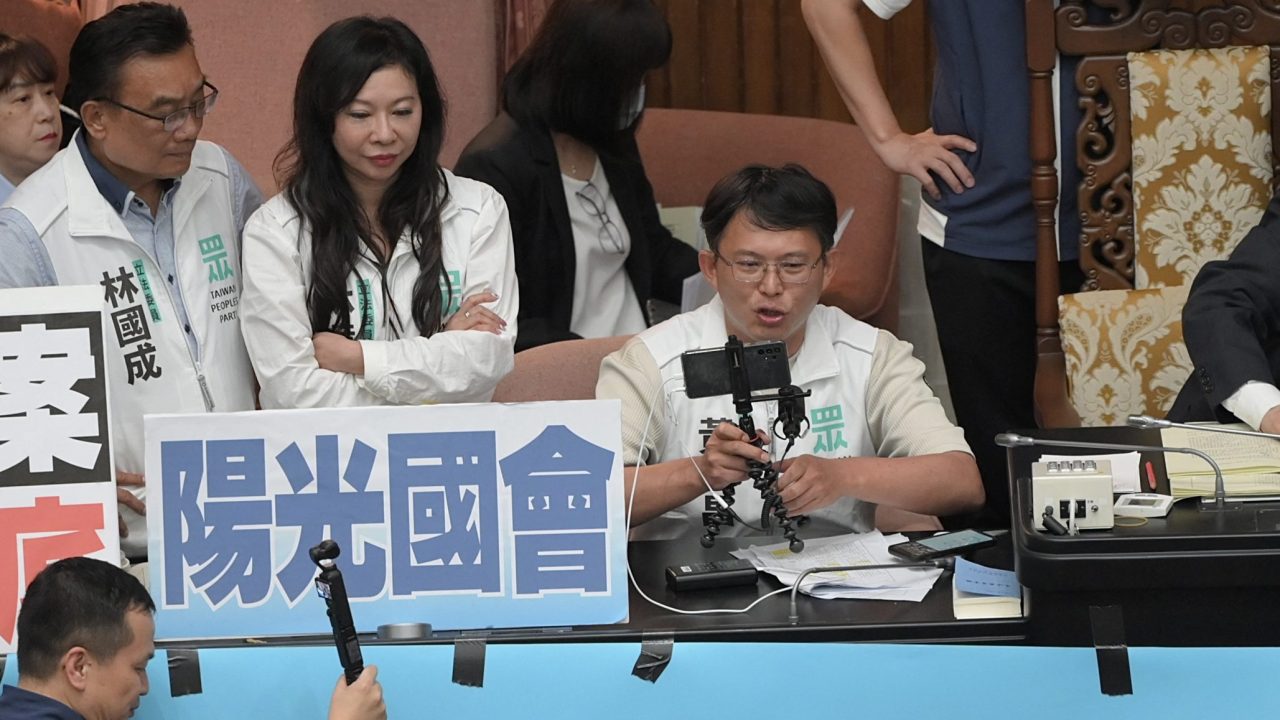
A delegation led by Huang Kuo-chang (黃國昌), the opposition Taiwan People’s Party (TPP) chair, left Taipei on January 11, heading to Washington to meet with U.S. officials to discuss defense procurement and tariffs.
Huang said he will have a tight schedule, spending only a single day in Washington before flying back the same night, arriving in Taipei on January 14. Huang described the visit as a chance to address public concerns and obtain reliable first-hand information.
The delegation will focus on Taiwan’s arms purchases from the United States, Huang said, including details of a proposed 1.25 trillion New Taiwan dollars ($40 billion) special defence bill under legislative review. Huang criticized the government for providing scant details beyond “two sheets of A4 paper,” despite public interest in purchase lists and delivery timelines.
On tariffs, Huang highlighted uncertainty after the U.S. raised rates to 20% plus existing duties on key exports, despite earlier assurances of temporary measures from the government led by Taiwan President Lai Ching-te (賴清德).
Huang emphasized that the trip was a responsible opposition effort to reflect public views while pushing for self-reliant defence. The TPP funded the privately arranged visit, Huang said, and coordinated with U.S. agencies including the American Institute in Taiwan.
The TPP supports boosting Taiwan’s defense spending to 3% of GDP, a position former chair Ko Wen-je (柯文哲) supported in the 2024 presidential race. Although they have not outright rejected the defense budget, the TPP and its coalition partner the Chinese Nationalist Party (KMT) have so far blocked the proposed $40 billion special defense budget six times from entering substantive review in the legislature.
Huang, 52, is the TPP’s incumbent chair, as well as one of its at-large lawmakers in Taiwan’s legislature. He first became widely known as a leading figure in the 2014 Sunflower Movement, a protest movement against a free trade agreement with China called the Cross-Strait Service Trade Agreement.
Huang later helped found and lead a reformist alternative party, the New Power Party, winning a New Taipei legislative seat in 2016 before shifting to the TPP. The New Power Party has since then seen many of its members leave, mainly to the ruling Democratic Progressive Party (DPP), run as independents or quit the party due to financial scandals.
Huang was elected TPP chair last year with overwhelming support, taking over after Ko’s resignation amid corruption probes. Ko, once a presidential contender, was arrested as part of a corruption probe into property bribes and campaign fund misuse during his Taipei mayoralty.
The TPP has experienced a number of controversies during this period, including media accusations of recruiting hackers to conduct cyberattacks on and running a paparazzi ring to surveil opponents, which Huang strongly denied. Huang recently resigned his legislator-at-large seat to comply with his party’s two-year term limit and announced a bid for New Taipei City mayor in the upcoming local elections.
The TPP’s sudden Washington visit has made headlines in Taiwan. DPP lawmaker Wang Ting-yu (王定宇) criticized Huang’s trip during a legislative session as hypocritical, noting Huang’s previous attacks on lawmakers traveling abroad mid-session. He also questioned the value of discussing tariffs, a government-to-government issue, and suggested U.S. officials would probe why the TPP and KMT are blocking defense budgets and arms deals.
A video of Huang’s in the U.S. that the TPP shared with local media indicates that he is scheduled to meet with five U.S. government agencies.
Before Huang arrived in Washington, U.S. media reported a possible deal that could see Taiwan’s export tariffs to the U.S. slashed from 20% to 15%.
DPP Caucus Chief Chung Chia-ping (鍾佳濱) voiced support for Huang’s Washington visit and joked that Huang used in-flight Wi-Fi or “mind powers” to influence the outcome of the tariff negotiations.
Ko, the former TPP chair, criticized the DPP-led government’s handling of U.S. defense purchases and tariff negotiations on January 13. He said he supported increasing defense spending to 3% of GDP but slammed the DPP for wasting money.



Watch these people take all the credits of negotiations and weapons deliveries. May also be opening off shore bank accounts.