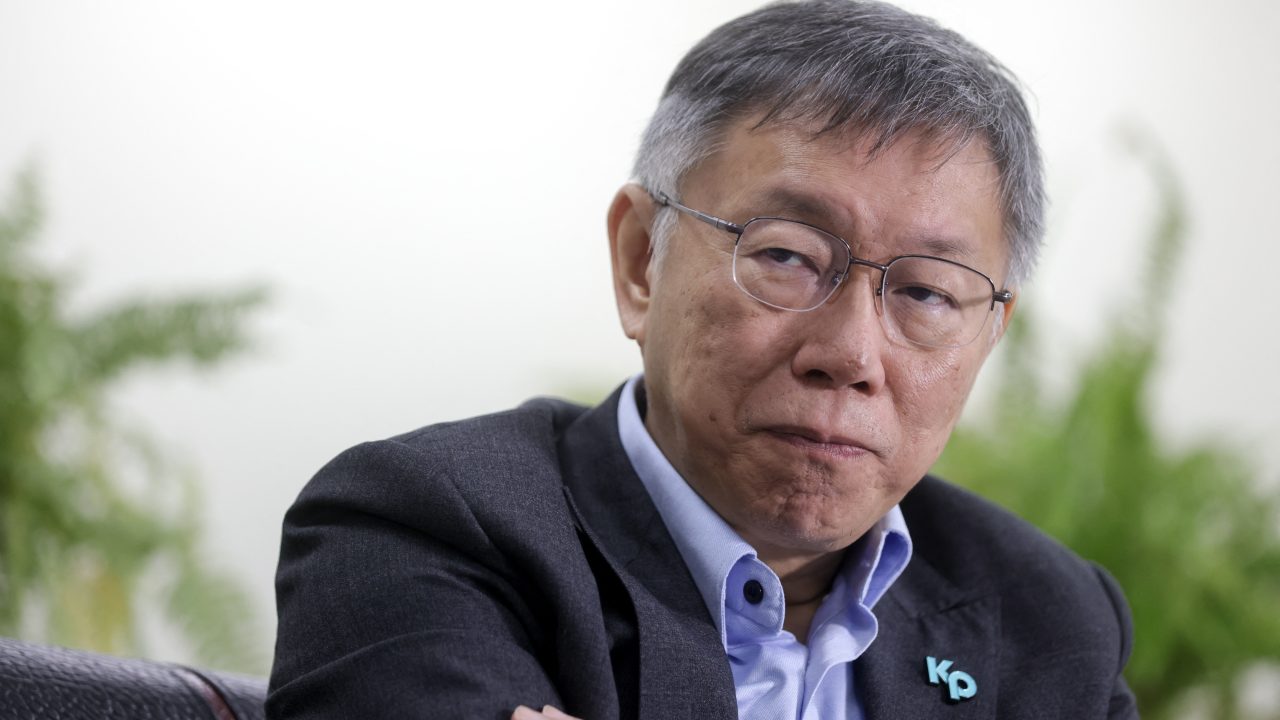
On November 23, a proposed coalition deal between the Chinese Nationalist Party (KMT) and Ko Wen-je’s (柯文哲) Taiwan People’s Party (TPP) collapsed in “extraordinarily dramatic” fashion, live in front of TV cameras at Taipei’s Grand Hyatt Hotel. Since then, the shape of the election has changed in a number of ways, but some key themes provide continuity with the election trajectory as it was before that infamous press conference.
Under the category of what’s changed, the most obvious thing is that Ko’s poll ratings have consistently trended down, while the KMT’s Hou Yu-ih (侯友宜) has seen his numbers rise. It’s pretty clear that “Ko got the blame” for the public collapse of coalition talks, summarized journalist Fan Chi-fei (范琪斐) at an election event hosted by International Community Radio Taipei (ICRT) and TVBS World this week.
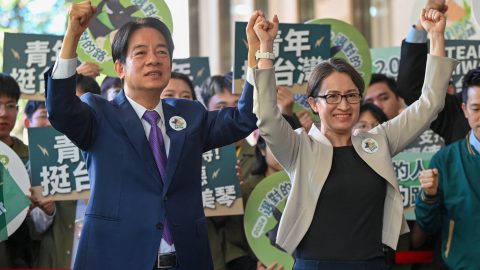
At the same time as those numbers have shifted, the themes of the election have solidified around the question of Taiwan’s relationship with China. “We are now seeing cross-strait relations take its formal and traditional place at the top of the table,” Bloomberg’s Taipei Bureau Chief Sam Ellis said at the ICRT-TVBS event. Key background for this take is the leading presidential candidates’ selections for vice-president. The KMT’s Jaw Shaw-kong (趙少康) is most commonly associated with those within the party who push for closer ties with China. The DPP’s Hsiao Bi-khim (蕭美琴) has in the past labeled herself a “pragmatic worker for Taiwan independence” and has served as the Taiwanese representative to the United States.
“When Taiwan is a contested state, the fundamental issue is still going to always be ‘Who are we, where are we and what is our future going to be with the PRC?’” Lev Nachman, an assistant professor at Taiwan’s National Chengchi University, said at the same event. The polling slide for Ko Wen-je’s Taiwan People’s Party, which had attempted to avoid the debate over China by focusing on domestic issues and proposing a “pragmatic” approach, now shows people want “clarity” not “deliberate vagueness,” Bloomberg’s Samson suggested.
And yet, if this makes the election sound like it has simplified into a battle between the KMT and the ruling Democratic Progressive Party (DPP) fighting along the usual lines, certain complications that arise from a less traditional three-way race remain.
“Ko Wen-je remains very strong at about 15-20% of the vote and those are core supporters,” said Chen Fang-Yu (陳方隅), assistant professor of political science at Soochow University, speaking at an event hosted by Taiwan News last week. These core voters are deeply dissatisfied with the two main parties in Taiwan, and thus have nowhere to go. Ko can still win six to nine seats in the legislature if his current polling holds out, Chen said, which would see him become a “key minority in the legislature” and remaining “one of the most important politicians in Taiwan after the election.”
The mechanism behind that power would be that Ko could hypothetically help the KMT disrupt any legislative agenda from the DPP — a topic already discussed for months now — or even work together within the executive branch, should the KMT win the presidential election. Both of these options are being openly discussed by the KMT side.
During the TPP-KMT negotiations, there were some “quarrales, distrust and calculation,” admitted Alexander Huang (黃介正), director of international affairs for the KMT at the Taiwan News event. However, “at this point … a future parliamentarian coalition is more than possible.” And while Huang said it was too early to speak confidently on cooperation at executive level, he said that it is a “widely shared understanding” that cooperation is possible and “we are psychologically prepared that if we win [we] will talk to the TPP and probably there will be some ministerial seats reserved.”
Thus, there could be an element of “the more things change, the more things stay the same,” here. Should the DPP win the presidential election but not hold a majority in the legislature, both Samson and Fan expressed concern about either “stagnation” because it would be difficult for the DPP government to pass legislation, or “chaos.” Should the KMT win the presidential election and offer Ko Wen-je ministerial seats, it may well look like the two sides went the long way around only to arrive at the same destination.
This is not to say that the new details don’t matter. Notably, Ko’s slide into a solid third place could exacerbate some of his problems in holding together the coalition of different views within his own party. Fan Chi-fei said that based on conversations with TPP candidates who felt they had not had much support from the top of the TPP, she “seriously doubt[ed] how much Ko Wen-je” can control them when it comes to organizing votes within the legislature. This would mean even a KMT president relying on TPP support in the legislature may have problems passing bills (and in the longer term intensifies the threat that the TPP could disappear).
So what would all of this mean?
Each one of the permutations suggested above would likely have the most dramatic effect on bills relating to China. Fan pointed out that during the previous example of a government without a strong majority in the legislature, under former president Chen Shui-bian (陳水扁), the raw number of bills passed was similar to the next president, Ma Ying-jeou (馬英九), because on domestic issues it is possible to find “consensus.” However, it was on issues relating to China where real contestation resulted in stagnation. Replayed, a similar situation now could mean problems passing arms deals with the U.S. or even, on the other hand, problems reviving the Cross-Strait Service Trade Agreement — as Bloomberg’s Samson pointed out.
For now, the next most likely turning point in this election cycle looks set to be the first presidential debate, held on December 30 (or, possibly, the policy presentations leading up to them, which begin December 20). And many still believe that the picture could change dramatically before election day (January 13). “If the election were tomorrow, I think [the DPP’s] Lai [Ching-te (賴清德)] would win. [But] I don’t think he would win by more than maybe five points,” Lev Nachman said. However, with around a month still remaining, caution around predictions is still very much in favor. “That’s a lifetime in Taiwanese politics. So what I think would happen tomorrow is practically irrelevant.”
Image: I-Hwa Cheng/AFP



Leave a Reply