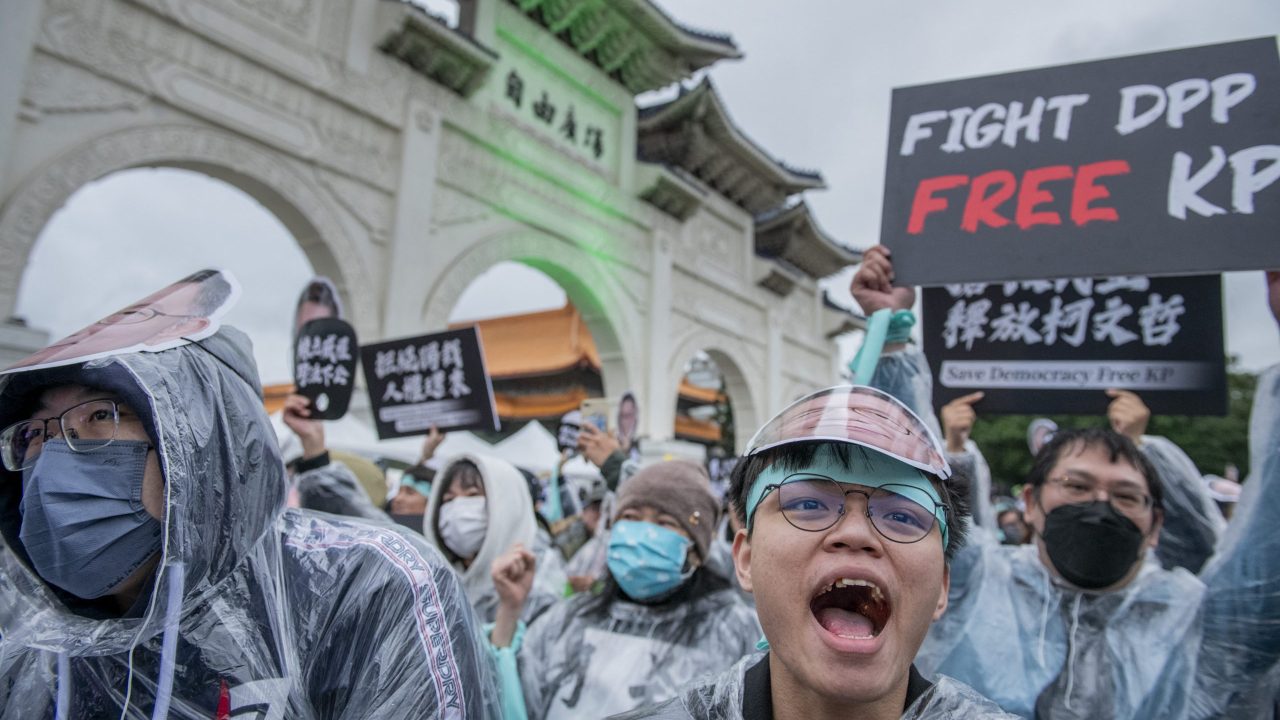
As Taiwan’s former presidential candidate Ko Wen-je (柯文哲) faces a maximum sentence of 28.5 years in prison for corruption charges, this weekend his appeal against a detention order was rejected. There are now increasing signs his party’s support among the youngest group of voters may be dissipating.
The Numbers
While Ko and his Taiwan People’s Party (T.P.P.) have consistently received most support from those aged under 40, previously the under 30 component of that cohort had been his strongest supporters. However — as political analyst Courtney Donovan Smith has recently pointed out — several polls since Ko’s arrest in August show a decline in favorability toward the T.P.P. among 20 to 29s, while favorability from 30 to 39s has held firm.
There are a couple of reasons this shift might be happening.
Uncertainty
The first is uncertainty over Ko’s situation. A poll from the T.P.P. last week found 30 percent of 20 to 29-year-olds believe Ko has been treated unfairly, while over 50 percent of 30 to 39-year-olds feel the same way. The key to that differential was that 35.1 percent of 20 to 29-year-olds weren’t sure if Ko has been treated fairly or not, the second-highest rate of respondents to offer that response (after the over 70s).
Sam Huang (黃詠恩), a 20-year-old student who we previously interviewed after the election, explained his view to Domino Theory.
“[T]he decision of [the judiciary] can really let me make the decision. Let’s wait and see,” Huang said. He added he felt Ko had “probably not” been treated fairly, because some of the prosecutors’ evidence presented in Taiwanese media has been indirect. But ultimately he is waiting for a verdict to decide if he would vote for the T.P.P. again.
“It depends. I don’t know whether Mr. Ko is corrupted or not. This decision can only be answered after I know the details of judgement in the future.”
In line with the other end of the polling, two other young people we interviewed were far more certain that Ko had been treated unfairly. “I think it’s obviously not fair to him,” Lo Yu-ching (羅俞晴), a 25-year-old student told Domino Theory, “Especially the electronic monitoring.” “No, definitely not. Killers go [to jail] for much, much less [time],” Eric Wu (吳奕昀), a 24 year-old recent marketing graduate said.
But their other responses alluded to the second cause for T.P.P. concern.
Leader Versus Party
Last year, after Ko finished third in the presidential election, post-election predictions about the T.P.P. and Ko’s future emphasized the potential weakness of the T.P.P. as a “one-man party.”
The disparity between the party’s vote in the national party-list vote and Ko’s presidential vote pointed to the fact that “there’s still more support for him as an individual [than] as a party,” Sara Newland, assistant professor of government at Smith College, told Domino Theory at the time.
We may now be seeing the implications of that.
While both Lo and Wu remain ardent supporters of Ko — Wu said even if Ko was guilty, he would support him — both told Domino Theory their support of the T.P.P. was contingent on him being leader.
This is a major issue for the party, given that Ko resigned as party chairman at the start of January.
“I’m not voting for his party, I’m voting for him,” Wu, who we previously interviewed about his experiences of military service in Taiwan, said, adding he would “need to see who’s the candidates” in a future election to make a decision about who he would vote for in place of Ko.
Translated into a view of the T.P.P., that comes out as a conditional commitment: Lo said she would still vote for them “if they still do well, which means keeping their party to be the third-biggest party … Because I think it’s important to keep the third party thriving in our democratic system.”
What Now?
Without Ko, a potential weakness could be becoming a real one. Political energy generated by young people around the T.P.P. might be dissipating as it seeks to survive without Ko as its front man.
But that doesn’t solve for where that political energy ends up instead.
My Formosa polling shows that the T.P.P.’s losses have correlated with a steady increase in favorability toward the ruling Democratic Progressive Party (D.P.P.). And the latest Global Views poll shows gains for both the D.P.P. and the opposition Chinese Nationalist Party (K.M.T.) in the wake of a drop off from the T.P.P. But resistance to the D.P.P. and the K.M.T. has long been seen as driving Ko and the T.P.P.’s rise to prominence, and our interviewees all said they distrusted the D.P.P. in relation to the Ko case. So neither larger party represents an automatic destination for anyone leaning away from the T.P.P.
In other words, no clear alternative focus point for young people’s political expression is obvious yet.
Following last year’s election, Sie Da-wun (謝達文), a PhD candidate specializing in political sociology at National Taiwan University, suggested he could foresee several future scenarios for the T.P.P. Some younger people could be politicized by events and move to the D.P.P. They could move to a fourth party. Or the T.P.P. could hold onto them.
For now, all those options all remain on the table.




Leave a Reply