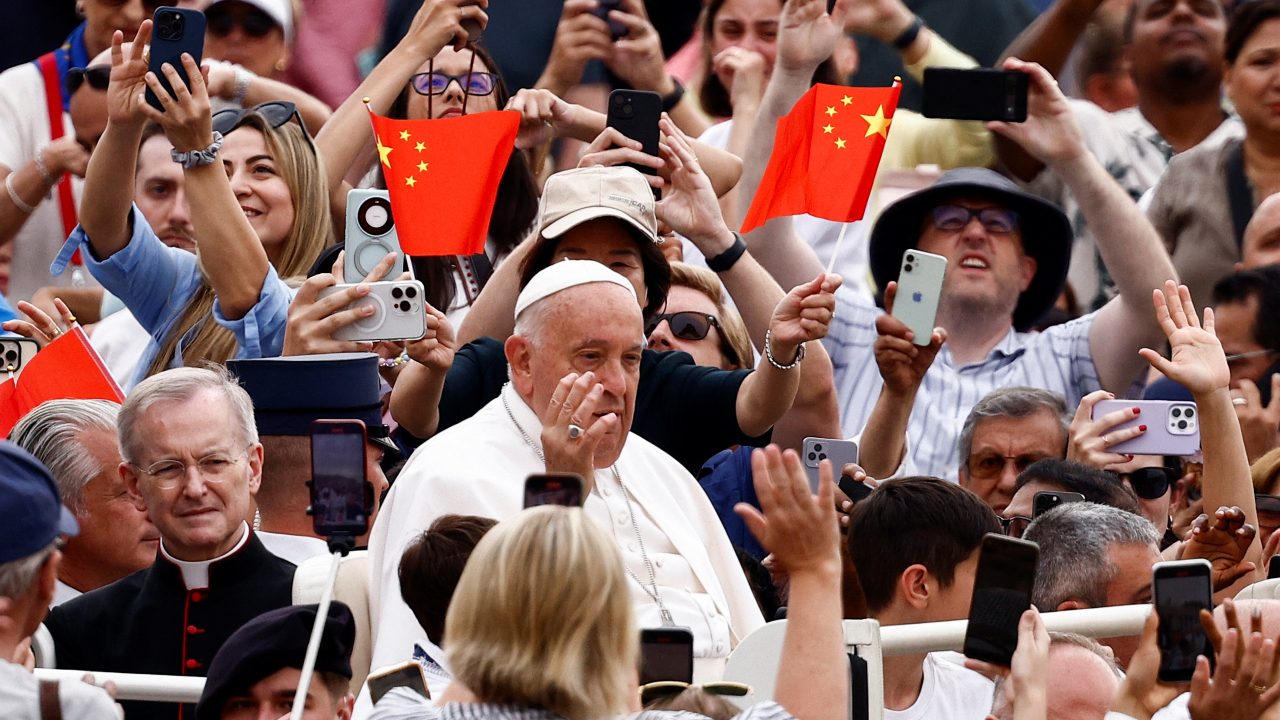
White smoke from the Sistine Chapel chimney will signal that a new Pope has been chosen. It might also mean a new era for Vatican-China relations.
A perennial tension that the Vatican navigates in its China policy is that the Chinese government cannot allow collective organizing independent of the Chinese Communist Party, which governs all aspects of political, social and cultural life. The party is particularly sensitive to institutions that could facilitate foreign influence, impact adherence to party doctrine or stoke dissent.
Indeed, the Catholic Church is an independent and inherently political institution. The Vatican takes stands on issues that are highly sensitive in China, including on religious freedom and human rights. Multiple aspects of China’s governance — particularly regarding religious freedom and government involvement in the appointment of bishops — have been at odds with the Vatican’s morals and religious authority. And yet, engaging with China is incredibly important to the Catholic Church, which is compelled to evangelize among China’s population of nearly 1.5 billion and take care of the approximately 10 million Catholics in the country.
Pope Francis believed in fostering dialogue with China and agreeing to terms that would increase the Vatican’s presence in China, even if the arrangement was not ideal. The hallmark of his China policy was a 2018 provisional agreement between the Vatican and the People’s Republic of China to allow Beijing to nominate bishops in China. Francis’ approach was unique and controversial, but he wasn’t a trailblazer. The Vatican’s delicate, even tenuous, dialogue with China today is the result of many years of negotiation across multiple pontificates. The next pope’s China policy will likely unfold gradually.
The state-sanctioned Catholic Church in China is called the Chinese Catholic Patriotic Association. The Patriotic Association was established in 1957 by a group of Chinese Catholics who gained approval from the PRC by establishing their commitment to the “three autonomies” — self governance, self support and self propagation. While the three autonomies satisfied Beijing by establishing independence from foreign influence, Pope Pius XII countered that independence from the Vatican meant that the Patriotic Association was no longer Catholic. He refused to recognize any consecrations in China (i.e., appointment of bishops) done without the Vatican’s approval.
The Patriotic Association ceased activities during the Cultural Revolution but resumed during Deng Xiaoping’s (鄧小平) era of reform during the 1980s. All the while, a parallel set of Catholic institutions in China called the underground church were forming in opposition to the state-sanctioned Patriotic Association. Underground Catholics consider themselves to be more loyal to the Vatican and the Pope. Whereas the Patriotic Association embraced sinicization, or the alignment of the Church with party doctrine, the underground church has rejected the influence of the Communist Party on the governance and ideology of Catholicism in China. In 1978, Pope Paul VI gave permission to nine Chinese bishops — from both the Patriotic Association and the underground church — to independently ordain bishops without prior approval from the Vatican.
In 2007, Pope Benedict made a further step toward softening relations with China when he published a letter to the church in China encouraging more dialogue. In the letter, Benedict said that “the clandestine condition is not a normal feature of the Church’s life,” which some have taken to mean that he disapproved of the underground church as a permanent fixture of Catholicism in China. He also expressed a desire for unity between underground and state-recognized Catholics. Toward this end, Benedict revoked the permission granted to the underground bishops to clandestinely ordain new priests without consent of the Vatican.
In 2018, under the leadership of Pope Francis, a provisional agreement was signed between the Chinese government and the Vatican that institutionalized their joint cooperation on the governance of Catholicism in China. While the precise details of the agreement are secret, we know that it gave the Chinese government the permission to recommend bishops, with the Vatican having veto power over the selections.
The provisional agreement has been renewed multiple times since 2018 (it is currently valid until October 2028). Francis consistently held that the agreement facilitates dialogue with China and promises better relations in the future. The Vatican hoped the agreement would foster unity between the Patriotic Association and underground Catholics by removing a key schism between the two — the Patriotic Association’s illicit appointment of bishops without the Vatican’s approval. The agreement also recognizes that there is a long game to be played with China — some engagement is better than nothing. While the agreement recognized the Vatican’s authority over the appointment of bishops in China, it also legitimized the Patriotic Association and the PRC’s control over Catholicism at the expense of the underground church.
Many think that China got the better deal out of the agreement. Prominent Catholic commentator, George Weigel called the agreement “degrading, embarrassing, and evangelically destructive … nothing short of scandalous,” pointing to the worsening of religious persecution in China since 2018. Cardinal Raymond Burke concurred: “The agreement which the Vatican made with the People’s Republic of China in 2018 … has been, in practice, a repudiation of the tremendous suffering of countless Chinese confessors of the faith and martyrs for the faith at the hands of the atheistic communist government.”
Cardinal Timothy Dolan has argued that negotiating with the Chinese Communist Party is “naive” and “extraordinarily counterproductive.” Dolan worries that softening relations with the party will alienate those Catholics in China who are resisting the party’s ideological pressure. Cardinal Joseph Zen, a prominent Hong Kong Cardinal, said that the deal “means the annihilation of the real Church in China” and will put the Vatican on the wrong side of Chinese history.
Some highlight China’s continuous violations of the agreement via its unilateral appointment of bishops as evidence that the Chinese government is undermining the independence and authority of the Vatican, as well as the Vatican’s diplomatic credibility. Others point to the relatively few bishops that have been selected by the Chinese government to be ordained since 2018 as evidence of the agreement’s failure. Another criticism is that the agreement undermines the Vatican’s moral authority by glossing over China’s human rights violations.
Other criticisms have taken less issue with the agreement itself, and focused more on the Vatican’s implementation of the agreement and Francis’ friendliness toward the Chinese government. For example, when China unilaterally appointed Bishop Joseph Shen Bin (沈斌) to Shanghai without approval from the Vatican, Francis decided to approve the nomination ex post de facto. Critics say he should have issued a formal protest, or an official expression of disapproval by the Holy See, instead. The Vatican, and Francis in particular, have also faced criticism for being quiet on the issue of persecuted underground Catholics and human rights abuses in China more broadly since the agreement was made. Some have suggested that the pope was pursuing closer ties with China independent of the general tilt of the Vatican secretariat of state, or the central governing body of the Holy See. Cardinal Zen blames, in part, Francis’ upbringing in Argentina for his sympathetic orientation toward communism.
In the coming weeks, the papal conclave will assemble at the Vatican to choose the next pope. Only cardinals under the age of 80 are eligible to vote, and Pope Francis appointed 80% of them. Cardinal Pietro Parolin is a clear front runner. Parolin is the second in command and the Vatican’s secretary of state. He was the architect of the 2018 agreement and has been responsible for explaining some of the Vatican’s more controversial decisions regarding China policy, like the approval of Shen Bin’s appointment. Critics have said he is “overly optimistic” about the impact of dialogue with China. Zen once said, “I now think that Cardinal Parolin cares less about the Church than about diplomatic success. His ultimate goal is the restoration of formal relations between the Vatican and Beijing.”
Whoever the next pope is, there seems to be enough dissenting voices regarding Francis’ China policy — among both senior church officials and Catholic media and commentators — to entail pressure upon the next pope to rebalance the Vatican’s China policy. In the near term, the next pope might seek to enforce the terms of the 2018 agreement with more fervor and transparency. Since the agreement is still provisional, the Pope might also be tasked with deciding whether the Church is ultimately willing to accept Chinese government influence.
These things will unfold slowly. For now, we need to wait for the white smoke.



Leave a Reply