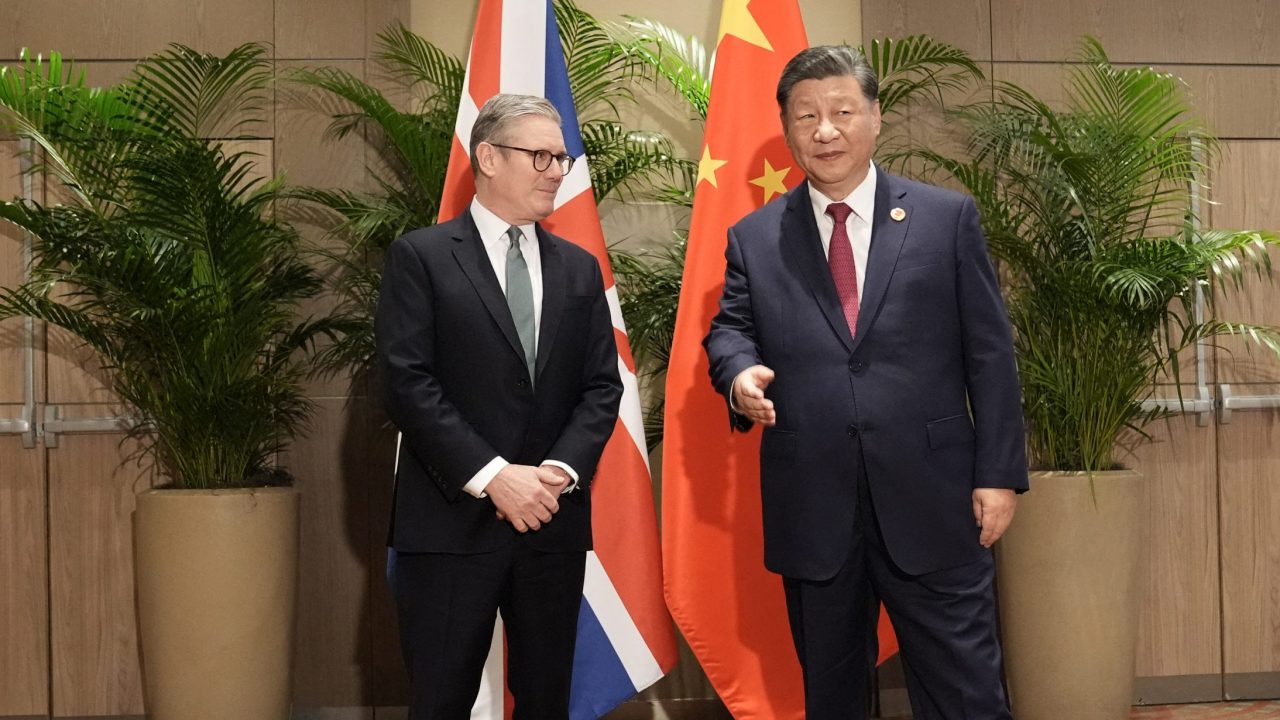
The U.K. government has a new catch-phrase for its China policy: “Not engaging with China is no choice at all.” When U.K. Foreign Minister David Lammy announced the results of the much-anticipated China audit in June, this phrase captured the main point. It’s also the title of an opinion piece Chancellor of the Exchequer Rachel Reeves wrote to justify the U.K.-China Economic and Financial Dialogue in January.
“Not engaging with China is no choice at all” does not merely mean that decoupling with China is a bad idea. The Starmer government also seems to believe that China is the answer to the U.K.’s economic woes. “[T]he audit made clear that our approach will always be guided by the U.K.’s long-term economic growth priorities,” Lammy said. “China will continue to play a vital role in supporting the U.K.’s secure growth.”
But will China be able to provide the economic relief that the Starmer government is looking for? Maybe not.
When Lammy, Reeves and like-minded Brits make the argument that China is the linchpin to the U.K.’s growth, they typically make one of two points. The first is that China already plays an important role in the British economy: China is the U.K.’s fifth largest trading partner (third largest if Hong Kong is included), accounting for 5% of goods and services trade. The second is that the Chinese market is so powerful that there must be opportunities for expanding exports in areas where the U.K. has complementary strengths, such as pharmaceuticals, financial services, tourism and education.
But even if the U.K. could significantly expand exports to China, the scale of trade is not big enough to have a notable macroeconomic impact on the U.K. Take the financial services sector, for instance. In 2023, McKinsey estimated that China’s asset management market will double to $40 trillion by 2030. If the Labour government can successfully create more regulatory harmony with China, this could be a source of growth. But financial services exports to China increased by only 2.8% in 2024. Even if financial exports to China increased by, say, 50%, this difference would equate to only 0.18% of total services exports and 0.03% of GDP.
Moreover, the scale of the U.K.’s trade with China pales in comparison to its trade with other partners. Exports to China accounted for only 3.4% of the U.K.’s total exports in 2024, while exports to the EU and U.S. amounted to 41.3% and 22.5%, respectively. While British exports to China dropped 11.4% in 2024, the U.K. exported more in general — up 0.7% from 2023.
Whether the Chinese market can absorb many more British exports should also be called into question. Reeves wrote that “China’s economy is expected to provide the largest driver of global growth this decade, from which there are significant opportunities that can benefit Britain.” But evidence suggests that setting the U.K.’s sights on China as a vehicle for growth is a chimera.
It came as no surprise when the Chinese government announced GDP growth for 2024 to be 4.8%, right around the target they set for the year. Rhodium Group estimates that China’s actual GDP growth rate was about half this value at 2.4% to 2.8%, in part because China’s official calculation of household consumption growth at 5.3% was artificially high. 5.3% is “hard to square” with significant declines in nominal retail sales growth, as well as flat growth in online retail sales. China’s marginal core price growth of 0.3% also suggests weak demand. Household consumption probably grew at a rate around 3.5% to 4%, according to Rhodium. While many experts generally agree with these calculations, the Federal Reserve does not think that China overstated its growth figures for 2024. Still, the Fed’s analysis acknowledged that growth was driven by industrial policy and global demand for Chinese goods, rather than domestic consumer demand.
China’s economy has been weakened by Covid-19, a prolonged real estate crisis and record-low consumer demand that has still not caught up to pre-pandemic levels. China’s real estate downturn began in 2020 when the government tried to forcibly correct a housing market bubble. This backfired, leading to a prolonged slump in property sales and home prices that has cost Chinese consumers an estimated $18 trillion in household wealth. A whopping three quarters of wealth in China is tied to real estate. A high unemployment rate and a broad-based anxiety about the stability of the job market are also negatively impacting consumption. In the long term, structural issues like China’s aging population might do the same.
If and when consumer demand picks up, much of it will be absorbed by the domestic market. Since 2012, domestic brands have consistently increased their market share at the expense of foreign brands. And Chinese consumers increasingly view domestic brands “as offering more bang for their buck and having their finger on the pulse of local consumer habits.”
Beijing has also encouraged domestic production and consumption through policies like Made in China 2025 and the dual circulation strategy. Their success is particularly evident in the automotive sector, which happens to be the U.K.’s top goods export to China. By 2015, China leapfrogged the internal combustion engine market and began to dominate in EVs. Between 2020 and 2024, the market share for foreign car manufacturers in China dropped 20 points to 33%. By the end of 2025, China will be able to produce 25 million EVs annually, far exceeding domestic demand.
Indeed, China is trying to turn around its consumption problem. Trade-in programs instituted last year initially boosted retail sales but this didn’t last. The Chinese government has also lowered interest rates to spur consumer spending, but household savings have stayed elevated since the pandemic. Measures introduced to fix the real estate slump seem to have primarily benefited state-owned developers.
In March, Beijing released a “special action plan” to boost consumption, but analysts say these policies lack specificity and are incremental and limited at best. While amending the household registration and welfare systems and providing fiscal support for lower income households could measurably increase consumer spending, Chinese President Xi Jinping (習近平) doesn’t seem willing to make these structural changes.
The U.K. will be hard pressed to find the answers to its economic troubles in China. Starmer needs to be careful about what principles and policies he’s willing to compromise on for an economic boon that might not exist.




Leave a Reply