The night before she was released, Tursunay Ziyawudun couldn’t sleep. For 10 months, locked in a reeducation camp near her hometown in Xinjiang, she had lived through hell: cramped quarters, relentless indoctrination and a series of brutal rapes. All the while she hoped for the day it would end. But now that it had come, she felt guilt. “My cellmates needed it more than I did,” she remembers thinking. “They had their babies, they had their kids out there.”
Ziyawudun — who is a member of the Uyghurs, Xinjiang’s largest Muslim minority — didn’t have a big reunion waiting. Her siblings were locked up in the same camp. Her husband, Qalmyrza Halyq, was in Kazakhstan. When they had last spoken a year before, he told her he wasn’t coming back to China. He feared that if he returned, he would be locked up, too. “I’m not going to risk everything,” he had said. “Take care of yourself.”
When morning came, Ziyawudun changed from her camp uniform into regular clothes, and the guards came and took her away. In the yard, a light snow was falling, and her legs felt heavy. Ziyawudun was 40 years old. The date was December 25, 2018 — day 300 of her second stint in captivity, day 327 overall. Less than 24 hours before, the guards had told her that it would be her last.
“When they told me that I was going to be released, I couldn’t believe it,” she says. But in the interrogation room the day before, the police insisted it was real. They asked her to sign some paperwork. They told her never to speak about the camps. What they didn’t tell her was why, after so many months, they were letting her go.
Ziyawudun’s story — and the stories of countless others whom the Chinese government locked in a vast network of reeducation camps in the northwestern region of Xinjiang — are why human rights organizations and investigative journalists exist. Without them, the world may never have grasped the scale nor the intensity of the atrocities that occurred there. But awareness is one thing. What about impact? Did the international scrutiny of Xinjiang actually change the Chinese government’s behavior?
China’s mass reeducation campaign in Xinjiang began in early 2017, and almost immediately thereafter, so, too, did researchers’ efforts to document it. They compiled satellite imagery, interviewed survivors and combed through construction bids. The United Nations — drawing on the work of German anthropologist Adrian Zenz, among others — found enough evidence to conclude, some 18 months after the crackdown began, that around a million people were being held without trial.
As the scrutiny intensified, the Chinese Communist Party, or CCP, deflected. It explained that the camps were “training institutes” designed to combat extremism — no worse than any other tactic in the war on terror. But to people around the world, who could look at satellite images of the buildings online, they looked like concentration camps. “China’s treatment of its Uyghur minority is beyond abhorrent,” U.S. Senator Bob Menendez said in November 2018.
That month, Menendez and his Senate colleague Marco Rubio first introduced the Uyghur Human Rights Policy Act, which called for a State Department investigation into the crackdown, and potential sanctions for its perpetrators. Donald Trump didn’t sign the bill into law until June 2020. By that point, Ziyawudun was back with her husband in Kazakhstan, and the Chinese government had started to dismantle the reeducation system.
Looking back, it’s clear that the climax of global backlash over the camps in Xinjiang coincided with China’s decision to close them. But correlation isn’t causation, which leaves room for another explanation. Maybe the Chinese government closed the camps because they had served their purpose. Maybe, when the CCP announced in December 2019 that “all trainees had graduated,” it wasn’t bowing to international pressure. Maybe it was declaring victory.
For people who believe in the power of human rights work — a belief that has fallen dramatically out of favor in today’s Washington — that would be a tough pill to swallow. But reassurance comes in the form of a new academic paper, published last week in the journal Modern China, that argues for the first time that international pressure did alter China’s policy toward Xinjiang. Look carefully enough at the government records, says the author, Jan Svec, a researcher at the Institute of International Relations Prague, and you’ll find that China’s leaders originally planned to operate the camps for much longer. Then the world raised hell, and they changed course.
Svec’s work carries with it the comforting implication that even a regime as powerful as the CCP can be moved by good, old-fashioned righteous indignation. Among Svec’s peers, however, this is far from a consensus view. And by arguing for it, Svec is arguing against Zenz, perhaps the world’s leading authority on China’s oppression of Uyghurs. Almost no one, as far as I can tell, has spent more time looking carefully at the government records than Zenz.
The Uyghur Question
In October, I met Svec for coffee in Taipei. He is several years older than me, but we both started studying Chinese around 2014, when the U.S. first began to coalesce around the view that China was not the friend it had hoped for, but a formidable foe. Svec told me that by 2019, his own disillusionment was complete. One morning that July, he was in the southwestern city of Chongqing, waiting for his train to leave, when he saw three men approaching from the next car. One looked like a ticket attendant; the other two wore police uniforms. Around him sat mostly Han Chinese, but also some Uyghurs, who made up roughly 45% of the population in Xinjiang, where the train was headed.
Xinjiang, which is more than twice as large as Texas, has long been one of China’s most strategically important regions. On the Silk Road, it was a passage connecting China to Central Asia and Europe. For the last decade, the region has been central to President Xi Jinping’s (習近平) Belt and Road Initiative, a modern take on the ancient trading route. But controlling Xinjiang hasn’t been easy. Many Uyghurs feel a stronger kinship to the Turkic peoples of Central Asia than they do to the Chinese. During World War II, the Uyghurs briefly won independence, declaring their homeland the East Turkestan Republic.
Xinjiang has remained a part of China since the Communists took over in 1949. But ethnic tensions haven’t gone away. Race riots in 2009 in Urumqi, Xinjiang’s capital, left more than 1,700 people injured and nearly 200 dead. In March 2014, a group of eight people wielding hunting knives killed 29 and injured 130 at a train station in the southwestern city of Kunming. Beijing blamed the stabbings on Xinjiang separatists. After visiting the region for the first time as president that April, Xi adopted a more aggressive approach to Xinjiang, betting that the government could force the region’s ethnic minorities to renounce Islam and assimilate into the majority Han Chinese culture.
On the train that morning in Chongqing, the officers weren’t there to harass Uyghurs. They were there to question Svec. One of the men asked him what he was doing in China. Studying Chinese and traveling, he told them. Svec had bought a ticket for an intermediate stop in Lanzhou. “Will you continue from there to Xinjiang?” the officer asked. Svec had discussed that question for hours with his girlfriend, who joined him for the first part of the trip. Before she flew back to Prague, she had tried to talk him out of it.
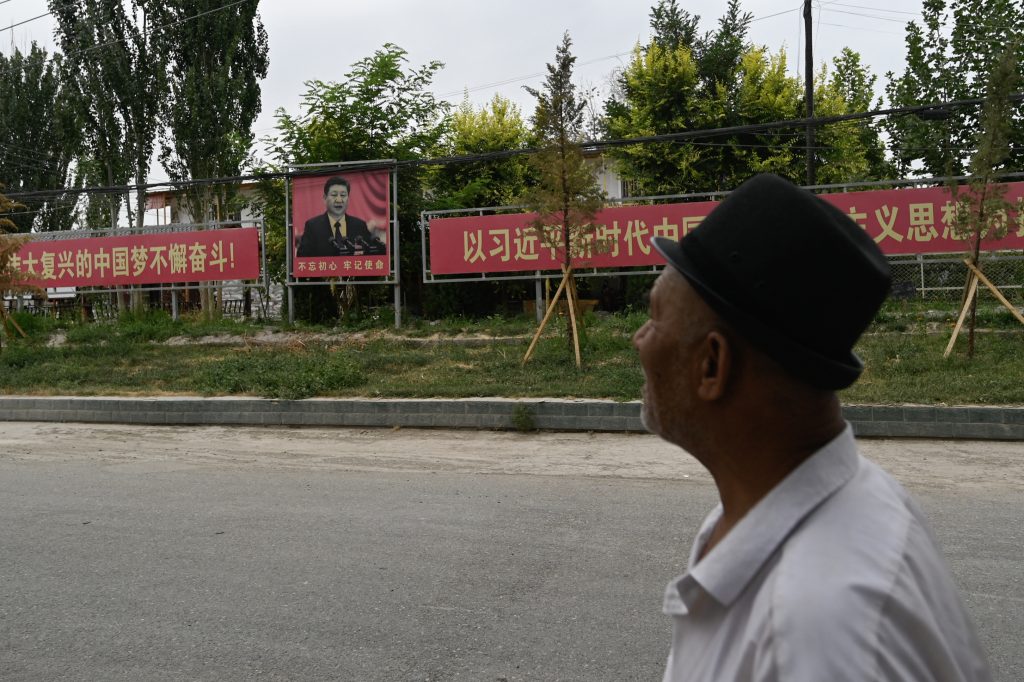
For his PhD, Svec was studying digital authoritarianism, and he knew there was no better place to witness it than Xinjiang. In 2016, Xi had appointed hard-liner Chen Quanguo (陳全國) as the region’s party secretary. Chen had just spent five years cracking down on religious dissent in Tibet, where he employed a mixture of police force and social control to subdue the region’s Buddhist population. In Xinjiang, the repression became more high-tech: iris scanners, surveillance cameras and an app that spied on phone usage.
Svec had imagined he might observe Chen’s police state as it observed him, maybe duck into a side street to talk to locals, maybe go to a mosque and see whether anyone was allowed to worship. But with the police looming over him on the train that day, it seemed too risky. Svec told them he wasn’t going to Xinjiang. They asked for his passport, took pictures of the visa pages, and left. Moments later, the train departed.
Svec never made it to Xinjiang. But in the years that followed, as the world’s interest in the Uyghurs waxed and then waned, Svec’s only grew. Then, he noticed something that puzzled him. It concerned the timeline of the camps’ closure. As late as spring 2019, just months before the camps were shut down, the Xinjiang authorities were still issuing multi-year reeducation sentences. On that schedule, detainees wouldn’t be released until 2021 at the earliest. Why, Svec wondered, would China spend billions of dollars on concentration camps, fill them with people sentenced to long terms, then close them just a few years later?
A ‘Carefully Premeditated Plan’
For Zenz, who runs China Studies at the Victims of Communism Memorial Foundation in Washington, the cost and timeline of the Xinjiang crackdown makes sense. China’s leaders believed they had found an effective policy for subduing the Uyghurs, so they gave the reeducation program their full financial support, no matter how wasteful it might have been. (Zenz did not respond to requests to speak with me for this article.)
To the West, with its zoning schemes and environmental impact reviews, the construction of the reeducation camps appeared frenzied. But Zenz maintains that there was a method to Beijing’s madness. That method, he argues in a paper from 2024 titled “Innovating Repression,” didn’t spring from the mind of Xi. It evolved — as many of Beijing’s policies have in recent decades — through a more diffuse process known as policy experimentation.
In the days of Joseph Stalin or Mao Zedong (毛澤東), autocratic dictates flowed almost entirely in one direction: from top to bottom. But today’s authoritarian regimes are different. They’re more flexible, and therefore more durable. (In 2023, the CCP eclipsed the Bolsheviks as the longest-ruling Communist regime in history). Instead of micromanaging every policy from Beijing, the central government lets provincial officials try out different ideas in different locations. Then they wait a while, take stock, and apply what worked more broadly.
Some scholars question whether such a practice survives under Xi, who is widely viewed as China’s most powerful ruler since Mao. Zenz says it has. By the time Xi visited Xinjiang in 2014, local officials had already experimented with a new approach to subduing the Uyghurs, or, as they called it, “de-extremification.” The strategy had two components: “strike hard” against the real “terrorists,” and work to “save” and “transform” people who were merely associated with them.
Through rote recitation of patriotic slogans and tight restrictions on religious activities, the Xinjiang authorities believed that the Uyghurs could be stripped of their dangerous beliefs. “The hand that strikes hard must be firm, and the hand that educates and guides must also be firm,” declared Zhang Chunxian (張春賢), Xinjiang’s party secretary at the time. In April 2014, with Xi’s go-ahead, the government started to implement the policy across the region.
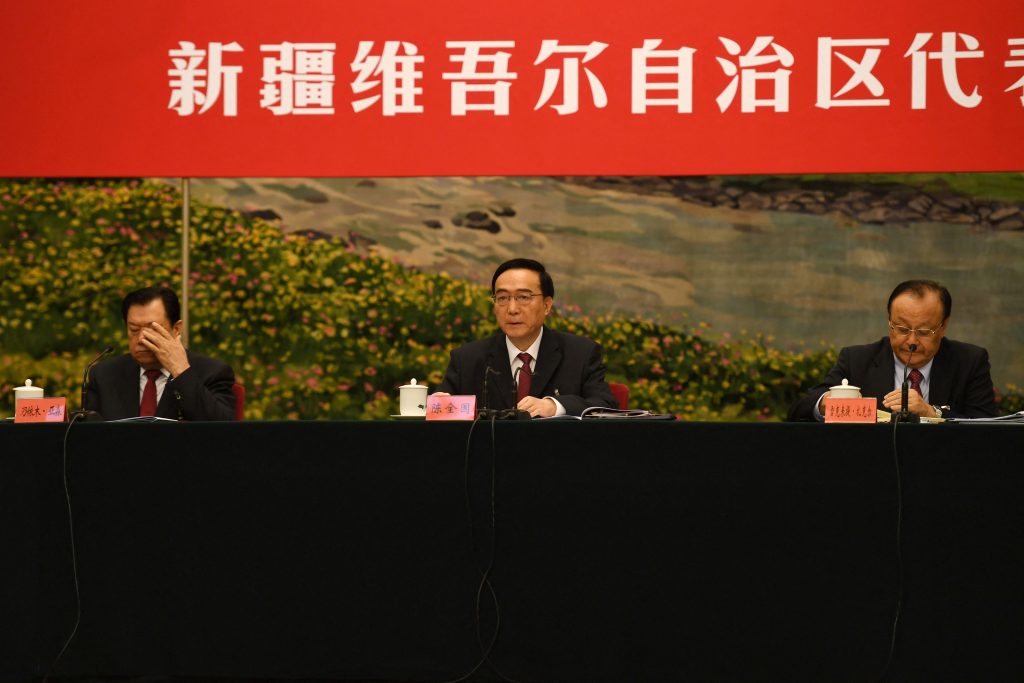
In 2016, the Xinjiang Committee of the Chinese People’s Political Consultative Conference, China’s highest advisory body, met to review the results. Such meetings are characteristic of Xi-era China, where top officials tolerate initiative, but like to keep a close eye on their underlings. Their review found that where “de-extremification” had failed, it had failed because local officials hadn’t gone far enough. A few months later, Xi appointed Chen, fresh off his tenure in Tibet, to be Xinjiang’s top party boss.
Chen took charge and immediately began to carry out a “carefully premeditated plan” for the region. “Round up everyone who should be rounded up,” he told his local comrades. According to Zhao Kezhi (趙克志), China’s minister of public security from 2017 to 2022, who later reflected on the crackdown, Chen carried out his policy as any good Leninist would: with a five-year plan. Year one (2017) was meant to “stabilize” the region. Year two (2018): “consolidate” those gains. Year three (2019): normalize the new status quo. By year five (2021): achieve “comprehensive stability.” In his paper, Zenz concludes that: “In December 2021, Chen was duly replaced by Ma Xingrui (馬興瑞), indicating successful execution.”
If Zenz is right, then the course of China’s crackdown on Xinjiang was predetermined. Exposing the camps might have minted a few Pulitzer Prizes and made a difference on the margins. But in the central chambers of CCP policymaking, the international backlash mattered little. Xi wanted tighter control over Xinjiang, so he followed the wisdom of policy experimentation and carried it through to the end. He let local officials try out different options, assessed which approach worked best, then brought in Chen to enforce it. When Chen and Zhao were satisfied with the outcome of the crackdown, Zenz suggests, the CCP decided to shutter the camps of its own accord.
Svec thinks the real story is more complicated. At the cafe in Taipei, he told me about the spring of 2019, when Uyghurs started to flow back out into society. “It seemed like they were quite hastily downsizing” the camps, he says. What makes him so confident that international pressure played a role? It comes down to what the CCP’s leaders were saying. Not in public, but to each other, behind closed doors.
Troves of documents later leaked to the International Consortium of Investigative Journalists and The New York Times show that, for years, Xi’s deputies spoke of the reeducation system as a long-term solution to the party’s problems in Xinjiang. “Some detainees may not be able to transform in three years, nor in five years,” Chen warned his comrades in May 2017. If a Uyghur locked up in 2017 took more than five years to “transform,” the camps would still need to be open in 2022. They might still be open today.
Chen acknowledged in that same speech that people around the world were starting to learn about the crackdown. “Hostile forces at home and abroad have already by various means acknowledged that a generation of people are being trained in some places,” he said. In November 2017, Chen’s deputy, Zhu Hailun (朱海崙), described the camps in a confidential directive as a “strategic, critical and long-term measure.” To Svec, this type of talk is a pattern: Chinese officials planned to operate the camps for years, perhaps even a decade, but they were conscious of the negative attention they might attract. Svec calls this the “reputational cost” of the reeducation program.
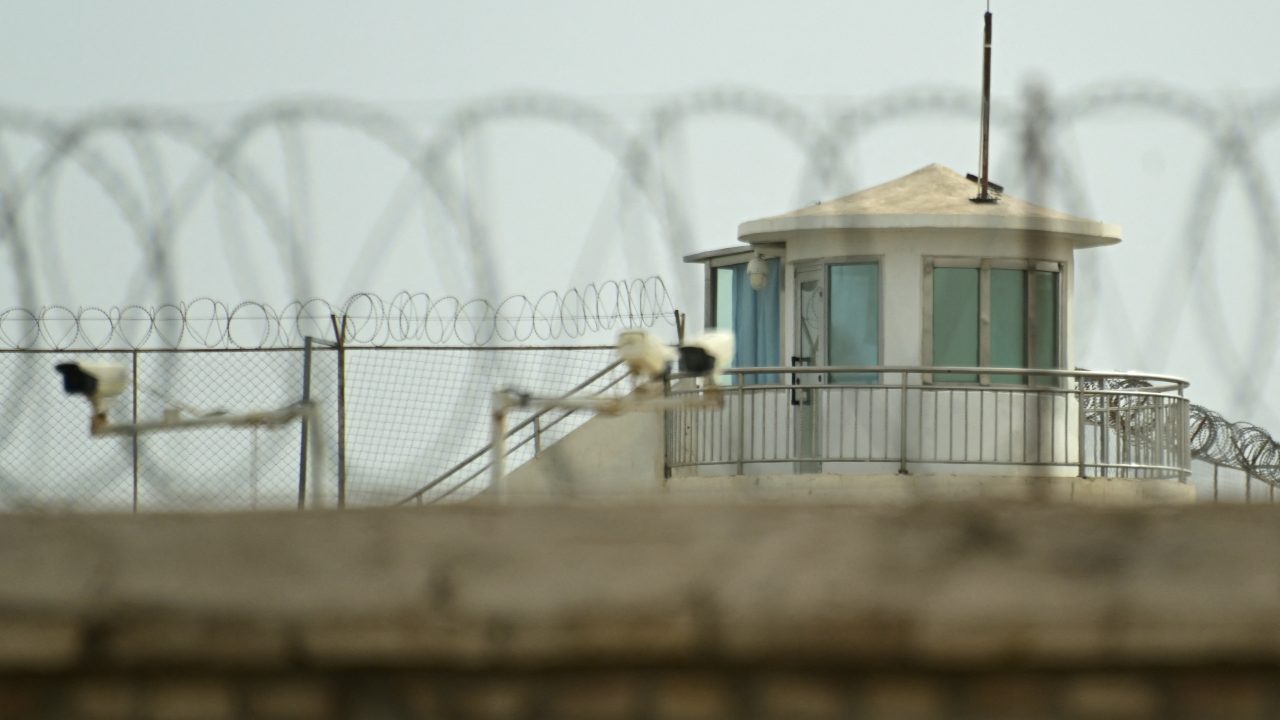
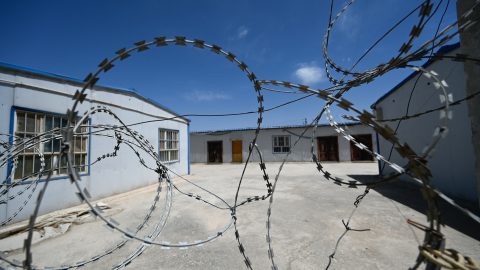
In April 2018, a Canadian student named Shawn Zhang launched a database of satellite images documenting the massive scale and menacing architecture of the camps. That summer, he got a full write-up in The Globe and Mail. Laura Murphy, a professor of human rights at Sheffield Hallam University, remembers that not long after, China started to change the camp’s architecture. We started to see some of the visible signs of the camps coming down, she told me. “The watchtowers came down because we could see them from space.”
China acknowledged for the first time in July 2018 that they were operating “training institutes” in Xinjiang. In private, the party continued to praise them as an effective long-term policy. At an internal meeting of Xinjiang’s leadership in June 2018, Zhao had told his colleagues that the reeducation program “must be adhered to for a long time.” At that same meeting, Chen introduced an even longer timeline for reeducation. Anyone with a sentence of up to 10 years would be sent to the camps, he said.
Then, in 2019, the party line shifted. That March, at the 40th session of the U.N. Human Rights Council, China was forced to respond to the 2018 report that had drawn heavily on Zenz’s research. It was there, in Geneva, that Beijing first suggested that they planned to close the camps. “The vocational education and training program was a special measure adopted by Xinjiang at a special time,” they told the committee. As the situation in the region improved, they added, “the training program would be gradually downsized, leading to its completion.”
As Svec and I walked from the cafe back to the metro, he mentioned something that didn’t make it into his paper. It concerns Zenz’s remark that Chen’s replacement in 2021 by Ma Xingrui indicated the “successful execution” of his five-year plan. Chen was 66 at the time, Svec told me. He had been a member of the Chinese Politburo for four years. At the next Communist Party congress, in October 2022, Chen would still be two years younger than the age when officials are usually forced to retire. If Chen’s posting to Xinjiang had been so successful, if China was so impervious to the reputational costs of the crackdown, then Chen should have been a lock for reelection, maybe even a promotion, Svec said. But at the party congress in 2022, Chen wasn’t reelected. He was retired.
Database of Atrocities
A few weeks later, Svec gave a talk at the European Values Center in Taipei. I sat in the back row, next to Gene Bunin, whom I had invited to the event. Bunin is tall, with fair features and a quiet way about him. In September 2018, Bunin was living in Kazakhstan, and he decided to launch the Xinjiang Victims Database. He’s spent most of his time since then collecting material on people the Chinese government has detained. The heart of the database are victim profiles, complete with incarceration timelines, witness testimonies and the current status of the victim, if it is known. At the time of this article’s publication, the site has 96,996 entries.
Bunin once told me that he sometimes imagines a future where men like Chen and Zhao will be put on trial for their crimes. He hopes that his website will be used for evidence, and that the victims will be compensated. On the bottom of each entry, there is a line where Bunin has calculated how much each victim should receive in compensation. China owes Ziyawudun more than $22,000.
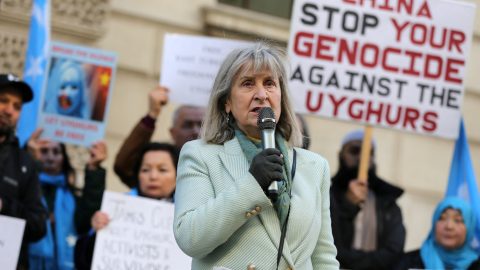
After the talk, Bunin went up and greeted Svec. Little of what he had heard seemed to surprise him. Svec’s thesis fits well with what Bunin has come to believe after years of sorting through the human rubble of the crackdown. But not every expert I asked about Svec’s argument was so quick to endorse it. Part of this is scholarly prudence. “It’s always difficult to make a causal argument like that, that external pressure leads to response XYZ on the part of the Chinese government,” Björn Alpermann, chair of contemporary Chinese studies at the University of Würzburg, told me. But another reason seems to be that, given how China has treated Uyghurs since then, declaring the camps as a great achievement for human rights activism can feel tone deaf.
During the question-and-answer session of Svec’s talk, a woman had asked him how things look in Xinjiang today. Svec deferred to Bunin. Of the roughly 500,000 to 1,000,000 people sent to reeducation camps from 2017 and 2019, most are no longer detained, Bunin said. Some have gone back to their lives before the crackdown, but others have been pressed into forced labor. There’s another half-million, though, that the international community doesn’t tend to talk about: the actual “terrorists,” in Beijing’s eyes, sentenced to multiyear sentences separate from the reeducation camps. According to Bunin, roughly half of them are still in prison.
Murphy, the Sheffield Hallam professor, was thrilled when I told her about Svec’s article. But even she described the achievements of Xinjiang advocacy as bittersweet. “If your only metric is, you’re not being tortured in a camp right now, then [the situation] is better for some people,” she said. “But the repressive apparatus has evolved. It hasn’t simply ended.”
Karma Police
After Ziyawudun got out, the local authorities placed her under a kind of house arrest. They gave her an apartment, but it came with roommates: a Han couple the government brought in to look after her. It wasn’t the sustained brainwashing she faced in the camp, but the pressure to renounce her religion continued. At one point, the couple tried to force Ziyawudun to drink with them.
What she didn’t realize was that for months, her husband had been doggedly advocating for her release. He had contacted Atajurt, a Kazakh human rights organization where Bunin was working. A video from Atajurt’s YouTube channel in January 2019 shows Halyq holding a life-size picture of his wife, speaking into the camera with a desperate look in his eyes, pleading for them to let her come to Kazakhstan. In a later video, Bunin sits next to him, calmly translating.
A month after Ziyawudun got out, the police finally let her talk to her husband. She made the call on a landline from a government office near her apartment. At first, she was terrified that the conversation would land her back in the camp. “I was afraid he was going to say something religious,” she remembers. But Halyq just asked her if she was doing okay, if she was healthy. Ziyawudun could only cry.
Then Halyq got on the phone with the police. She could hear him screaming through the receiver. “I want her alive,” he said. “If anything happens to her, I’m going to complain. I’m going to talk to the media.” Ziyawudun says that this scared her even more. But then she saw how the police responded. And it was at that moment that she realized how much had changed, how much the threat of telling her story mattered. The officers seemed kind, almost, as they tried to calm Halyq down. “Xing, xing, xing,” they said. In Chinese, the word means “okay.”






Leave a Reply