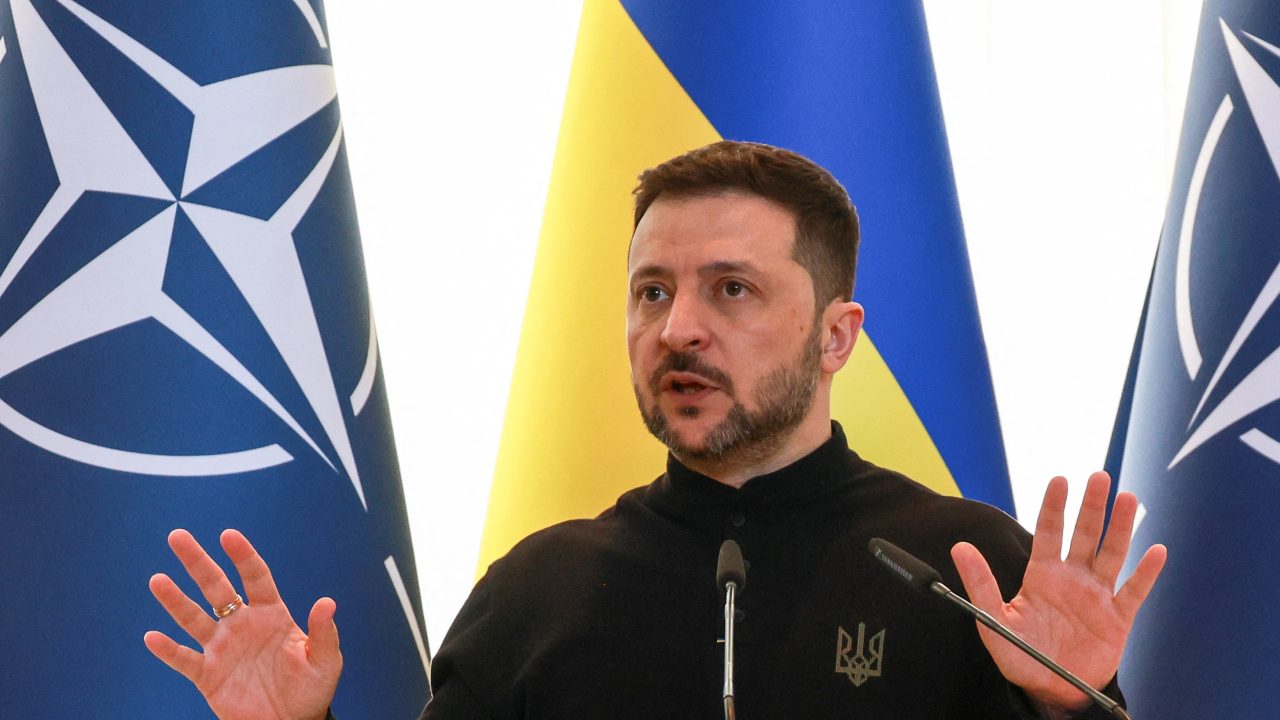
Ukraine is on the brink of a major diplomatic break with China.
President Volodymyr Zelenskyy yesterday accused China of directly “supplying weapons to the Russian Federation.”
Through more than three years of war, in which the People’s Republic of China has stood firmly behind its “no limits” partnership with Russia, both Kyiv and Beijing have been careful to keep the Ukrainian relationship with China from going off the rails.
As part of this effort, Beijing has been careful to always be seen as falling short of providing Russia with outright military assistance, and Kyiv has been careful never to accuse it of doing so.
Until yesterday.
Zelenskyy told a press conference in Kyiv on Thursday that “representatives of China” have been producing weapons on the territory of Russia, and that these weapons relate to artillery and gunpowder. He said that he would be able to talk about this in great detail next week.

There are two reasons why Ukraine had maintained its relationship with China on an even keel through these three years.
One is that Kyiv had never given up hope, at least publicly, that Beijing would play its part in bringing about some kind of peace.
But the second, darker, reason is that Ukraine feared that if China openly declared for Russia and started to supply large quantities of weapons, vehicles and ammunition to Russian armed forces, it could spell defeat and the end of the war.
So what has changed?
It’s possible, of course, that the intelligence Zelenskyy alluded to yesterday is genuinely new and he is breaking it publicly on a normal timeframe.
But there is no such thing as a normal timeframe for declaring that China is lying about not supplying weapons to your enemy.
Yesterday’s accusation also follows less than two weeks after Ukraine revealed it had captured two Chinese nationals fighting for Russia.
Zelenskyy personally alleged that Ukraine has further information that there are more than 150 Chinese citizens “involved in the war against Ukraine by Russia.”
Lin Jian (林劍), a spokesperson for China’s foreign ministry, said that this has “no basis in facts.” It is unclear on what grounds he was claiming this.
Ukraine does not appear to think the two Chinese citizens captured and shown to the media were ever members of the Chinese military or were otherwise acting on behalf of the Chinese state.
But Reuters has reported that Western intelligence believes Chinese officers have visited Russian frontlines in an observer capacity.
Why Now?
Why has Zelenskyy, after three cautious years, personally began to throw serious and well-evidenced accusations that China is doing a lot more for Russia than it claims?
The answer is Trump.
Under its new president, the U.S. has withdrawn its support for Ukraine and has rhetorically attacked Zelenskyy while refusing to criticize Russia. It’s an abrupt about-face from the Biden administration that threatens to ruin Ukraine’s defense of its homeland.
And yet while Trump seems very happy to throw jabs at Ukraine, he still talks about pursuing mineral deals with Kyiv and brokering a peace with Moscow.
In short, the stakes are a lot higher for Ukraine now than they were before Trump’s inauguration. But the potential for catastrophe, while still large, seems to have been moderated somewhat from the days and hours after that disastrous press conference in the White House.
Add into this mix Trump’s burgeoning tariff and trade war with China, and Zelenskyy’s calculus becomes clearer.
If Kyiv can tie Russia’s invasion of Ukraine back into a wider global conflict between the U.S. and China, then he may manage to maintain some modicum of American support, particularly in the face of Russian disinterest in peace.
He may.
But obviously, trying to balance the already existent loss of U.S. military aid with the threat of tipping Beijing towards becoming openly hostile towards Ukraine is a high-wire act.
And while Trump is seemingly happy to break up and then make up if it’s good for the cameras, the introduction of personal animosity between Zelenskyy and Chinese President Xi Jinping (習近平) will almost certainly be harder to walk back.
“We talked with the Chinese leader and he gave me his word that he won’t sell or give weapons to Russia. Unfortunately, we have facts and see the opposite information,” Zelenskyy said in apparent reference to Xi yesterday.
Where to Now?
One factor that Kyiv must be counting on is that while Beijing might want to respond harshly to this new strategy, it will almost certainly feel it has to moderate because it is simultaneously on a charm offensive in Europe and the rest of the world.
Because the Trump administration has decided to wage tariff wars indiscriminately and on all fronts, China is able to portray itself as the upholder of free trade and the defender of the existing, giving Beijing yet another shot at the mirage that it will be able to peel European capitals away from Washington into a quasi-alignment with China under the guise of strategic multipolarity.
That would be threatened if not destroyed by a shift to open and full military support for Russia. It is extremely unlikely to happen, and if it does would be a sign of dysfunction within China’s foreign policy decision-making apparatus.
Instead, we should expect that Beijing will full-throatedly deny whatever evidence Zelenskyy presents next week and then continue to do it, if not redouble its efforts.
That appears to be the calculation that Zelenskyy has made that he can live with: weapons that he says Beijing is already providing, and harsh words that will be lesser among his concerns.
What is much less clear is the long-term outcome. Where does this leave China’s relationship with Ukraine during and after an eventual peace?
I don’t know, but I suspect that Zelenskyy doesn’t, either.




Leave a Reply