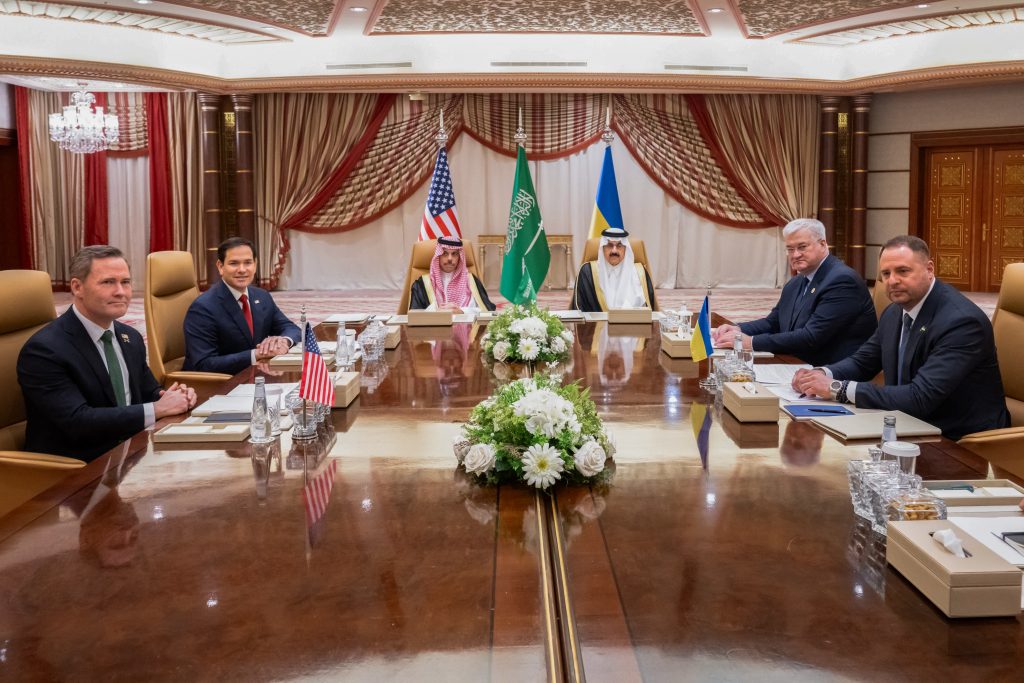
Ukraine has agreed to a ceasefire plan that it formulated with the U.S. at a summit in Saudi Arabia. At the time of writing, Russia is still reviewing the proposal.
Over the last few weeks, there has been much speculation about the potential role of China in the peace process, but a lot of this is predicated on the U.S. pulling back and leaving a vacuum.
While that is still clearly a possibility, for now America appears to have adopted a “spiky hug” strategy, where it subjects Ukraine to indignation and military pain but is still engaged in pushing Ukraine towards a ceasefire and peace process. That process looks to be on the U.S.’s terms, not Ukraine’s, but the current active proposal does not contain details about Ukrainian concessions.
Where does this leave China? Well, the answer might be in the first paragraph. Perhaps China’s role would be in either bringing Russia to the table, or coming to the table with Russia.
Let’s take two steps back and first ask why Ukraine might want Chinese involvement, and then second why China might want to agree.
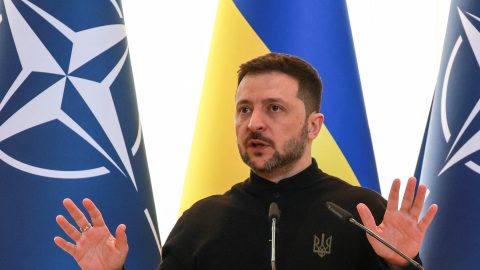
Publicly, Ukraine has not given up on the theory it has held since day one of the invasion that somehow Chinese influence over Russia could help to end the war. Last month, Ukrainian President Volodymyr Zelenskyy said “It’s important for us to engage China and use its influence to pressure Putin to end the war.”
Conversely, Russia is China’s most important partner on the global stage. China might be motivated to try to draw the war to a close if it thought its neighbor was bleeding too much. “The real outcome that Beijing would like to avoid is a very much weakened Russia,” according to Chong Ja Ian (莊嘉穎), a China scholar at the National University of Singapore.
It should not escape the reader that these are not sides of the same coin. Either Russia is winning and needs to be stopped or it is losing and needs to be saved. And right now it does not seem that Russia is losing. So why would China step in?
China wants to be seen as a force of stability globally, as a peacemaker. It has been a part of joint peace proposals with Brazil during the course of the invasion, but there is no evidence that it has at any point exerted its influence to try to bring Russia to that or any other negotiating table.
Being seen as the key player that delivered a permanent ceasefire would also allow China to undermine the U.S. Ukrainian sinologist Vita Golod told The Diplomat that the outcome that would benefit China the most would be “a negotiated settlement achieved through China’s mediation … This outcome would undermine U.S. dominance, which aligns with China’s long-term strategic interests.”
So the theory of why both Ukraine and China might want China involved is quite developed from a geopolitical perspective, but it is untested, and many analysts doubt that China could bring Russia to the table against Moscow’s will.
There are other reasons for Chinese involvement. In the aftermath of a permanent peace, or truce, there will be hundreds of billions of dollars of reconstruction work and contracts to rebuild Ukraine. Many in Kyiv and Beijing would like to see Chinese renminbi deployed in this manner, as pointed out by former Lithuanian foreign minister Gabrielius Landsbergis, who certainly does not personally support the idea.
It has also been suggested that China could contribute to peacekeeping forces stationed in Ukraine after a peace treaty. Former People’s Liberation Army general Zhou Bo (周波), now a senior fellow at the Centre for International Security and Strategy at Tsinghua University, said that China had “sufficient troops and military strength” to contribute to an international post-war effort, according to the South China Morning Post, but he didn’t think this would be possible if NATO countries also contributed.
Why not?
The main argument against Chinese involvement is that China is a Russian partner which does not have Ukraine’s interests at heart, and has been supporting the aggressor in this war.
This was enunciated by the EU High Representative for Foreign and Security Policy, Kaja Kallas who said “China is a key enabler of Russia’s war of aggression against Ukraine,” and that “Without China’s support, Russia would not be able to continue its military aggression with the same force.”
Mariia Makarovych, the head of the Liberal Democratic League of Ukraine’s East Asia office in Taipei told Domino Theory that having China provide security guarantees would be “dangerous” for Ukraine and “bad news” for Taiwan because it would lead to more Chinese influence globally.
Will it happen?
China is not really acting as if it expects to be involved. Fu Cong (傅聰), the Chinese ambassador to the United Nations, said this when talks started between the U.S. and Russia in February:
“China welcomes all efforts dedicated to peace, including the recent agreement reached by the United States and Russia to start peace talks. At the same time, China hopes all relevant parties and stakeholders involved in the Ukraine crisis will engage in the peace talks process, and reach a fair, lasting, and binding peace agreement acceptable to all parties.”
Not exactly a strident expression of Chinese state capacity. China has also repeatedly called for Europe to be involved in the talks, but this seems to be more using Ukraine as a wedge issue against the U.S., trying to forward Chinese diplomatic ambitions in Europe.
“When you look at how the Trump administration has implemented a brazen and domineering policy towards Europe, treating its allies in this way, honestly, from a European perspective, it’s quite appalling.” This from Lu Shaye (盧沙野) the Chinese Special Representative for European Affairs, and a man not known for his pro-European sensibilities.
Ukraine definitely isn’t ruling Chinese involvement out. At the Munich Security Conference in February, Ukrainian Foreign Minister Andrii Sybiha said “China has a crucial role to play in achieving peace,” following a meeting with Chinese Foreign Minister Wang Yi (王毅).
In the end, it is the view of this author that if China is involved, it will not be as a result of pressure from Beijing forcing Moscow to the table. Apart from anything else, those parts are now played by Washington and Kyiv. Rather, if at the end of a peace process China has played a key part, it will be because Russia was happy to give it the “peacemaking win” on a process that was already largely determined.
As Makarovych said, that is unlikely to lead to anything good for Taiwan.



Leave a Reply