
Taiwan’s presidential and legislative candidates are ramping up efforts to win over voters with one week to go until the 2024 presidential election.
As of 12:00 a.m. on Jan. 3, the dissemination, reporting, sharing and referencing of polls is expressly forbidden to prevent any undue influence on voters in Taiwan. Violators will be fined between 100,000 New Taiwan dollars ($3,223) and 1 million NTD ($32,230). The fines will be increased to between 200,000 NTD ($6,457) and 2 million NTD ($64,570) if violators are candidates of or working for a political party.
Taiwan’s ruling Democratic Progressive Party (DPP) has played up news of China’s attempts to interfere in Taiwan’s election. DPP presidential candidate Lai Ching-te (賴清德) said on Wednesday that anyone supported by China must not be elected.
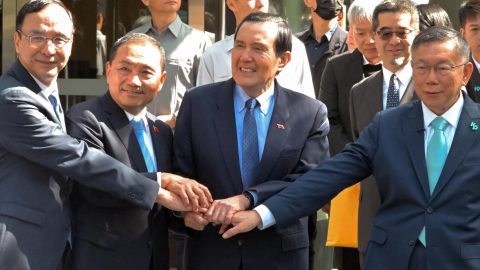
The obvious target of these remarks, Chinese Nationalist Party (KMT) presidential candidate Hou Yu-ih (侯友宜), on Thursday returned to his home court in New Taipei’s Banqiao District for a motorcade campaign event. There, he asked voters to support the strongest opposition candidate. Hou said he strongly opposed foreign interference in Taiwan’s democratic elections and called on the DPP refrain from disseminating fake news and to not engage in red-baiting (抹紅).
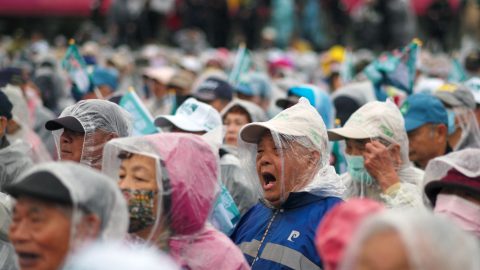
Taiwan People’s Party (TPP) presidential candidate Ko Wen-je (柯文哲) held a motorcade campaign event in Taoyuan, visited night markets to interact with supporters, and attended a campaign rally for a fellow TPP legislative candidate. Ko, who has positioned himself as between the “pro-war” DPP and the China-friendly KMT, stated that he has not said Hou is associated with China, though he has asked why China faked polls for Hou.
It is worth noting that, based on the New Taipei City Election Commission’s declaration of the number of eligible voters for the 2024 election, there are 1,635,390 male and 1,766,674 female voters in Taiwan’s largest city, totaling 3,402,064 voters. This number, in Hou’s home constituency, is 80,605 more than in the last presidential election, accounting for one-fifth of all eligible voters nationwide.
Taichung City and Changhua County are traditionally seen as the “swing states” in Taiwan’s elections. The two have a combined population of more than 4 million people. In the central and local elections that have taken place every two years over the past eight years, votes have swung between the blue and green camps by considerable margins, without a clear political leaning. In the past two presidential elections, the vote distributions in Taichung and Changhua have been almost a microcosm of the overall national results. In other words, capturing the preferences of voters in central Taiwan seems key to winning the presidential election.
Elections for Taiwan’s legislature will also be held on January 13. There are a total of 113 seats in Taiwan’s Legislative Yuan. The term length is four years, and legislators can be re-elected for consecutive terms. Taiwan uses a “single district two votes” election system. Among the seats, 73 are district legislators, and 34 are at-large legislators (not representing any district). Six seats are reserved for indigenous candidates, three legislators elected each from lowland and highland constituencies.
Taiwan currently uses a “parallel system” to calculate the number of at-large legislative seats. The number of seats to be elected, 34, is multiplied by the party’s vote percentage. The integer determines the number of seats allocated to each party. For example, if a party wins exactly 50% of the vote, it gains 17 at-large legislative seats.
If there are leftover seats, the “remainder” of each party’s vote percentage is then compared, calculated to the fourth decimal place. The fifth decimal place and beyond is rounded, and the largest remainder gains an additional seat.
The Additional Articles of the Constitution of the Republic of China (中華民國憲法增修條文), guarantees at-large seats for women. Half of a party’s at-large legislators must be women. Any vacancies filled must also abide by this regulation for guaranteed women’s seats.






Leave a Reply