
Last month, Taiwan’s National Central University (NCU) handed over its Deep Space Radiation Probe to the Japanese company ispace Inc, ready for it to become the first piece of Taiwanese technology to go to the moon. This is an impressive achievement, yet it flags up an oddity: Taiwan’s relatively nascent space industry looks well placed to be an important player in global space innovation despite not being able to legally launch anything into space itself — because of its international status outside of the United Nations.
The context for the moon trip is that the global space economy was worth $384 billion in 2022, and Taiwan’s government increasingly believes in the economic potential of its own space industry. During President Tsai Ing-wen’s (蔡英文) inaugural speech at the start of her second term, she listed the space industry as one of six core industries and financing has followed. After putting forward around $790 million (25 billion New Taiwan dollars) over ten years to Taiwan’s National Space Program in 2019, Tsai’s government committed a further $1.26 billion (40 billion NTD) to the program at the end of last year.
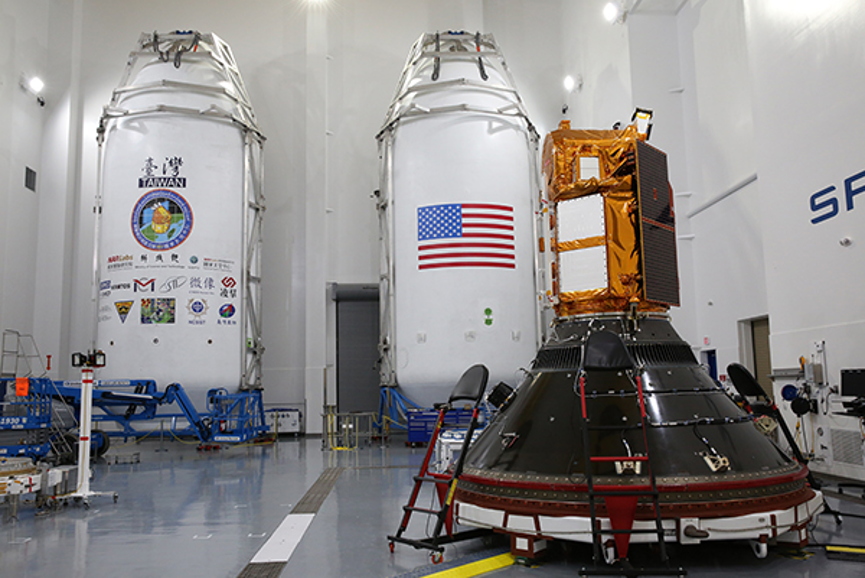
Government financing comes in response to existing economic success. The global satellite sector contributed $281.1 billion to the overall value of the global space economy, and Taiwan’s satellite sector was worth around $6.8 billion (215.8 billion NTD) in 2022. The vast majority of that value, 98.7%, comes from supplying ground equipment, where notably, Taiwanese companies supply SpaceX. Although competition remains fierce, this builds directly on existing expertise in precision engineering, electronics and communications.
NCU’s probe — designed to test the effects of ionizing radiation on electronics — is at the leading edge of a wave of efforts to also get more involved in producing the hardware that actually goes into space, such as low-Earth orbit communication satellites.
“With the growth in low-Earth orbit communications, this has made satellite communications a lot more accessible to people on Earth,” Loren Chang (張起維), chair of the Department of Space Science and Engineering at NCU, told Domino Theory on a video call. “So a lot of Taiwanese companies that make similar products are taking notice. And the idea is if they can have a better understanding of how you design and qualify a product for this particular market to be used in some cases in an operational space environment, then they can design products that they can then sell to international companies as OEMs [Original Equipment Manufacturers], or design components..”
Taiwan’s Advantages and Disadvantages
In seeking to do this, a number of factors fall in Taiwan’s favor, according to Chang. It has a mature precision industry and electronics and 5G communications sector, with access to the entire supply chain. It has a great reputation for manufacturing at high volume. It is a trusted partner in existing, sensitive supply chains involving companies from North America, Europe, Japan or India. It has good relations with major space faring countries or regions. And it has “a lot of latent capability,” such as advanced testing facilities currently used for advanced medical purposes, that could be moved over for use within space manufacturing.
Its main disadvantage is political. Taiwan is not a member of the United Nations. To launch a spacecraft you need to ensure that your space station has undergone frequency coordination by the International Telecommunications Union (ITU), which is a branch of the U.N. Similarly, orbital slots for satellites are also regulated by the ITU. This means that for both launches and orbital slots, Taiwan must work through other countries.
International Collaboration Opportunities
The gap is being bridged through collaborations. Launches in other countries are becoming increasingly regular, with two Foxconn satellites launched in California last November and Taiwan’s first domestically-produced weather satellite launched in French Guiana last October. U.S. lawmakers have just introduced legislation to allow NASA to work with the Taiwan Space Agency (TASA) on civilian projects. And there is more to come.
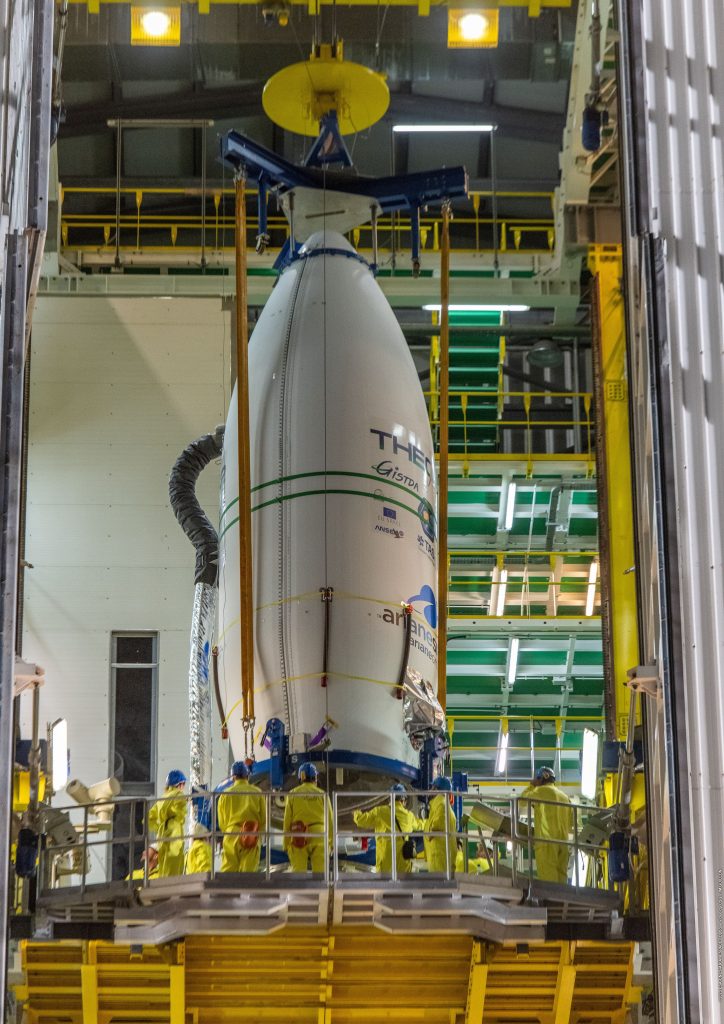
Last September the Taiwan Accelerator Plus 2023 International SpaceTech Startup Supporting Program selected 16 space startups from seven countries to immerse themselves in Taiwan’s space industry in a process that is now bearing fruit.
“To be really honest with you, we [didn’t] know much about Taiwan, other than the fact that they make a lot of electronic chips and that’s it,” Arun Radhakrishnan, head of business development and strategy at Inspecity, one of the companies involved, told Domino Theory via video call. “What we got to know [after a month visiting Taiwanese space companies] was that the relation with the Taiwanese space ecosystem was more than just electronic components.”
Radhakrishnan noted TASA has already developed the “quite advanced” FORMOSAT series of satellites, that it has a company developing launch vehicles and that a number of smaller companies are manufacturing a significant amount of subcomponents that can be used by TASA. As a result, Inspecity, an Indian company right now focusing on satellite maintenance, felt that it could get involved in a productive back and forth with Taiwan’s space industry. It offered its own propulsion system, for instance, for inclusion in products manufactured in Taiwan, such as Attitude Determination and Control Systems, or ADCS, which help a spacecraft know which way it’s facing and makes sure it stays that way while it’s flying through space. Discussions are now ongoing on a number of collaborations.
In terms of advantages of working with Taiwan, Radhakrishnan echoed Chang’s comments about manufacturing prowess, noting both the quality and speed of the work. “People work at a very breakneck pace. So what we said three months, they said, ‘We can do it in a month’ in terms of manufacturing in terms of correlating the certain critical components,” he said.
But there were also soft factors in Taiwan’s favor. Whereas in other countries’ accelerator programs there might only be initial workshops, in Taiwan, “These guys just did all the homework for us,” Radhakrishnan said. “They hosted us, they took us to these companies, and mentioned to these companies about us, it made things much easier for us to start in our development.”
The Medium-Term Outlook
For Radhakrishnan, what this all adds up to is a story of strong medium-term potential, albeit with an asterisk regarding geopolitics. “I see Taiwan developing [its] space industry along the lines of its semiconductor industry, because what I saw in Taiwan was satellites flying around, but with no launch records to put them in orbit. And they’re sort of seeking countries from around the world to sort of assimilate them and bring them with it. So, I expect things would go well for the coming years. I mean, if [Chinese President] Xi Jinping doesn’t change his mind [and take military action.]”
That asterisk does have an impact. Inspecity is developing one product using Taiwanese parts, and one entirely in India, to mitigate against the risk of supply chain disruption in Taiwan. But for now, the collaboration looks highly promising, even down to offers of ride sharing. Taiwanese companies or Taiwan’s space agency “could say, ‘Hey, do you have space on board? We would like to test out our star tracker,’ and we could say, ‘Sure, just put it on our rocket.’ These discussions are happening. So it’s like a synergy,” Radhakrishnan said.
This chimes with Chang’s view of the next ten years, in which Taiwan “will probably access space more often than we have in the past, there’ll be more players, not just government space agencies, but also universities, private companies.” For Chang, “the typical way of accessing space launch opportunities will probably still be the international providers, either for larger satellites by directly interfacing with companies like SpaceX or Ariane, or in the case of smaller satellites or payloads, making use of ride share opportunities, where we piggyback on the launch of a larger satellite.”
Thus, the strength of these collaborations becomes the answer to the riddle of how Taiwan can end up as a major space player without being able to launch anything itself.




Leave a Reply