
Semiconductors and Artificial Intelligence
Citing AI infrastructure demand and the finalization of a trade deal with the U.S., Taiwan raised its gross domestic product growth projection for 2026 from 3.54% to 7.71% in February. The statistics bureau expects exports to rise 22.22% and Taiwanese GDP to surpass $1 trillion this year.
Taiwan’s chip industry is already off to a strong start, with the Taiwan Semiconductor Manufacturing Company hitting a market capitalization of $2 trillion for the first time last month. Just a year and a half prior, in July 2024, TSMC became Asia’s first stock to reach the trillion dollar threshold since 2007.
This momentum will likely continue, as several new investments into Taiwan’s semiconductor ecosystem are planned for the year. Taiwan could have up to 10 fabrication facilities under construction or breaking ground in 2026, the Liberty Times reported last month. On February 10, Industrial Technology Research Institute, or ITRI, a government backed research organization that played a central role in the founding of TSMC, broke ground on its Advanced Semiconductor R&D Base in Hsinchu. TSMC is contributing technology and expertise to the construction of the facility, which will be completed in December 2027. ITRI hopes the facility will help shorten product development timelines by 30%. Grand Process Technology, a chip equipment manufacturer, announced last month that it is partnering with the National Taiwan University of Science and Technology to build an advanced packaging R&D platform. The five-year collaboration will put NT$50 million toward upgrading packaging technology, developing talent and patenting research outcomes.
In a new development for homegrown Taiwanese artificial intelligence, Taiwanese weather app Raining Bell was upgraded to include an AI-enabled voice assistant called Firefly that can dialogue with users in Mandarin and Taiwanese Hokkien. Firefly runs on the Trustworthy AI Dialogue Engine, or TAIDE, Taiwan’s flagship sovereign AI model tailored to the local cultural and linguistic context.
Throughout February, Taiwan continued to grapple with the terms of its trade deal with the U.S., which was announced in January and commits Taiwanese semiconductor and technology companies to new, direct investments of at least $250 billion into the U.S.’s chip manufacturing industry.
Officials are assuring the public that expanded investment in the U.S. compliments, rather than undermines, Taiwan’s chip dominance. Vice Premier Cheng Li-chiun (鄭麗君) said on February 8 that it’s “impossible” for Taiwan to transfer 40% of its chip production to the U.S., responding to a comment that U.S. Commerce Secretary Howard Lutnick made last year. “I told the U.S. side, we can’t distribute production capacity, but we can expand our layout in the U.S.,” Cheng said, reiterating that Taiwan’s most advanced semiconductor technology will not be transferred abroad.
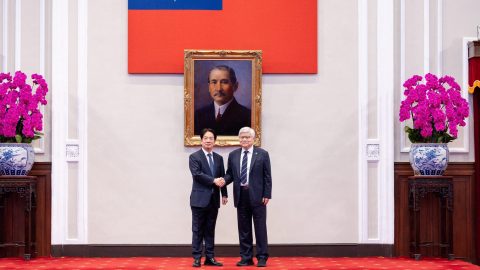
Taiwan is also leveraging its investments in the U.S. semiconductor industry to build diplomatic capital. When Taiwanese President Lai Ching-te met with John Nueffer and his delegation from the Washington-based Semiconductor Industry Association on Monday, Lai said that the chip partnership between the U.S. and Taiwan has evolved beyond supply chains to become a “comprehensive strategic alliance” covering economic security, technological resilience and democratic principles.
But some in Taiwan are still worried that these new investments will lead to the hollowing out of its semiconductor industry. The Chinese Nationalist Party (KMT), Taiwan’s main opposition party, announced last week that it plans to introduce a bill requiring legislative approval for the export of advanced chip technology.
Defense and Space Technology
February was a big month for U.S.-Taiwan drone collaboration. The National Chung-Shan Institute of Science and Technology, Taiwan’s military research and development center, and U.S.-based defense company Kratos successfully tested the Mighty Hornet IV, a jet-powered attack drone, integrating a Taiwanese mission payload. If flight tests are successful, volume production of these drones will start later this year, “delivering affordable mass” to Taiwan’s drone fleet. Shield AI announced on February 11 that it is also partnering with the military institute to equip Taiwan’s drone forces with AI pilots.
The first images were released from the Taiwan Space Agency’s Formosat-8A satellite, which made its maiden voyage in November 2025. The images achieved 1-meter resolution, allowing for detailed observation of small objects. 84% of Formosat-8A’s components were designed and manufactured in Taiwan.
The Taiwan Space Agency also announced that it is planning to construct a space rocket research center in Tainan. The center will focus on the production of rockets around 25 meters to 28 meters in length to enable Taiwan to launch satellites weighing around 200 kilograms into orbit. The space agency is also planning to build a rocket launch center in Pingtung County.


Leave a Reply