
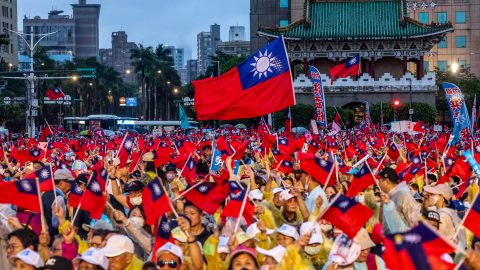
“This is not called peace, this is called surrender!” political leaders and activists shouted in central Taipei’s bustling shopping district on May 23. 57 civic groups and hundreds of people were gathered to protest legislative cuts to Taiwan’s defense budget amid rising threats from Beijing.
Organized by the Taiwan Economic Democracy Union, the rally included a massive march through Taipei’s downtown. The protest targeted recent legislative actions by the main opposition party, the Chinese Nationalist Party (KMT), and its smaller ally, the Taiwan People’s Party (TPP). Specifically, their rejection of President Lai Ching-te’s (賴清德) 1.25 trillion New Taiwan dollars ($40 billion) special defense budget.
Taiwan’s legislature passed a reduced NT$780 billion special defense budget on May 8, narrowing the arms-procurement package and removing funds for domestically produced drones and AI integration.
“Only with drones and unmanned boats can we survive on today’s battlefield,” said Lee Ming-che (李明哲), a Taiwanese pro-democracy activist who was detained by Chinese authorities for five years. He warned that China’s military is aiming to be ready to invade Taiwan by 2027. “We must deter them so that our front-line officers and soldiers don’t have to expose themselves directly to enemy fire.”
The protest’s timing was deeply symbolic, marking the 75th anniversary of the “Seventeen-Point Agreement” signed by Tibet and China in 1951, in which China promised “peaceful liberation” for Tibet. Protesters pointed to Tibet’s subsequent annexation as a cautionary tale of a “fake peace” when dealing with China.
“The peace agreement didn’t represent an equal relationship between two countries, but a relationship of being annexed,” said Yang Tsung-li (楊宗澧), a board member of the Human Rights Network for Tibet and Taiwan.
Protestors also targeted the upcoming trip to the U.S. by KMT chair Cheng Li-wun (鄭麗文), scheduled for June 1. The KMT says the 10-day trip aims to convince the U.S. of a potential “new direction” for cross-strait relations that aligns with U.S. interests and reassures international partners that the party remains “pro-U.S. and amicable with mainland China.”
The rally highlighted Taiwan’s increasingly complicated security relationship with its primary defense supplier, the United States. After Taiwan’s legislature passed the reduced special defense budget, acting U.S. Navy Secretary Hung Cao said at a Senate hearing on Thursday that “Right now we’re doing a pause in order to make sure we have the munitions we need for Epic Fury — which we have plenty,” referring to the U.S.-Israel joint military operation in Iran.
“Taiwan’s security should never only rely on the U.S.,” said Wang Wan-yu (王婉諭), chairperson of the New Power Party, which currently holds no seats in Taiwan’s legislature. Wang noted that the pause underscores why Taiwan must build its own weapons. “Taiwan’s self-reliant defense production capability is absolutely indispensable.”
Industry leaders have warned that the legislative deadlock is a “disaster” for Taiwan’s nascent defense sector. Max Lo (羅正方), chairman of the Taiwan National Drone Industry Association, recently said that failing to secure a multi-year special budget disincentivizes local companies from making the investments necessary to scale production.
All 57 participating groups vowed to continue their movement until the entire $40 billion special defense budget is restored.
Police estimated that around 1,200 people attended the rally. Organizers said the 57 civic groups participating in the rally vowed to continue their movement until the entire $40 billion special defense budget is restored.
This article was corrected on May 25. The original version of this article stated that thousands of people attended the rally. The actual number of participants was in the hundreds. Rally organizers announced to the public that there were around 8,000 participants. Police officers at the scene told us there were 1,200 participants.



Leave a Reply