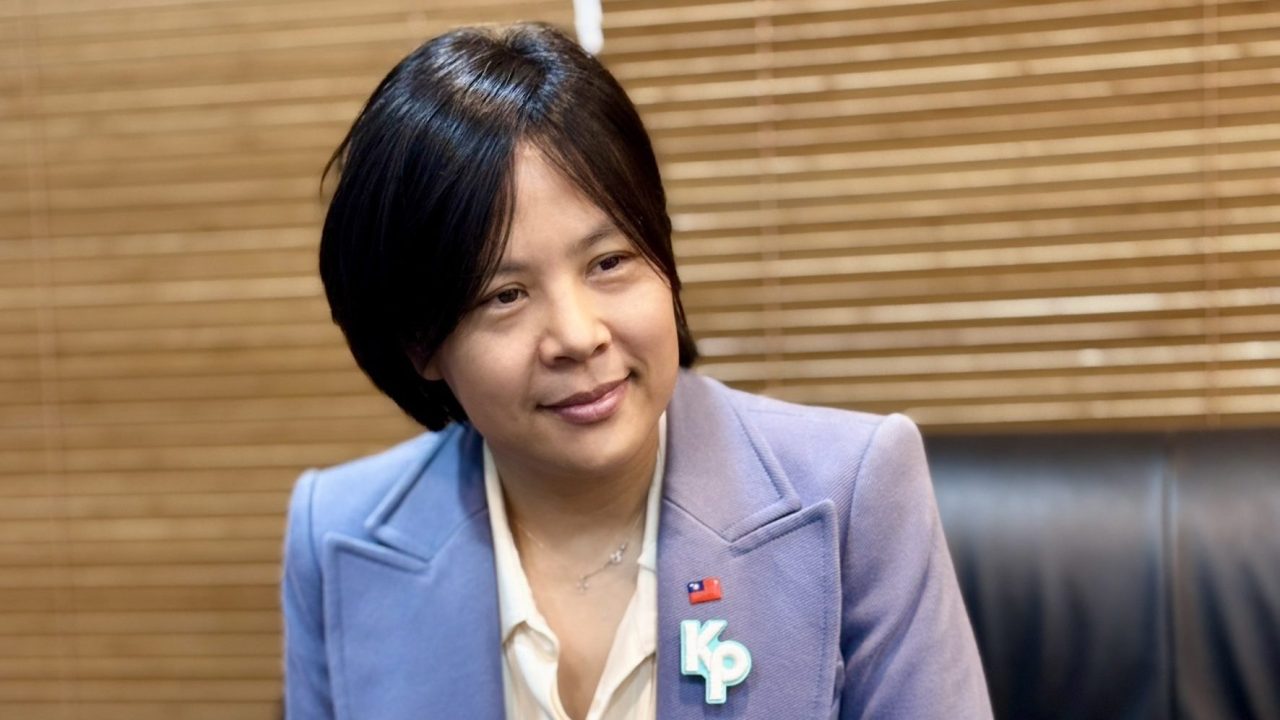
Li Chen-Hsiu (李貞秀) didn’t follow the usual path into Taiwanese politics. She was born in China, but left in 1993 after marrying a man from Taiwan. For the next three decades, Li says that she lived the ordinary life of a “mainland spouse,” the term used in Taiwan to describe someone born in China who obtains long-term residency by marrying a Taiwanese citizen. She raised five children and built a career in the thriving tech industry.
Last week, amid controversy over her eligibility to serve, Li became the first Chinese citizen to be sworn in as a member of Taiwan’s parliament.
Her appointment comes at a fraught time for Taiwanese politics. The ruling Democratic Progressive Party (DPP), which controls the executive branch, and the Chinese Nationalist Party (KMT), which holds a plurality in the legislature, remain deeply polarized over the question of how to handle looming threats from Beijing.
In recent weeks, both sides have come under pressure from U.S. lawmakers to pass some version of the DPP’s unprecedentedly large proposed defense package, which would provide $40 billion for weapons purchases over the next eight years. The bill had been stalled in the legislature since early December until the KMT agreed last month to begin discussing it when parliament returned from the Lunar New Year recess.
Li is a member of the Taiwan People’s Party (TPP), which was founded in 2019 as an alternative to the KMT and DPP’s political duopoly, but which has been steadfastly aligned with the KMT in its opposition to President Lai Ching-te (賴清德) during the current legislative term. Li says that her background makes her uniquely suited to serve as a bridge between Taiwan and China, where much of her family still lives.
“As people of the same language and culture, it would be better if we understood each other, especially when a misunderstanding risks igniting a war,” Li said in an interview with Domino Theory at her legislative office on Tuesday.
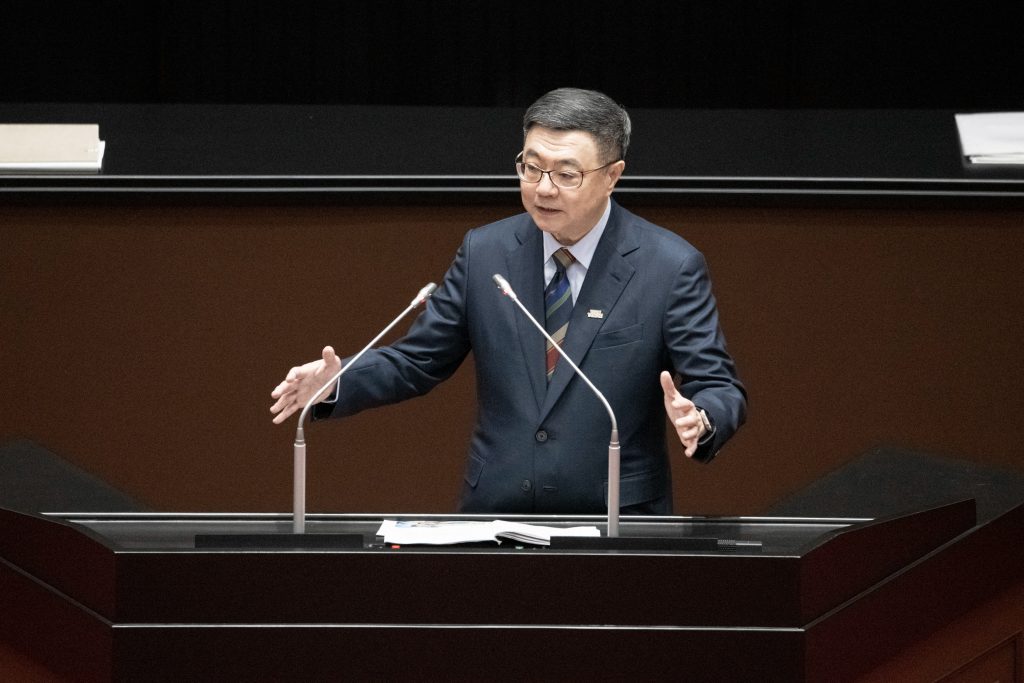
Li’s critics say that her background makes her a threat to national security. Last week, Premier Cho Jung-tai (卓榮泰) advised government ministries to refrain from sharing briefing materials with Li, classified or otherwise, saying that the question of her eligibility to serve in parliament remains unresolved. Loyalty to the constitution that is passive or compelled, Cho told parliament, is “completely without value.” Local media later reported that prior to his address, Cho greeted her as “Ms. Li,” in place of the usual honorific, “legislator.”
Li says that Cho’s directive has yet to impact her ability to function as a lawmaker, stressing that it is ultimately up to the legislative branch to decide whether she can serve. She has been appointed to the influential Internal Administration Committee, a position her legislative office director, Huang Bo Yuan (黃柏源), says will allow her to shape policy affecting Taiwanese citizens “from birth to death.”
“I think people can tell the difference between a party and politician who is doing genuinely beneficial work, and one which is deceiving voters and engaging in political maneuvering,” Li said.
The dispute over Li’s eligibility to serve stems from a contradiction between two laws governing the status of foreigners in Taiwan. A 1992 law passed soon after democratization says that mainland spouses who have held household registration in Taiwan for more than 10 years are eligible to run for public office. The Nationality Act of 1929, passed when the KMT still controlled all of China, however, requires that elected officials renounce foreign citizenship within one year of taking office.
“The law stipulates that legislators cannot hold dual citizenship,” DPP legislator Wang Ting-yu (王定宇) wrote in a Facebook post last month. “Is it so difficult to abide by the law? As for whether this person has provided proof of renunciation of citizenship, that’s a scientific question. They either have or they haven’t.”
Li says that she traveled to China last March to renounce her Chinese citizenship, but that her request was denied by China’s Ministry of Public Security. (Accepting such a request could suggest that the Chinese government deems Taiwanese people residents of a foreign nation, an implication it staunchly rejects.) Also last March, Li submitted proof to Taiwan’s Mainland Affairs Council that she canceled her Chinese household registration in 1993. But the Council has said that the format and content of the certificate were “unusual.”
Household registrations have long been used as a proxy for citizenship, allowing Taiwan to skirt the paradoxes arising from its constitution’s enduring claim to the entirety of China, says Su Yen-tu (蘇彥圖), a research professor at Academia Sinica. The Cross-Strait Relations Act of 1992 included a ban on holding household registration cards in China and Taiwan at the same time, but “it had been laxly enforced under previous administrations,” he says.
It was only recently, under the Lai administration, that the government started to use the much older Nationality Act to enforce a prohibition on dual citizenship. “The whole legal basis is not as strong,” Su says. “Especially if you consider whether that kind of requirement has some kind of retroactive effects.”
The TPP’s founder and former chairman, Ko Wen-je (柯文哲), said in response to Premier Cho’s comments last week that if he intends to continue questioning Li’s status as a lawmaker, then Cho should clarify whether “Chinese spouses who hold Taiwan ID cards have political rights,” adding: “If Cho is willing to say so openly, we’ll have Li step down.”
The status of mainland spouses has become politically potent in Taiwan, which is home to 300,000 of them. In a country of 23 million, that represents an important constituency. Last year, Taiwan’s National Immigration Agency revoked the residence permit of the mainland spouse and social media influencer Liu Zhenya (劉振亞), who had called for China to annex Taiwan by force in videos broadcast to her 400,000 followers on her YaYa in Taiwan Douyin account.
Li says that people like Liu are a “big headache” for the rest of the mainland spouse community. “Most of us genuinely choose to be Taiwanese because we truly love Taiwan,” she says. “In a free country, it’s not a crime to shout for Taiwanese independence, nor is it a crime to shout for unification. But advocating war is absolutely intolerable.”
Ko Wen-je ‘Played a Very Good Card’
When Li first moved to Taiwan in 1993, it was to be with her new husband whom she met while working at a factory in Shenzhen. But there was another reason she wanted to leave China. “I was worried there was going to be another Cultural Revolution,” she said.
Li was born in 1973 in a small town in Hunan province, three years before Mao Zedong (毛澤東) died. By the time she moved to Shenzhen in the early 1990s, it was China’s most famous boomtown, dubbed the “overnight city” for the feverish pace of its business activity. Shenzhen’s rise was helped along by the market-friendly policies of Mao’s successor, Deng Xiaoping (鄧小平), who also loosened restrictions on Taiwanese business activity in China.
Today, Li says that China should be proud of the progress it has made since Deng took over. “No matter how you look at it, they have managed to guide such a large country with a huge population and economic growth to where it is today.” She says that her parents, who still live in China, are well looked after by the Chinese Communist Party.
She added that in her view, even though they don’t have the right to vote, Chinese citizens continue to support the CCP at very high levels. “It seems the more authoritarian a country is, the higher the popular support,” she said. “It’s not the case that their people are all afraid to speak out, as we might assume when we think of a one-party state.”
In her first two decades in Taiwan, Li didn’t pay close attention to politics. “I was just having children,” she said. But when Ko established the TPP in 2019, promising a new kind of politics in Taiwan, she was inspired, and soon began volunteering for the party. Then, before the 2024 general elections, Ko selected her as one of the party’s candidates for an at-large seat in the legislature. The TPP, which won eight at-large seats that year, has an internal rule that at-large legislators must be cycled out every two years. Li’s 15th position on the party’s at-large roster put her in line to step in this year.
Li believes that Ko “played a very good card” by selecting her, because her unique background is a form of “cognitive warfare” against China. “I can highlight that the political and economic system of the Republic of China is superior to that of the other side,” she said. “We can let a girl from the countryside marry into Taiwan, and give her equal opportunity to participate in politics.”
For someone so new to the game, Li is a talented politician. She spent the entirety of her 70-minute conversation with us leaned forward in her chair, looking us straight in the eyes while she answered sensitive questions both political and personal. She spoke with real passion about the issues facing Taiwanese people, especially working mothers.
On the topic of the special defense budget, Li was less enthusiastic. She said that she does her best not to touch on controversial bills that are still under consideration. The TPP’s current chairman, Huang Kuo-chang (黃國昌), told The Japan Times on Tuesday that the party would be open to passing the special defense budget. On one condition: U.S. President Donald Trump must approve the $12 billion in additional arms sales to Taiwan that he has reportedly delayed in an effort not to anger Beijing.
When we brought up Huang’s comments to Li, she deferred to her aide to address the specifics. But her broader perspective on defense soon became clear. Our position, she said, is that we always support the defense of Taiwanese autonomy.
“We cannot build Taiwan’s security solely on the goodwill of a neighboring country,” she added. “They have goodwill toward me today, but what if they don’t have goodwill toward me tomorrow?”


Leave a Reply