Kenya was the first African country in which Huawei invested in 1998. Since then, the Chinese tech giant’s footprint in the country has continued to expand, impacting not only the deployment of technology — Huawei has laid nearly 9,000 kilometers of fiber optic cable in Kenya — but also tech governance. Last week, a Huawei delegation met with Deputy President Kithure Kindiki to discuss their “shared vision” for technological advancement in Kenya.
Sometimes called the “Silicon Savannah,” Kenya is a hotspot for tech development in Africa. It has also become a key arena for U.S.-China AI competition. “You see this enormous potential,” said Brad Smith, Microsoft’s vice chair and president, “I think that’s important to the United States. China recognizes that as well.”
Beyond selling its technology across the world, China seeks to be a leader in AI governance. On a technical level, China has sought to shape standards (i.e., product specifications) for facial recognition, video monitoring and other technologies at international forums like the International Telecommunications Union and the International Organization for Standardization. China also promotes an ethic of non-interference and respect for sovereignty. In practice, this means that when China is selling technology to the global south, it tends to frame governance standards, like the kind the U.S. promotes, as an obstacle to development.
Still, the implementation of technological systems by Chinese companies like Huawei and Hikvision, a leading supplier of video surveillance equipment, impacts the governance of these technologies. Some experts argue that the commercial penetration of Chinese technology has legitimized draconian use cases like facial recognition for ethnic profiling, making it more difficult to form an international consensus on limiting the harmful application of this technology. Although technical aspects of AI systems like security and transparency impact their trustworthiness, the U.S. National Institute for Standards and Technology has cautioned that “AI systems are not inherently bad or risky, and it is often the contextual environment that determines whether or not negative impact will occur.” A risk of adopting Chinese AI systems is that they are built in and often serve a political context of surveillance and control.
Case in point is Huawei’s safe city infrastructure, first implemented on the African continent in Nairobi, Kenya in 2014. A series of terrorist attacks, including the massacre at Nairobi’s Westgate shopping complex in 2013, prompted the government to collaborate with Huawei and Kenyan telecommunications company Safaricom on this surveillance system, which integrates artificial intelligence, video surveillance and communications infrastructure to improve policing and reduce crime. Huawei was tasked with constructing and maintaining 116 LTE base stations, 7,000 eLTE handheld terminals, 1,800 high-definition cameras, 200 traffic surveillance systems and two data centers. Huawei also built an “Emergency Command Center” to centralize Nairobi’s surveillance capabilities.
In addition to surveillance infrastructure, there is a concern about the transparency of Huawei’s cloud systems deployed in Nairobi’s “safe city” project and elsewhere in Kenya. Alvin Camba and Jessica C. Liao argue in The Diplomat that since Chinese AI systems are highly centralized, the deployment of these systems in the global south creates a dependence on China-based cloud service centers. This means that countries that have implemented Huawei cloud technology, like Kenya, don’t have the ability to independently audit these systems.
Whether Huawei-enabled systems infringe on Kenyan’s constitutional right to privacy is a concern that journalists and academics have raised multiple times. Nairobi’s safe city infrastructure was implemented five years before Kenya passed national privacy legislation. Since 2014, Kenya has increasingly integrated surveillance technology from companies around the world, including from Hacking Team in Italy, NSO Group in Israel and Circles in Bulgaria. Freedom House demoted Kenya to “partly free” in 2018 in its Freedom on the Net report, citing increasing evidence of Kenya’s “unlawful and disproportionate surveillance capabilities.”
The passage of Kenya’s Data Protection Act in 2019 did not lead to the reversal of this “partly free” status. Although the content of the act reflects concepts and terminology in the EU’s General Data Protection Regulation, Freedom House found that in reality, the law leaves ample room for the government to deal with data broadly related to “national security or public interest” at its own discretion. The report also noted that the office created to implement the law is not an independent body under the constitution, which raises “concerns about its autonomy.” Reports of Nairobi’s safe city infrastructure show no significant change in the extent or capabilities of the safe city system since the passage of the Data Protection Act — this indicates that new regulations adapted to existing infrastructure, not the other way around.
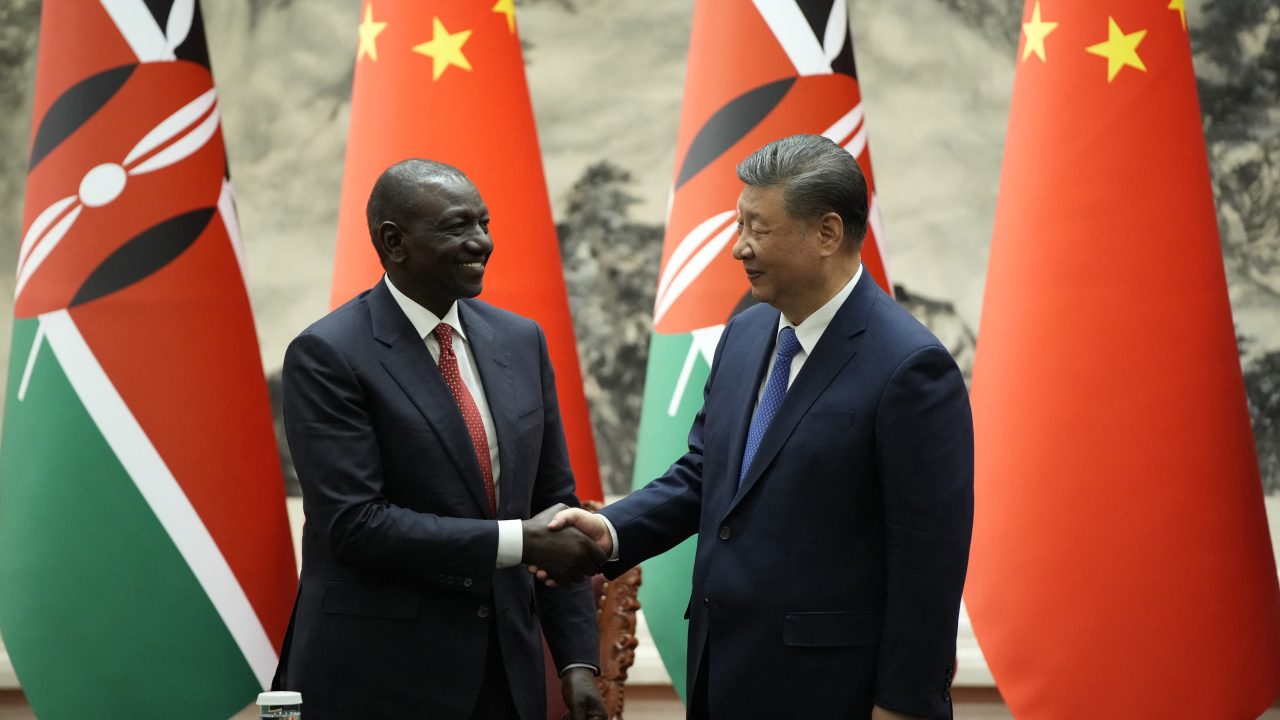
Kenya’s technology policy has coevolved through its partnership with Huawei. One study found that companies like Huawei have played a key role “circulating ideas and best practices around smartness” in Kenyan cities. The 2022 Kenya National Digital Master Plan, which states that Kenya will increasingly integrate intelligence capabilities into its surveillance system, was created with input from Huawei. Kenyan President William Ruto signed a memorandum of understanding with Huawei in 2023 to promote digital transformation. This spring, the Kenyan government announced its new AI plan — the Kenya AI & Cloud Pioneer Initiative — at a conference hosted by Huawei. In April 2025, Kenya joined China’s Group of Friends for International Cooperation on AI Capacity Building, which supports China’s Global AI Governance Initiative.
How future collaboration between Huawei and the Kenyan government impacts AI governance in Kenya remains to be seen. So far, the success of these systems has been exaggerated. While Huawei claimed that crime decreased by 46% between 2014 and 2015 in areas where its safe city infrastructure was deployed, data from Kenya’s National Police Service found that the reduction in crime during that time was much smaller and actually increased to pre-installation levels by 2017. Reflecting on this data, one expert concluded that the safe city infrastructure in Kenya is less about preventing crime and “more about the promotion of a specific vision of a digitized urban environment and the need for pervasive surveillance over the population.”
When Deputy President Kindiki met with Huawei last week, they clearly didn’t exchange empty words. The “shared vision” is behind them as much as it is ahead.







Leave a Reply