
On Monday, lawmakers and officials from the Chinese Nationalist Party (KMT) met with staff at the American Institute in Taiwan (AIT), including director Raymond Greene. The meeting lasted for 90 minutes, not the 20 minutes that had been reported by Taiwanese English-language newspaper Taipei Times. AIT is the de facto U.S. embassy in Taiwan.
“Director Greene welcomed the delegation and led the first segment of the 90-minute discussion, whereafter AIT technical experts continued the briefing on specific topics,” an AIT spokesperson told Domino Theory.
AIT had initially revealed the meeting on their Facebook page on Monday, saying that: “We appreciate the KMT’s continued partnership in enhancing Taiwan’s national security and whole-of-society resilience and we welcome a continued strong commitment from all parties to enhancing Taiwan’s defense reforms and expenditures.”
The KMT followed this on their own Facebook with a statement: “The KMT has always actively promoted defense resilience, actively monitored the progress of national defense implementation in all aspects, supported the defense budget to reach 3.5% of GDP, and insisted on safeguarding the rights and interests of friends in the military.” Facebook is an important tool for political communication with the public in Taiwan.
After AIT posted the picture of the meeting, Democratic Progressive Party (DPP) lawmaker Rosalia Wu (吳思瑤) said that the participants looked awkward and serious, and pan-Green online tech commentator Hsu Mei-hua (許美華) speculated that AIT had “stepped in to confront the KMT,” adding: “Their purpose was clear: to ensure that both the ruling and opposition parties in Taiwan would strengthen their national defense.” This sparked a wave of contentious domestic coverage.
One of the KMT officials present at the meeting, director of international affairs Alexander Huang (黃介正), posted on Facebook on Wednesday that the meeting had been “candid and business-like.” Domino Theory contacted Huang’s office and those of several KMT lawmakers present at the meeting for comment but was declined in all cases.
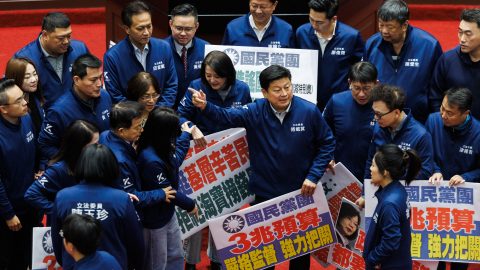
After Taiwan’s KMT-controlled parliament cut and froze a substantial part of Taiwan’s defense budget back in January, American senators voiced their disapproval at the confirmation hearing of undersecretary of defense for policy Elbridge Colby. Dan Sullivan, a Republican, directly criticized the KMT, saying it was “playing a dangerous game.” Angus King, an independent, said it was “disturbing to me that in recent months the parliament of Taiwan has moved to cut their defense plan.”
This came after the KMT had sent a delegation to Washington in February to explain the KMT’s position on national defense. That delegation included Alexander Huang, as well as legislator Richard Chen (陳永康), who both attended Monday’s meeting with Greene.
Despite continued efforts, the KMT has been unable to throw off the perception that it is weakening Taiwan’s defense through its actions in Taiwan’s parliament. This has endured despite the unfreezing of the majority of the defense budget in June.
Eric Chu (朱立倫), the outgoing party chairman, has now committed the KMT to supporting spending 3.5% of GDP on defense, as long as it is beneficial to the country. That is substantially more than the 2.38% that Taiwan spent this year. Hsu Chiao-hsin (徐巧芯), a KMT legislator who has been criticized for being weak or even dangerous on defense in the past, said on Facebook that Monday’s meeting, which she attended, was meaningful and she hoped it would help replace rumors and division with mutual understanding.
Sense Hofstede, the author of De Chinese Wouden, a Dutch-language newsletter on Taiwan and China, told Domino Theory via a direct message exchange that Hsu’s post on Facebook highlights that “the KMT feels misunderstood and misrepresented in the U.S. when it comes to its support for Taiwanese defence spending.” But he warned that the KMT “cannot blame the lack of trust in its intentions among US interlocutors on DPP ‘fake news’ entirely. In fact, such attempts to blame genuine concerns on misunderstanding and fake news might only signal to American counterparts that their concerns are not taken seriously.”
The defense meeting between Greene and the KMT lawmakers on Monday was not the only such event. AIT announced on the same day that Greene had met with defense minister Wellington Koo (顧立雄) the previous week, to discuss “the continued fulfillment of our commitments consistent with the Taiwan Relations Act to bolster Taiwan’s defense capabilities,” and “further U.S.-Taiwan cooperation in traditional and asymmetric military deterrence as well as societal resilience.”
On Wednesday afternoon, both AIT and the Taiwan People’s Party (TPP) announced that Greene had met with TPP Chairman Huang Kuo-chang (黃國昌). AIT said the two discussed “U.S.-Taiwan cooperation on economic, defense, and whole-of-society resilience issues.” The TPP specified that topics included “national defense resilience, U.S.-Taiwan tariff issues, judicial reform, and domestic politics.”
U.S. Senators Roger Wicker and Deb Fischer, both Republicans, are due to visit Taiwan in the next few days, as part of a longer trip to many Indo-Pacific destinations. Wicker is the chairman of the Senate Armed Services Committee. His visit follows reporting last month from the Financial Times that the U.S. had canceled a planned meeting in “the Washington area” between Koo and Elbridge Colby due to concerns it would impact trade negotiations with China.



Leave a Reply