
In Taiwan, December 25 is a national holiday, but officially, it’s not for Christmas. The date marks the 1947 adoption of the Republic of China’s constitution, a heavily amended version of which still governs the island today.
So when a group of constitutional scholars gathered at Academia Sinica, Taiwan’s premier research institution, on Thursday, they were there to discuss salvation — not of souls, but of Taiwan’s democracy.
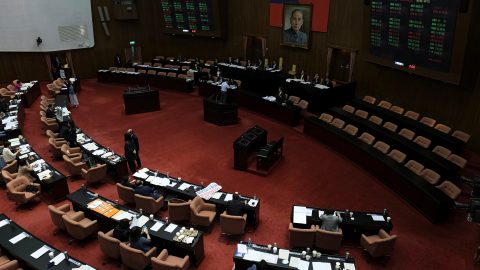
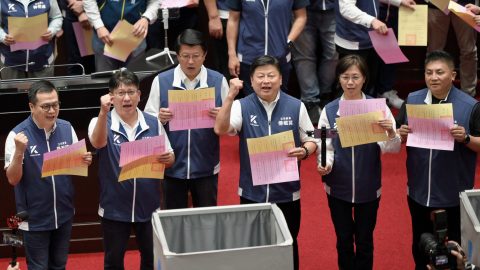
Taiwan’s long-simmering constitutional crisis has quickly escalated since last week, when the executive branch, which is controlled by the Democratic Progressive Party (DPP), refused to co-sign amendments to a spending bill passed by the legislature. In retaliation, the legislature, which is controlled by a slim majority coalition of the Chinese Nationalist Party (KMT) and the Taiwan People’s Party (TPP), has threatened Premier Cho Jung-tai (卓榮泰) with a vote of no confidence and President Lai Ching-te (賴清德) with impeachment.
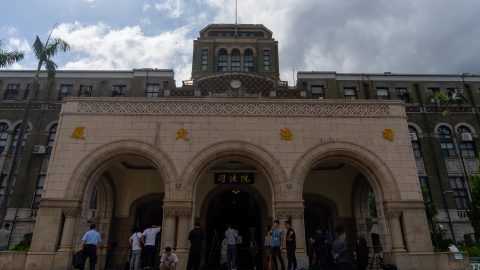
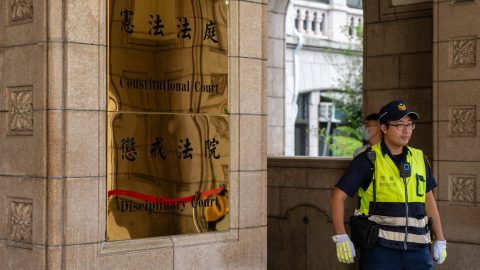
Caught in the middle is Taiwan’s Constitutional Court, “the combat veteran of Taiwan politics,” as Yung-djong Shaw (邵允鍾), assistant professor at Academia Sinica, described it. The court successfully mediated inter-branch conflicts during Taiwan’s other era of divided government, from 2000 to 2008. But the experts assembled on Thursday agreed that this crisis is different. “Unprecedented” was a common refrain. So was “backsliding.”
Chun-yuan Lin (林春元), professor at National Taiwan University’s College of Law, said that he hadn’t been able to find useful comparisons for the crisis, neither in Taiwan’s history nor elsewhere. “Most countries who are labeled as democratic backsliding usually are led by a powerful leader,” he said. “But in Taiwan it’s different. Our so-called constitutional crisis was initiated by legislative power.”
Shaw, the Academia Sinica professor, described the beginning of the crisis as a “one-two punch” from the legislature.
First, the legislature refused to approve any of President Lai Ching-te’s (賴清德) nominees for the Constitutional Court. The 15-seat court has had only eight justices since the end of Lai’s predecessor Tsai Ing-wen’s (蔡英文) second term, when the seven others reached their term limits. Lai has twice proposed a list of replacements only to be rejected both times.
KMT and TPP lawmakers then passed an amendment to the Constitutional Court Procedure Act, raising the quorum threshold for issuing judicial decisions to 10 justices. With only eight justices on the court and the legislature refusing to confirm nominees for the remaining seats, the courts were effectively paralyzed.
Last Friday, five of the eight justices came together to rule that the quorum amendment was unconstitutional, effectively reviving the Constitutional Court after more than a year of inaction. The three others sat the deliberations out. KMT and TPP legislators are now advancing a motion to officially censure the court for its decision.
A group of nearly 300 legal scholars and academics has signed a statement endorsing the justices’ overturning of the quorum threshold, saying it was a necessary step toward restoring Taiwan’s democracy. The attendees of Thursday’s legal conference overwhelmingly agreed.
But they also argued that the crisis’s causes are too fundamental for one court decision to fully address. “Restoration of the Constitutional Court alone cannot solve the problem,” said Chang Chia-yin (張嘉尹), a Soochow University professor who has publicly endorsed Premier Cho’s decision not to countersign the legislature’s budget bill.
To Lin, the source of danger traces back to the 1990s, when a series of constitutional reforms transformed Taiwan from a one-party state into a functioning democracy. With martial law and the dictatorship of Chiang Kai-shek (蔣介石) still a recent memory, Taiwan’s democratic reformers sought to empower the legislature to check the executive. But now, the legislature has become too powerful, Lin said.
Near the end of Taiwan’s previous era of divided government, in 2007, the KMT-led legislature rejected four of DPP President Chen Shui-bian’s (陳水扁) eight nominees for the Constitutional Court. Those seats were filled the next year after the KMT retook the presidency. Shaw said that one reason the court was able to survive that era was that the legal establishment at the time was far more sympathetic to the KMT than they are today.
The court may also have weakened itself. “The [Constitutional Court] had cultivated strong public support before it entered the first period of divided government,” Shaw writes in a paper he submitted to the conference along with his co-author Su Yen-tu (蘇彥圖), a research professor at Academia Sinica. The court won support by issuing decisions that were “democracy-reinforcing” and socially conservative, they argue.
“By sharp contrast, the TCC has become a hero to some and a villain to others after it ruled for same-sex marriage in 2017 and invalidated the criminal punishment of adultery in 2020,” they write, referring to the Taiwan Constitutional Court. “Its death penalty decision of 2024, though falling short of holding [the] death penalty unconstitutional per se, has further weakened the public support for the [TCC] a month before it ruled to reign in the overreach of the parliamentary powers.”
Su says that with the court in a weak position, the legislature’s tactics have intensified, a shift he attributes to KMT’s struggles in recent national elections. “They lost five out of the seven last presidential elections. They are not so sure that they can retake the presidency, and so they are more willing to constrain or to dilute the presidential prerogative,” he said. “They want to change the whole rules of the game.”
The conference was long on analysis but short on recommendations. But Su did suggest a concrete change: Strengthen the president’s veto power. With the legislature able to override the president’s veto with a simple majority, it is far too easy for them to bully the other two branches, he says.
But in the current gridlock, Su thinks saving Taiwan’s constitution might require unconstitutional measures. “Sometimes you just need to do the wrong thing in order to do the right thing,” he said.



Leave a Reply