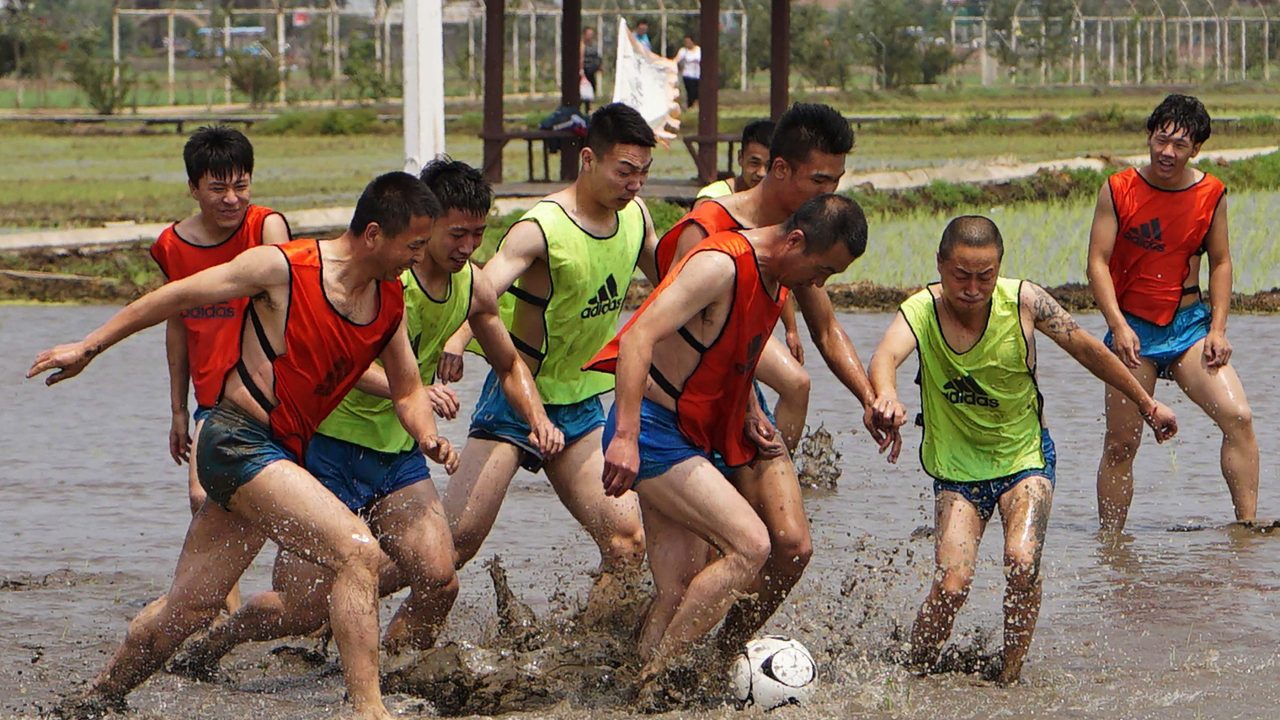
In the 1980s, waves of political activism emerged alongside economic liberalization in post-Mao China. In the northeast city of Shenyang, however, students seemed to prefer soccer to politics.
That changed in April 1989 when Hu Yaobang (胡耀邦), the pro-reform politician who had been ousted from his post as Chinese Communist Party general secretary, died. His death triggered student-led protests in Beijing that spread across China, even to its more distant and conservative regions. “The Democracy Movement in Shenyang can be considered a barometer of how widespread dissatisfaction had become in Chinese urban society by 1989,” Asia security analyst Shirley Kan wrote in November of that year, based on first-hand observations of the protests. She noted that Shenyang “came alive with a force once inconceivable” as people “took on a passion for something other than soccer.”
Even so, soccer still surfaced in the democracy movement in Shenyang, which Kan, who later worked at the Congressional Research Service, calls the “Shenyang Spring.” Nine days before the People’s Liberation Army killed hundreds, maybe even thousands, in the Tiananmen Square massacre, students in Shenyang distributed a “Sports News” flyer that used a soccer game as a metaphor to describe their movement. The flyer offers a glimpse into how students interpreted tensions within the Communist Party over reform, as well as their confusion about who exactly the Chinese military was loyal to.
Student activists in Shenyang followed the lead of their counterparts in Beijing, who they heard from via phone calls, faxes and foreign broadcasts. Around mid-May, the movement in Shenyang finally picked up speed, gaining tens of thousands of protesters each day. On May 18, over 100,000 people marched. “For brief moments, individual Shenyang citizens considered themselves important members of China for once,” Kan wrote.
On May 20, martial law was declared in Beijing, creating uncertainty about the future of the movement around the country, and protests in Shenyang sputtered. Students at Shenyang Education College distributed the flyer on May 26 to describe the state of play. On one side of the soccer field, the “Despots” were led by paramount leader Deng Xiaoping (鄧小平). On the other side, student activists in Beijing spearheaded team “Democrats,” which included Zhao Ziyang (趙紫陽), then-general secretary of the Chinese Communist Party, who was sympathetic to the protesters. The flyer said that Zhao had been “kicked and injured” so he left the field.
On the Despots team, Li Peng (李鵬), then-premier of China, was given a “yellow card, warning of foul language and rough behavior. He also had an attitude problem and could be expelled from the field,” the flyer said. Li championed the hard-line stance against reform and was competing with Zhao, a moderate, for influence within the party, under the ultimate authority of Deng. Observers thought that Li’s enormous unpopularity among the public would make him vulnerable to being removed, according to a report published by The New York Times on the same day.
“The college students perceptively linked the pro-democracy movement to the [Chinese Communist Party’s] internal power struggle,” Kan wrote in an email to Domino Theory. Kan was surprised by the incisiveness, given the taboo of party politics and Shenyang’s distance from the capital.
The People’s Liberation Army served as the referee but was making calls that sided with the Despots team. Kan said that assigning the military an ostensibly neutral position reflected “the ambiguity and questions about the PLA’s role at the time.” Students, including those who made the flyer in Shenyang, were asking a range of questions about the military, according to Kan: whether it obeyed military or political leadership, whether some units were more sympathetic to students, whether soldiers would be speedy or slow to follow orders, whether units from outside Beijing would intervene, and whether it would use force or just show its presence.
“Victory [for the Democrats] is within reason,” the flyer said in closing.
After the Tiananmen Square massacre on June 4, the democracy movement in Shenyang picked up for about four days. Slogans became “Strangle Li Peng!” and “Chop up Deng,” according to Kan’s account. But the student leaders soon decided to dissolve the movement rather than risk violence. Zhao was formally dismissed from his position weeks later on June 24.
David Perdue, the U.S. ambassador to China, was in Shenyang this week to celebrate the 250th birthday of the United States. “Two and a half centuries ago, America’s revolutionary vision for freedom changed the entire world,” Perdue wrote in Chinese on X. “This year has been a great one too, because once again we’ve changed the world by rebuilding a fair and equal relationship between the United States and China.”
Thirty-seven years ago, protesters in Shenyang had a vision for freedom, too.







Leave a Reply