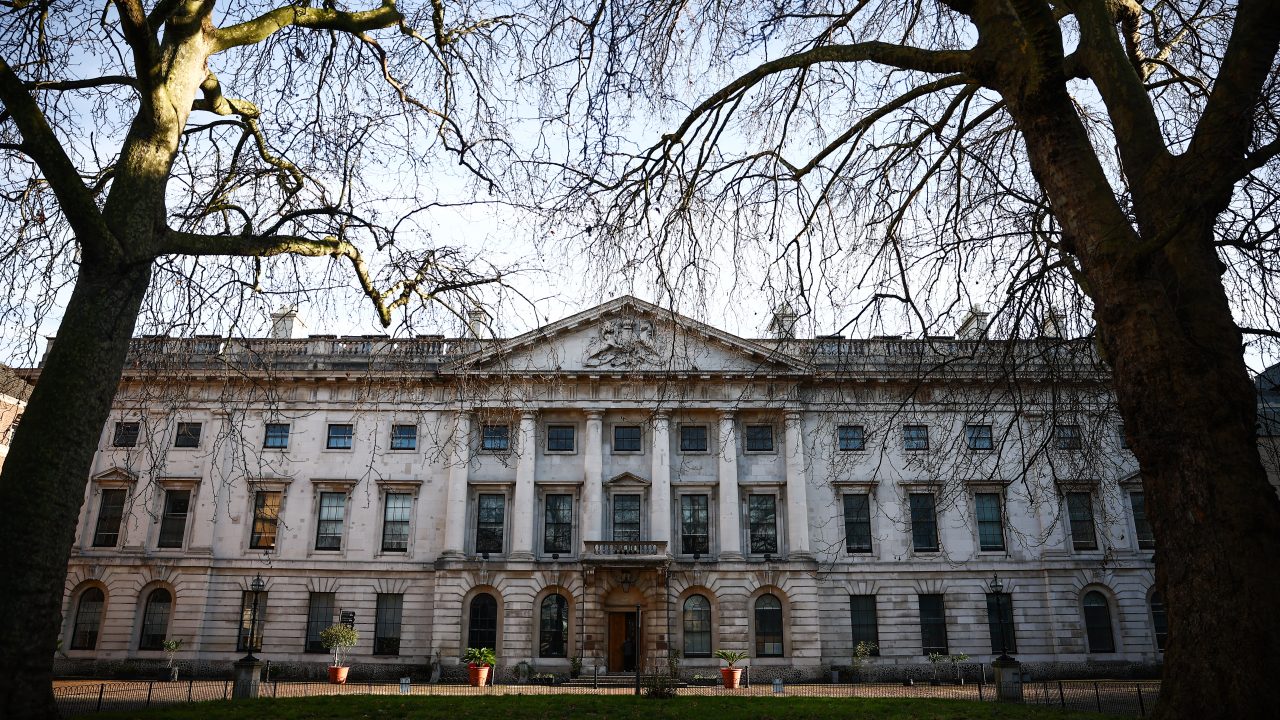
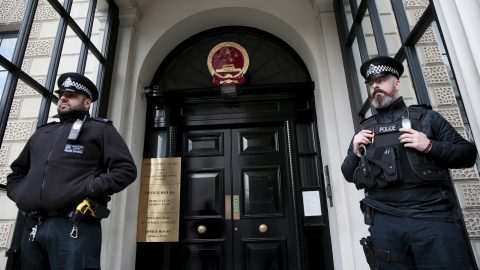
Security guards at the Chinese Embassy in London appeared to threaten protesters outside of their premises with electroshock weapons.
A video obtained by The i Paper and published last week shows security guards, standing behind a gate, waving the batons at protesters carrying the old British Hong Kong flag. The protesters were marking the death of a Tibetan activist who self-immolated in New York. The incident took place on July 3.
In a second incident, which happened in May, a security guard waved a similar baton at intruders at the Royal Mint site, where China’s new “mega embassy” will be built. This was reported on Wednesday by The i Paper.
“These weapons are illegal” in the U.K., Alicia Kearns, the Conservative shadow minister for national security, wrote on X.
British police cannot enter foreign embassies without an invitation, and foreign diplomats have immunity from prosecution in most circumstances. Speaking on the Today program on Radio 4 on August 29, Kearns pointed out the Chinese government still has to observe British laws, and “cannot abuse diplomatic bags or the personal baggage of diplomatic agents to bring in prohibited weapons.”
Kearns has written to the security minister asking if the U.K. government has authorized the Chinese embassy to possess electroshock weapons, and if not, how the government believes the embassy acquired them, and what action it might take. All of this is preceded by a crucial “if confirmed.”
The new Chinese mega embassy has been opposed for many reasons, but among them was the presence of grayed-out areas in the basement that the Daily Mail described as potential “spy dungeons.” When then-housing minister Angela Rayner asked for an explanation, a representative for the Chinese government said it was neither “necessary or appropriate to provide full internal layout plans.”
In 2022, a protest outside the Chinese consulate in Manchester descended into violence after consulate staff, including the consul general, Zheng Xiyuan (鄭曦原), attempted to take the protesters’ banners. In the ensuing melee, staff and protesters were both physically assaulted.
Police ultimately did enter the property to remove one protester who was being beaten near the gate inside.
The U.K. requested six officials from the consulate waive their right to diplomatic immunity so the police could question them. China subsequently recalled all six to Beijing without allowing any interviews. Kearns, who was chair of Parliament’s Foreign Affairs Committee at the time, tactfully said the six had “fled the UK like cowards.”
Kearns is one of a number of China hawks who still hold sway in the Conservative Party. Another is the man who was security minister at the time of the Manchester incident, Tom Tugendhat, who became the new shadow foreign secretary two days ago.
Only one day into the job, Tugendhat posted this on X:
“China threatens our security and democracy. Standing with partners protects us all. I’ve been in Taiwan where they’re on the frontline and we have much to learn. Will [Foreign Minister Ed Miliband] look for real partners and visit Taiwan or continue turning to China?”
Not all parties are as China-skeptic.
On July 6, which, to be clear, is two months before the news about the alleged electroshock weapons was reported, the Chinese Embassy held an event called “The Communist Party of China and the World.” Ambassador Zheng Zeguang (鄭澤光) told the audience that the party has “remained committed to the pursuit of truth, stayed deeply rooted in the people, courageously shouldered its historical missions, followed the trend of the times, dared to fight and fight well, and continued to strengthen itself.”
He added that closer dialogue and cooperation between China and the U.K. serves the interests of both countries and the wider world.
Among the guests were such political luminaries as Alex Gordon, the general secretary of the Communist Party of Britain; Andy Brooks, the general secretary of the New Communist Party of Britain; and Daniel O’Brien, vice chair of the Communist Party of Great Britain (Marxist-Leninist).
But it was also attended by Mark Hendrick, the Labour vice chair of the China All-Party Parliamentary Group, which is a group of legislators with an interest in China-U.K. ties.
Hendrick’s attendance is recorded in the write-up of the event by Friends of Socialist China, a British Marxist organization dedicated to “supporting the People’s Republic of China and promoting understanding of Chinese socialism.” Friends of Socialist China says Hendrick contributed to the discussion.
Kerry Brown, director of the Lau China Institute at King’s College London; Stephen Perry, honorary president of the 48 Group Club; and Keith Bennett, co-editor of Friends of Socialist China and vice chair of the 48 Group Club, were also in attendance.
“[H]ow to inherit the red gene, amidst once in a century changes unfolding at an accelerating pace, is a crucial question that Xi Jinping Thought on Party Building addresses,” Bennett opined to the audience.
Whether Hendrick was making notes to share with his comrades in the Labour Party as well as his cross-party colleagues in Parliament as a whole is not recorded. His office did not respond to a request for comment.



Leave a Reply