
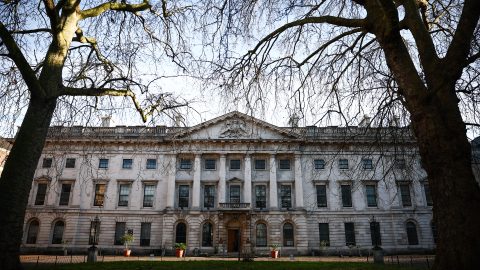
Three Black Plague mass burial trenches. A Cistercian monastery. The British army’s weapons store. The Royal Mint. And now, a Chinese embassy.
If approved by Prime Minister Keir Starmer’s government, this five-acre compound located in the heart of London would become the largest embassy in Europe. It would be 18% larger than the American embassy in Nine Elms and bigger yet than the Chinese and British embassies in Washington.
Peter Golds, a locally elected Tower Hamlets councillor representing the Isle of Dogs, asked this reporter to imagine someone emerging from Tower Hill Station. “They see the Tower of London. The next thing they see is this humongous Chinese flag flying right by the Tower Bridge,” he said. “Can you imagine what would happen if the Chinese proposed a mega embassy next to the Smithsonian?”
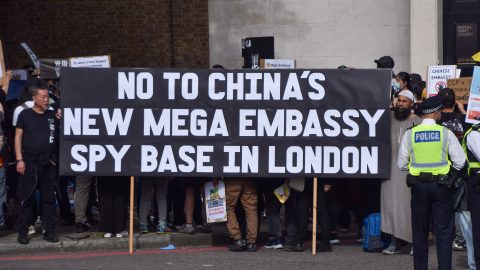
The local Tower Hamlets Council rejected China’s proposal to build an embassy here in 2022 and then again in 2024, citing concerns about heritage assets, traffic congestion and terrorism. But Starmer’s government “called in” the application last year and now retains authority over the final decision. Starmer has taken a noticeably softer stance on China compared to his predecessors, creating the impression that there is a good chance he will approve the embassy.
Still, Starmer needs to weigh several factors beyond the typical city planning considerations, not the least of which is national security. “In a situation like this, the government is going to be taking advice from the intelligence agencies about whether the new location in itself is a heightened security risk, and then the fact that the size of it is a security risk,” said Sir Mark Lyall Grant, former national security advisor to David Cameron and Theresa May.
The arguments voiced by opponents of the embassy are well circulated in the media. Its unprecedented scale could potentially accommodate more diplomatic staff, and therefore more spies. And the Royal Mint Court sits right next to a telephone exchange, which convenes a dense network of underground cables, including ones that carry sensitive information between the City and Canary Wharf, London’s two major international financial centers. The problem, for the public at least, is that the criticism typically does not get more granular than this.
Perhaps this is because a general — yet not necessarily unwarranted — fear of the Chinese government seems to influence the perception of the embassy. China is “a vast world power. A huge world power. Wishes to be the world power,” Golds said. He described a Tower Hamlets meeting when a man who “couldn’t” identify himself mysteriously appeared and said he had concerns about China “listening in.”
Intelligence experts interviewed for this story acknowledge the risks but say they can be mitigated. To say “you can’t do this, because basically, China’s an evil country that oppresses its people — it’s not in keeping with the international regulations on this,” said Tim Law, deputy director of UK-China Transparency and former British defense attache in Beijing.
China has a right to a diplomatic base under the United Nations Vienna Convention on Diplomatic Relations. And the experts interviewed seemed to agree that China needs a new embassy in London. “The one [China has] got currently in London is simply not fit for purpose. I’ve been in it many times. It’s not big enough, it’s not modern enough. It doesn’t have the sort of facilities that a modern embassy really needs to have,” said Nigel Inkster, senior advisor to the International Institute for Strategic Studies and the former assistant chief and director of operations and intelligence at MI6.
Even so, building plans for the embassy show that there will be 200 rooms designated as living quarters for staff. And this has spooked people, including an anonymous source who told the Daily Mail that the new embassy would become “a student-style campus for spies.”
But a bigger embassy doesn’t necessarily mean more staff, said Law. There are currently 142 Chinese diplomats in the U.K. He thinks that if additional staff are approved, it would be on a case by case basis.
And for a couple reasons peculiar to China, more diplomatic staff would not necessarily mean more spies. First, China does not employ local staff on its diplomatic premises, Inkster said. Everyone from Ministry of State Security officers to the “cooks and bottle washers” are brought in from China. “So inevitably, there’s going to be more demand for diplomatic accommodation than would be the case for, say, the United States or the U.K. overseas, where much more use is made of locally engaged staff.”
Second, most Chinese human intelligence collection is not conducted out of embassies, according to Inkster. “Most of the problematic espionage directed by China against the U.K. comes either in the cyber domain or through the deployment of natural cover officers or illegals [spies who operate without official diplomatic cover]. And they’re not, by definition, going to be connected with an embassy.”
“MSS and PLA legal residencies don’t appear to be engaging in very extensive espionage in the way that in the past, for example, Russia has tended to do,” Inkster added, using the acronyms for the Chinese Ministry of State Security and People’s Liberation Army.
Law agreed, noting the 2017 National Intelligence Law — which requires all organizations and citizens to cooperate with Chinese intelligence work — and the many Chinese spies in the U.K. under journalistic and business cover. “It’s a bit of a red herring saying, just because they’ve got an embassy that’s bigger and more swish, they’re going to be able to do more intelligence work.”
Even so, a large, centralized location for diplomatic operations could aid China’s U.K. mission by facilitating coordination between different offices, Law said. At the moment, China only has several small diplomatic premises scattered across London.
China has been known to use its diplomatic apparatus to take advantage of the open environment to quietly serve the party’s interests. The Center for Security and Emerging Technology published a study in 2021 that highlighted the role of Chinese “science and technology diplomats” in surveilling foreign, sensitive technologies and brokering their acquisition. While much of this work occurred at China’s consulate in Houston before it was shuttered in 2020, the study identified the U.K. as another main target.
Beyond size, the other major risk associated with the Royal Mint site is proximity to key communications infrastructure. “It is a fact that there is one data center quite close to this site, and there’s two a little bit further away. It’s a fact that fiber optic cables run beneath the streets pretty much right by or underneath that compound, and it’s a fact that there’s a public telephone exchange pretty much on the site itself,” said Tim Stevens, head of the Cyber Security Research Group at Kings College. “They could all potentially be exploited by China.”
Near a telephone exchange, cables converge. If China could somehow gain physical access to these cables, it could install a tap and “suck up all the data that’s transferring across them,” said Stevens. The risk might be particularly acute during construction, when there is a pretext for altering the embassy’s basements in such a way that helps China move horizontally toward London’s underground infrastructure.
If successful, the tap could be used to gain access to sensitive financial information or to train AI models about what people in London are doing and thinking, said Stevens.
While China is already extremely effective at extracting information remotely from the global internet, “most companies and government agencies notice … when you start exfiltrating those huge data volumes, and the alarm bells go off,” said Stevens. But passive data collection through a physical tap is different: “Nobody notices. For the most part.” Although there are anti-technologies for fiber optics, they’re not 100% effective.
Inkster acknowledges this cyber risk but he thinks the U.K. is aware of and resilient to it. “I would expect [U.K. authorities] to be looking out for evidence that such activities are taking place. I think if China were to be called out doing something like this, there would be significant political embarrassment and ramifications,” said Inkster.
“Once you’re aware of the risk, you know where to look. That already constitutes a significant element of deterrence.”




Leave a Reply