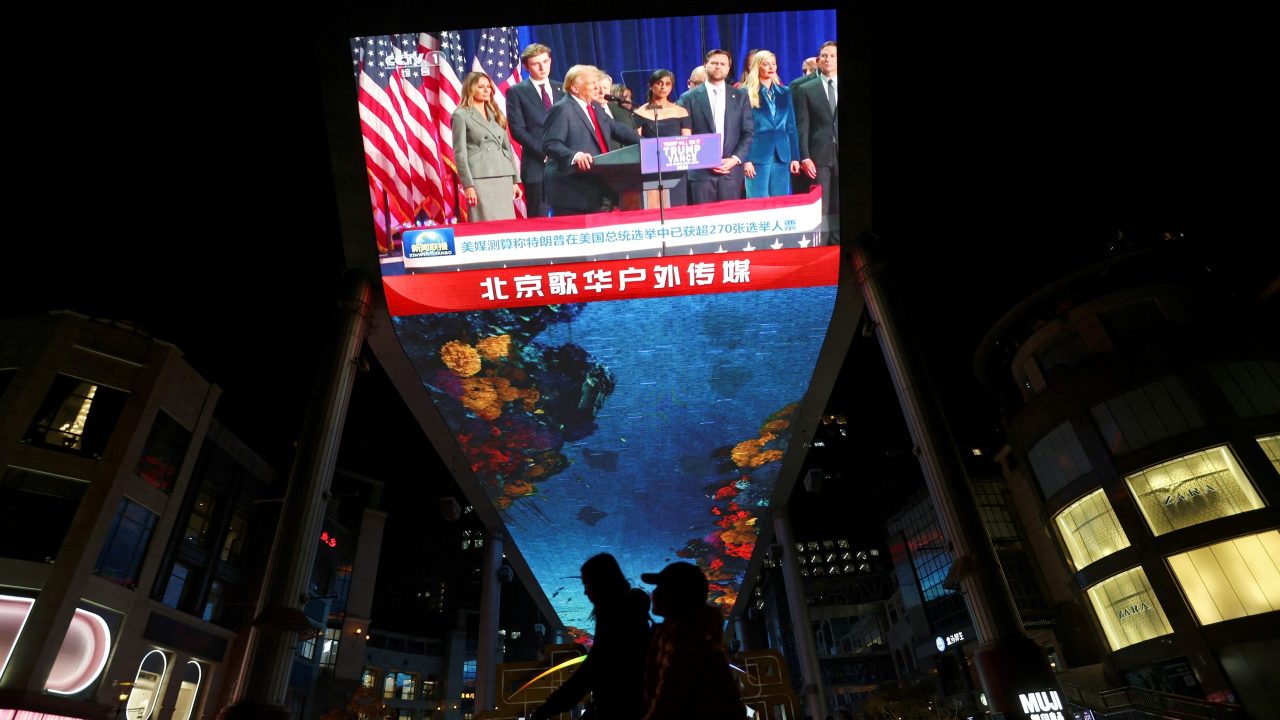
The United States’ prominent role in global affairs makes its elections a focal point worldwide, shaping the future of American politics and influencing international dynamics. In the Chinese-speaking world, Taiwan — a young democracy — closely observes American democratic practices, monitoring each election cycle to gauge the strength of American support. Meanwhile, China, as America’s primary geopolitical competitor, actively promotes its political agenda during U.S. elections. As a result, discussions about U.S. elections within the Chinese-language information environment reveal prevailing perceptions of the U.S. and attitudes toward American democracy.
Observing these discussions highlights the discrepancies between U.S. domestic policy priorities and their perception abroad. To advance China’s political agenda, Chinese media often underscores perceived flaws in American democracy, framing the U.S. as a nation that “prioritizes interests over values.” American politicians’ actions and rhetoric during election cycles frequently serve as key material for information manipulation.
Distinct Perspective to U.S. Elections in Chinese-Language Information Environment
The Taiwan Information Environment Research Center (IORG), a Taipei-based civil society organization, published an analysis of discussions about U.S. elections in the Chinese-language information environment from April 2021 to July 2024. Three key periods saw heightened attention: the November 2022 midterm elections, the presidential primaries from January to March 2024, and a series of election-related events from June to July 2024. They include the first presidential debate, an assassination attempt on Donald Trump, Trump’s interview with Bloomberg and Joe Biden’s withdrawal from the presidential race. Similar to the concerns expressed in U.S. polls, economic issues were among the most frequently mentioned topics on platforms widely used by Taiwanese (Facebook, Taiwanese news media, YouTube) and Chinese audiences (Chinese state media, Weibo, Douyin).
Unlike the policy priorities of American voters, topics related to diplomatic and foreign affairs appeared more frequently in the Chinese-language information environment, according to IORG research, than domestic issues such as abortion, crime, healthcare, race and climate change, which are of greater concern to American voters. This pattern suggests that external perspectives often emphasize international issues — diplomacy, war and trade — over concerns of domestic affairs. Additionally, there appears to be an ideological leaning in the Chinese-language discussions about U.S. elections. Topics commonly prioritized by conservative voters, including the economy, immigration, crime and diplomacy, are more prominent than issues typically emphasized by liberal voters, like abortion and healthcare. Whether Chinese speakers are more inclined toward conservative issues is thus an intriguing question for future research.
Chaotic American Democracy
A recurring theme in Chinese-language discussions about American elections is the portrayal of “chaotic American democracy.” According to the IORG report, topics like “populism” and “political violence” frequently surface in these discussions. Within the Taiwanese information environment, there was a greater focus on U.S. electoral institutions, whereas Chinese sources emphasized issues like money politics and social rifts within U.S. elections.
These themes echo longstanding critiques China has directed at “American democracy.” Since Hu Jintao (胡錦濤) introduced the concept of “confidence in system,” his successor Xi Jinping (習近平) and the Chinese Communist Party (C.C.P.) have actively promoted the “institutional advantages of socialism with Chinese characteristics,” portraying Western democracy as corrupt, ineffective, unrepresentative, chaotic and divisive. The close ties between American politicians and wealthy donors further support this narrative, casting American democracy as dominated by elites of interest groups, rather than one that serves the public good.
The C.C.P. also argues that “U.S. is not democratic” by underscoring how populist politicians employ polarizing rhetoric to win votes and by highlighting deepening social rifts and political violence, citing events like the January 6 Capitol riot and an assassination attempt on Donald Trump.
Interests Over Values
Another prevalent narrative about U.S. elections in the Chinese-language information environment is that the U.S. and its politicians prioritize “interests” over “values.” This viewpoint suggests that U.S. competition with the People’s Republic of China and support for Taiwan are driven purely by national interests — using the “Taiwan card” as leverage against China — rather than by a commitment to shared democratic values between America and Taiwan. It implies that the U.S. might exploit Taiwan as a “pawn,” destroy Taiwan or even abandon Taiwan if it aligns with its strategic interests.
At a personal or partisan level, this narrative suggests that American politicians’ support for Taiwan is often motivated by electoral or personal interests. This perception gained traction when figures like Mike Pompeo, Nancy Pelosi and Kevin McCarthy announced plans to visit Taiwan, actions viewed by some as politically motivated rather than principled. Transactional rhetoric, such as Trump’s suggestion that “Taiwan should pay the U.S. for protection” and Vivek Ramaswamy’s proposal to defend Taiwan “until the U.S. achieves semiconductor independence,” further reinforce this narrative.
There also appear to be contrasting preferences between “interests” and “values” within the Taiwanese and Chinese information environments, according to the IORG report. In Taiwanese discussions, terms like “democratic values” and “democratic alliance” are commonly used, highlighting shared ideals and solidarity with democratic nations. In contrast, phrases such as “personal interests” and “party interests” dominate the Chinese information environment’s discourse on U.S. elections, reflecting a focus on the perceived self-serving nature of American politics. This distinction aligns with Chinese state rhetoric portraying the C.C.P.-led system as upholding a “people-centered philosophy” focused on the welfare of its citizens, in contrast to what it describes as the U.S. system’s focus on “electoral politics and partisan interests.”
Impacts of American Politicians’ Words
On the surface, Chinese officials have consistently maintained a neutral stance on U.S. elections, particularly when faced with accusations of interference from American politicians. For example, in 2018, Chinese Foreign Minister Wang Yi (王毅) dismissed Donald Trump’s claims that China was meddling in the U.S. midterm elections. However, Beijing sometimes criticizes American politicians for “making China an issue” in their campaigns or for meddling in China’s “domestic affairs.” When Bernie Sanders, during his presidential campaign, stated he would not “sit by” if the P.R.C. invaded Taiwan should he be elected president, a spokesperson from China’s foreign ministry responded by calling for non-interference in internal matters, such as Taiwan.
Although the Chinese-language information environment may not show a clear preference for either the Republican or Democratic parties or their candidates, it often emphasizes controversies and perceived weaknesses of these politicians to underscore flaws in American democracy. According to the IORG report, Trump’s personality and legal issues, as well as concerns about Biden’s age and governance capabilities, are common focal points in Chinese-language discussions of presidential candidates, whereas candidates’ specific policy positions receive less attention.
Chinese state media occasionally amplifies specific actions or statements by American politicians to further its agenda. For example, Speaker Pelosi’s 2022 visit to Taiwan became a viral topic on Chinese state media as IORG research shows, while other Chinese-language platforms did not see the same surge in coverage. C.C.P. outlets, such as the People’s Daily, criticized Pelosi’s visit as a tactic aimed at gaining votes in the upcoming midterms. Similarly, from June to July 2024, Trump’s interview with Bloomberg became the most-discussed topic on Chinese state media, while other platforms focused more on events like the assassination attempt on Trump and Biden’s withdrawal from the race. In the interview, Trump suggested that Taiwan took the semiconductor business from the U.S. and should pay America for protection, without committing to sending troops to defend Taiwan. These cases suggest that the C.C.P. may selectively amplify U.S. election issues to portray America as “using Taiwan to contain China” or to cast doubt on the U.S. commitment to Taiwan’s defense.
Conclusion
The founders of the United States described American democracy as an “experiment,” acknowledging its potential imperfections. Yet, much like the “Kitchen Debate” between the U.S. and the Soviet Union during the Cold War, a new contest over political systems has emerged between the U.S. and China. As the U.S. and other democracies criticize China for its lack of democracy and human rights abuses, the C.C.P. counters with a form of “whataboutism,” reminiscent of Soviet-era arguments, in this ideological rivalry. To highlight the “advantages” of the C.C.P. system, Chinese propagandists often critique Western democratic values, pointing to perceived chaos and an “interests over values” approach in American politics. These narratives resonate within the Chinese-speaking world, particularly in Taiwan — a frontline of the U.S.-China competition — where they blend truth and disinformation. Democracies must remain vigilant against these narratives, as they risk fostering anti-American and anti-Western sentiments.
Yang Kuang-shun is a researcher of Taiwan Information Environment Research Center (IORG) and co-founder of U.S.-Taiwan Watch.






Leave a Reply