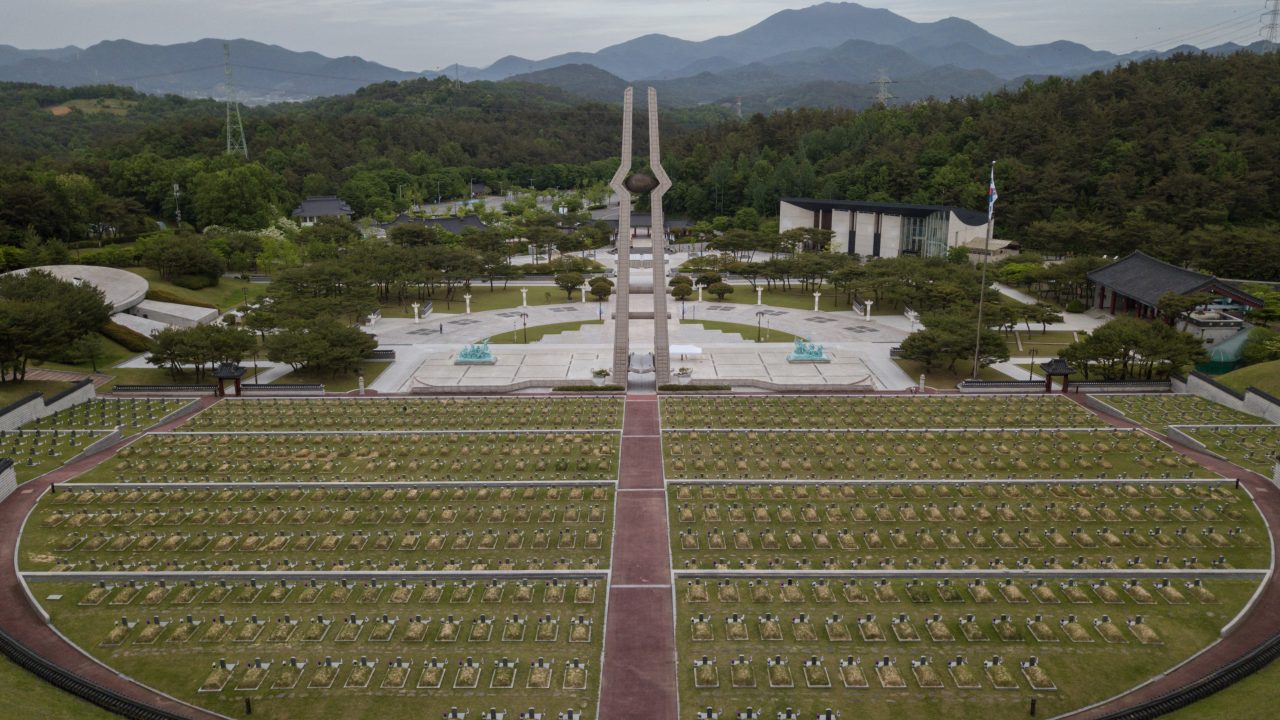
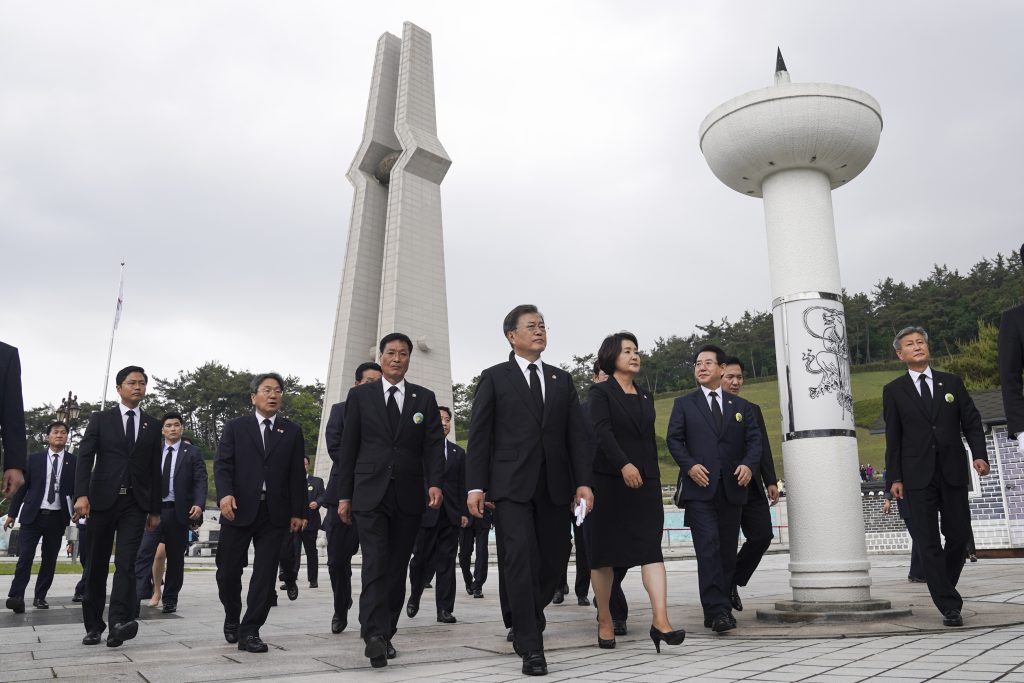
Entering the May 18th Memorial Center in Gwangju’s quiet 5.18 Memorial Park under the gray sky of a late winter afternoon is political freedom in a nutshell: It is not entirely clear where to go; nobody is there to direct you; and you cannot help but feel slightly lost despite knowing exactly where you stand.
Stick around for a moment and things become startlingly clear. Documented in photographs, video footage and poetry is the Gwangju Uprising of May 1980, when the city opposed a post-coup military dictatorship, which beat, injured and ultimately murdered protesting citizens, causing their number to rise, at the rebellion’s height, to an estimated quarter of a million participants.
People donated their blood to save those who were injured and formed a militia for defense. Before long, its members knew that they would be defeated by amassing government forces, which were operating with U.S. approval. Sending the women and high-school children home from their number in order that their story would be told, many paid with their lives as the city suffered attack from helicopters, tanks and troops in armored cars. Whether hundreds or thousands, the total death toll from the whole incident remains disputed.

When the people of South Korea finally participated in elections in 1987, it was thanks in part to these brave souls of Gwangju that voting control over the country’s rulers had been achieved. The legacy extended through the June Democratic Struggle of the same year that precipitated the restoration of voting rights and the 2016 protests that brought down the corrupt president Park Geun-hye, when thousands took to the Gwangju streets again.
Viewing such material in the winter of 2024 amid the varying degrees of wreckage from the revolutions in Hong Kong, Belarus, Iran, Thailand and Myanmar, as Russia and China attempt to reverse the fall of the Iron Curtain and Navalny sleeps forever in his grave is poignant, terrifying and hope-filled, all at once. Gwangju shows that the more dictators wound their people, the more they wound themselves. But what a process.
And the city holds another, less visible message that is just as prescient: As much as the spirit of democracy persists under even the most repressive circumstances, the reverse is equally true: Those who would subjugate others to their total power have ample space to further their objectives in open societies.
For among the numerous monuments, squares, archives and public spaces that Gwangju has devoted to ensure that May 1980 is never forgotten, dedications to a very different life history are popping up: sites to celebrate the city as the hometown of the late composer Jeong Yul-sung (Jeong Yul-seong), perhaps more widely known by his Chinese name Zheng Lvcheng (鄭律成), who rose to prominence producing propaganda music for the People’s Armies of both China and North Korea in the middle years of the 20th century and became a Chinese citizen under Mao.
Intending to attract tourists from China, a Gwangju street has already been controversially named in Jeong’s honor, along with other tokens like statues and a wall documenting how the Korean and Chinese people are coming together over his memory. The latter seems to have missed the fact that many of the former consider him to be a traitor and emblem of totalitarianism. It may also be overlooking the plight of those Chinese citizens who look to democracies like South Korea to escape the symbols of dictatorship, not to be reminded that there is no way out.
But the resurrection of Jeong’s memory does not end there: Amid rancorous debate about its appropriateness and vows by the South Korean government in Seoul to block it, a new $3.6 million park (4.8 billion won) is being constructed for him, too. Delayed from its original completion schedule, the site reveals a nearly complete replica of his birthplace, pocketed in a back alley, almost as if Gwangju is hiding the latest addition to its inherently political streets.
Large stones carved in Mandarin to identify the spot meanwhile lie on the floor, a step backwards from August 2023, when a photo available at Alamy shows that at least one was already erected. The roof of the birthplace also appears to be undergoing either removal or replacement. Neither local tourism authorities nor the relevant district government office could offer clarity of when the park will eventually open.
All this may change in the coming months, but, for now, its condition is symbolic of the Chinese Communist Party’s often covert, full-court press attempts to influence South Korea and the tug of war surrounding them. For years, events like the Jeong Yul Seong International Music Festival, have been hosted in both Gwangju and cities in China. While these sound innocent enough by title — and doubtless are for many participants on both sides of the Yellow Sea — they can be fertile ground for Beijing’s strategy to create tensions and subsurface currents in democracies that always run in its direction, no matter the policy from the capital.
Indeed, memorializing Jeong has been associated with the kind of hospitality visits for local politicians to China that have concerned intelligence and security agencies in both Australia and Taiwan. Language accompanying objects in his honor has apparently sometimes been phrased to imply that Beijing’s support of the north during the Korean War was part of a liberation exercise against the U.S. or to omit the more uncomfortable aspects of his past for a local audience.
China President Xi Jinping himself drew upon Jeong as a unifying link with South Korea during a 2014 speech at Seoul National University. And the projects to surface the composer spur opposition to immigrant rights, fuel suspicion of ethnic Koreans who have relocated to Seoul’s jurisdiction from China and potentially act as a lightning rod for the Korean far right, all of which can sew divisions in the electorate and corral the Chinese diaspora back towards Xi again.
That Beijing sees Jeong’s legacy as an asset was further evidenced on January 25 when the Chinese Ministry of Foreign Affairs stepped in to tell Seoul that it had “no need to get ideological” and should “respect facts” when localities have “built spontaneously facilities” to tell the stories China likes. It was responding to reports that Jeong’s name may be dropped from an exhibition center and Gwangju funds of up to an annual $30,000 put to uses other than hosting tribute concerts for a naturalized Chinese propagandist who penned pep tunes for Pyongyang. A less self-interested partner surely would have expressed understanding about Jeong’s complicated past.
Clearly, the ministry wants to see more children of Korea attending schools with murals of Jeong in the background as the United Front-associated Confucius Institute arranges for them to sing his odes to happiness under the five-star red flag, but this is just one element in its gameplan. The composer and Gwangju sit adjacent to the wider context of continuing state-linked Chinese investment and misinformation, through which Beijing will look to swerve the vote favorable to its direction during South Korea’s legislative elections on April 10.
Some 38 inauthentic Korean-language news websites were reportedly traced back to Chinese public relations companies late last year. Many were posing as regional Korean outlets for provinces and cities including Gwangju and pretending to be members of the Korea Digital News Association to boost credibility. They drove scare stories about the release of treated radioactive water by Japan and supposed U.S. germ labs on Korean soil as well as narratives about the success of China’s COVID-19 response.
Another recent instance that generated traction involved the fabrication in an allegedly China-leaning online community that South Korea President Yoon Suk Yeol had made vulgar remarks in a speech. Prone to authoritarian-sounding anti-communist outbursts, Yoon has recently attracted Beijing’s ire over his criticism of its aggressive stance towards Taiwan and his moves towards closer relations with both Tokyo and Washington. China may therefore like to see him pegged back by a contrary legislature for the remainder of his term to 2027, much as it has settled for a similar picture in Taiwan.
Thus, as amply demonstrated by Gwangju, democracy in South Korea has many layers, not all of them working to reinforce it. Among the plurality of voices, one of the Gwangju Uprising’s greatest gifts, it is vital that certain among them are identified for what they truly are.
NOTE: Some of the information gathered from this article was translated from the original Korean into English with the help of ChatGPT or Google Translate.

Leave a Reply