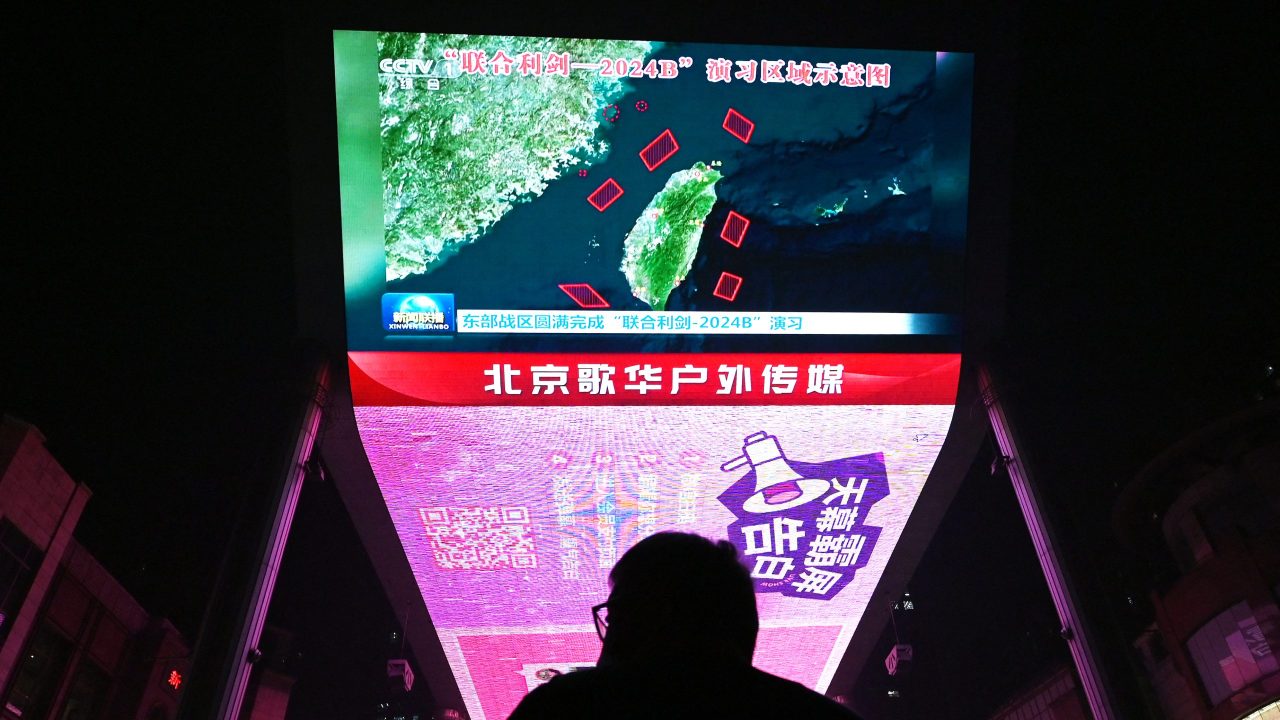
In a world where influence over policy perfectly corresponded with expertise, it would be hard to know whom to recommend J. Michael Cole’s new book, “The Taiwan Tinderbox,” to. For the average person, Cole’s prose is unlikely to win a battle with Netflix or TikTok for that one free hour at the end of the day. And the think tank type who has already spent the last decade reading Foreign Policy or The Diplomat may not discover much new here.
But that, my friends, is not the world we live in. Washington’s foreign policy-making organs, and especially the middle rungs of the State Department, are now populated to a large extent by denizens of the New Right, utterly self-assured in their desire to remake the world, yet unsure about whether there should be a place for a democratically ruled Taiwan within it.
To those people, I say this: Read Cole’s book, and let your Nietzschean dreams be colored at least in part by the particulars of this island — its internal politics, its defense posture, and the central role it will play in determining the shape of the world to come.
Cole, who began his career as a Canadian intelligence analyst before moving to Taipei in 2005, is a skilled guide for the uninitiated. He traces Taiwan’s status as a geopolitical flashpoint back to 1895, when the Qing Dynasty ceded the island to the Japanese Empire. Since then, Taiwan has remained a pawn in a larger game: an offshore refuge for the Chinese National Party, or KMT, after their defeat in the Chinese Civil War, an unfortunate piece of collateral in Nixon’s efforts to pry Beijing away from the Soviets, and now a crucial prize in the new Cold War between the U.S. and China.
The other battle that defines Taiwan — its internal struggles over national identity — dates back to the 17th century, when waves of Han settlers began to arrive on the island. “Thus were sown the first seeds of a contest of identity that continues to characterize, and in some ways to haunt, politics in Taiwan today,” Cole writes.
“The Taiwan Tinderbox” is at its best when describing these internal dynamics. The first chapter recounts how the pro-China policies of Ma Ying-jeou (馬英九), Taiwan’s KMT president from 2008 to 2016, paradoxically enhanced ordinary citizens’ ability to organize around issues transcending the traditional division between “mainlanders,” or waishengren (外省人), who descend from the KMT’s 1949 refugees, “native Taiwanese,” or benshengren (本省人), whose families arrived long before.
Cole argues that Chinese President Xi Jinping’s (習近平) increasingly belligerent approach to Taiwan, intended to make the country accept its fate, has similarly backfired. A particularly misguided ploy was Xi’s effort back in 2019 to assure Taiwan that it would be protected under the “one country, two systems” approach granted to Hong Kong. With the city descending into chaos at the time, Cole writes, the Chinese president’s timing could not have been worse. Xi’s provocations have made it hard for the Beijing-friendly KMT to articulate a coherent message on cross-strait relations, which is one of the reasons why their rival, the Democratic Progressive Party, or DPP, has won three consecutive presidential elections.
Like the majority of his foreign correspondent peers, Cole is more sympathetic to the DPP. He has served for the last four years as executive editor of a think tank founded by Tsai Ing-wen (蔡英文), the DPP’s former president, and his account of her administration, which lasted from 2016 to 2024, is accordingly sympathetic. But “The Taiwan Tinderbox” is refreshingly attuned to the fact that the KMT remains viable enough to command a plurality of seats in the country’s legislature, and that political polarization now threatens to undermine Taiwan’s efforts to defend itself.
Will Taiwan survive if China invades? Under a sustained assault with no assistance from the U.S., probably not, Cole concludes. The contest of military power across the Taiwan Strait, which leaned in Taiwan’s favor as recently as two decades ago, is now no contest at all. Even if Taiwan were to increase its defense spending to the 10% of GDP that some in the Trump administration have called for (a virtual political impossibility), it would still only mount to one-third of what China is spending.
But saying that Taiwan is no longer a match for China’s military is not the same as saying that China would win a war over Taiwan. The country still has an opportunity to make the costs of a conflict great enough that they would not be worth it. That has been one of the lessons from the war in Ukraine, Cole writes, where the Ukrainian military continues to make the invasion costly for Russia, despite its military advantage.
A reassuring note comes during the chapter on Ukraine, when Cole argues that it would take months for China to mobilize for an invasion. And such large-scale maneuvers, he says, would surely be picked up by Taiwanese and U.S. intelligence. “There is no element of surprise, which gives defending forces — and their allies — time to strengthen their defenses and mobilize accordingly,” Cole writes. This might not be true for long, however. According to the Center for Strategic and International Studies’ China Power Project, Beijing has been training its forces to invade with minimal warning.
Cole finished writing the book in January 2025, and so Donald Trump, who was only just then retaking office, makes notably few appearances. His name doesn’t even appear in the index. Yet with the escalation of China’s military exercises around Taiwan that Cole so lucidly details likely to continue, it may soon fall on Trump and his new crop of deputies to prevent the tinderbox from catching fire. In the meantime, one can only hope they will take time to learn about the kindling.
The Taiwan Tinderbox by J. Michael Cole, Polity Press, $29.95, 250 pages
This is Domino Theory’s first book review. To suggest a book for a future review, contact us at: harry@dominotheory.com



Leave a Reply