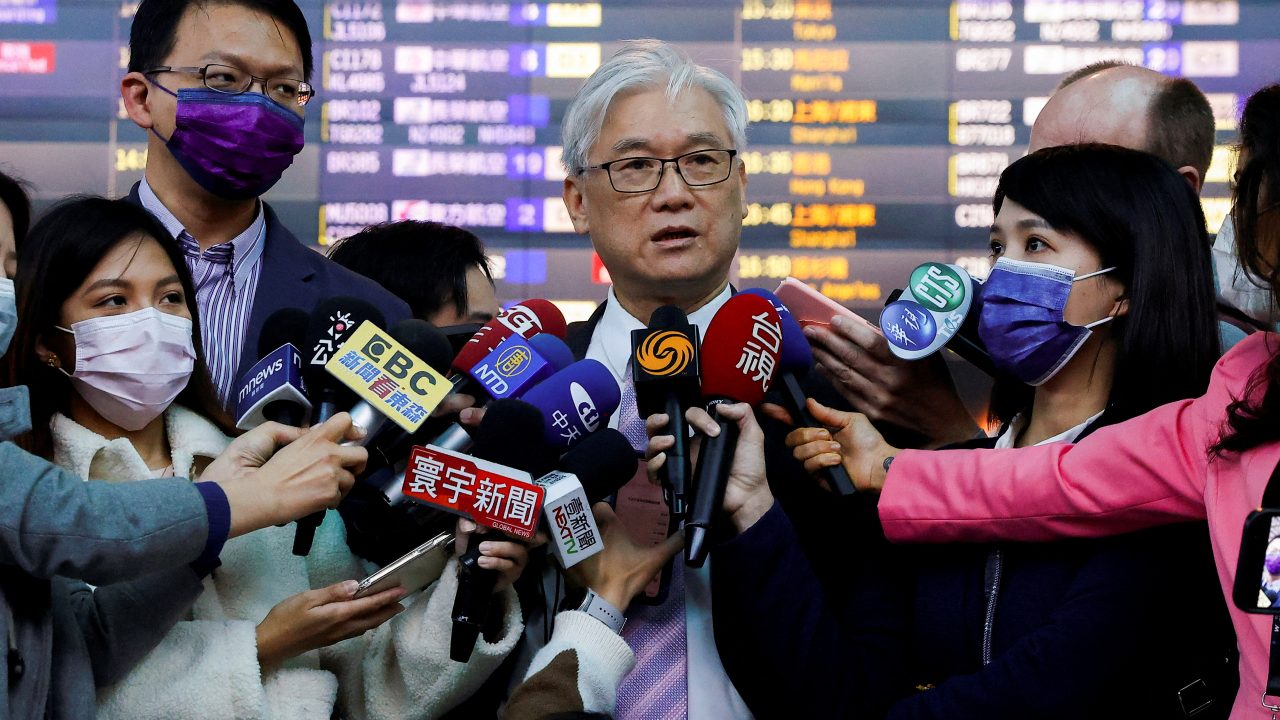
With turbulent waters internationally, in the strait and at home, the message for Europe from the Chinese Nationalist Party (KMT) in Taiwan was that the Democratic Progressive Party (DPP) isn’t the only dance partner in town.
Andrew Hsia (夏立言), vice chairman of the KMT, spent over a week in Europe at the end of May. His visit coincided with former president Tsai Ing-wen’s (蔡英文) own trip. Hsia even went to one of the same events, the Copenhagen Democracy Summit.
In recent years, Taiwan has improved its ties with Europe, and the salience of Taiwan as a geopolitical issue for European leaders greatly increased. This happened under the governance of the Democratic Progressive Party (DPP), the party of Tsai and current president Lai Ching-te (賴清德).
The KMT, and Hsia himself, have traditionally been more focused on ties with China and to a lesser extent the U.S. Whereas Tsai’s visit was unsurprising, Hsia’s trip represents more of a new avenue for the KMT to engage with Europe.
Before and during his trip, Hsia focused on several key messages, including protecting democracy and promoting dialogue. These themes combine normal foreign relations themes with particular domestic and cross-strait concerns.
The KMT wants to tell Europeans that the democracy of the Republic of China (Taiwan) needs to be protected not only from the authoritarian threat of the People’s Republic of China, but also what it characterises as a looming “green dictatorship” of the DPP. It seeks to present itself as a responsible partner, able to engage with China where the DPP cannot.
Hsia emphasized these beats during public remarks at the International Democrat Union annual forum held in Brussels on May 15. He appeared on a panel titled “Security and Trust in the 21st Century: A New Era of Transatlantic and Indo-Pacific Partnerships,” alongside heavy hitters like former Australian prime minister Scott Morrison and former U.K. home secretary Priti Patel.
“Democratic nations must unite and take concrete action against any form of authoritarianism,” Hsia told the audience. He said “Defense, Dialogue, Democracy, and Diplomacy” are the pillars of the KMT’s foreign policy, according to China Times.
Taiwan is currently undergoing significant domestic political turmoil. Although the presidency is held by the DPP, the KMT and its allies the Taiwan People’s Party have a majority in Taiwan’s legislature. Last year there were significant protests against actions by the legislature, now known as the “Bluebird Movement.”
Grassroots movements connected to the DPP launched recall campaigns against almost all KMT legislators, and in response the KMT is attempting to recall many of the DPP’s own. A successful recall vote would mean the legislator in question being removed from office and unable to run again. Votes will be held this summer, and currently the DPP has been far more successful in gathering the necessary signatures to force specific constituency votes.
If enough of these recalls against KMT legislators are successful, the DPP could potentially flip the legislature. This scenario was initially seen as unlikely, but the DPP now thinks it might have the numbers. Losing control of the Legislative Yuan would be catastrophic for the KMT. They characterize the recalls as antidemocratic and authoritarian, whereas the DPP says they are a part of Taiwan’s constitutional process.
In Brussels, Hsia told the audience the KMT had played an indispensable role in Taiwan’s democratization process. This is a dramatic retelling of history, casting an authoritarian regime as the force that delivered Taiwan out of its own dictatorship. There has been no reporting on how these remarks landed at the conference.
The KMT was representing the Republic of China at the International Democrat Union annual forum, so it had an “even greater obligation to express to party allies such as the US Republican Party, Germany’s CDU, UK Conservative Party, South Korea’s People Power Party, and European People’s Party that Taiwan’s mainstream public opinion supports defending democracy and opposes any actions that undermine the regional status quo,” according to an editorial in the China Times by Chance Hsu (須予謙), the KMT’s assistant director of international affairs.
Later in the trip, at a “Fireside Chat” at King’s College, Cambridge, Hsia told students that Taiwan is currently facing triple challenges from external to internal sources: the unpredictable and ever-changing international situation, the continued deterioration of cross-strait relations, and the escalating political polarization domestically. According to a press release, he said that in all three cases the KMT advocates for replacing confrontation with dialogue.
The audience contained both Taiwanese and Chinese students, but the majority were other nationalities, according to Wei Azim Hung (洪偉), a student at Cambridge who was involved in organising the event. Hung said he asked Hsia about national identity and also the KMT’s policy on defense spending but didn’t feel he got clear answers.
What Was Hsia’s Trip All About?
“The KMT is just trying to send a message to Europe that a KMT-led government would be more aligned with European interests in the Taiwan Strait than the DPP government,” said Marcin Jerzewski, head of the European Values Center think tank in Taipei. He suggested that because Europe wants to maintain the status quo in the Taiwan Strait, it is open to seeing the KMT as the party of cross-strait stability.
The European Values Center’s parent organization in Prague hosted a KMT delegation in Prague last year. Jerzewski said the KMT has done a lot of outreach to the international community, and the party has many capable diplomats in their ranks. He said that even though recent remarks comparing the DPP to the Nazi party were “not well-received,” the KMT doesn’t have a communication problem.
In contrast, Jerzewski said the DPP does “hardly any strategic communication about the recalls in a consistent and effective way,” creating an information gap where European audiences don’t understand the recall mechanism.
But not everyone agrees. Marc Cheng (鄭家慶), executive director of the European Union Centre in Taiwan, said that the KMT doesn’t have strong relations with Europe.
Cheng said the KMT is trying to draw a comparison between Taiwan and Europe, with the latter still seeing the value in engaging with China despite problems. “You perceive China as [a] top competitor and [a] systematic rival. But you still have a conversation.” In other words, the KMT is trying to point out that it talks to China and the DPP mostly does not.
Cheng also believes that because former president Tsai improved ties with Europe, Europeans believe that current president Lai will also act in their interest. But he says that the KMT wants to show that Lai and Tsai are different people.
Hsia’s trip to the U.K. might be “a recognition that the DPP controls the story when it comes to Taiwan,” according to Max Dixon, a Ph.D. candidate at the University of Portsmouth who is researching the U.K.’s foreign policy towards Taiwan. Parliament’s Foreign Affairs Committee says Taiwan is effectively already an independent country, he pointed out. “It almost leaves no space for the KMT, in a way.” Dixon suggested that Hsia was going to the U.K. to communicate “there are two sides to the political debate in Taiwan, trying to avoid a situation where, in the British Parliament, you think about Taiwan, you think of only the DPP, Tsai and Lai Ching-te.”
Domino Theory asked several members of the KMT who went on Hsia’s trip to comment, but all declined or failed to reply.
Hsia started his trip at the Copenhagen Democracy Summit, where he met with key figures such as Engin Eroglu, the chair of the European Parliament’s China Delegation. According to Hung, who heard him speak at King’s College, Hsia said he had briefly crossed paths with former president Tsai in Copenhagen, and she had teased him that he was following her to Cambridge.
Following Tsai’s example to build ties with Europe certainly wouldn’t be the worst strategy.


Leave a Reply