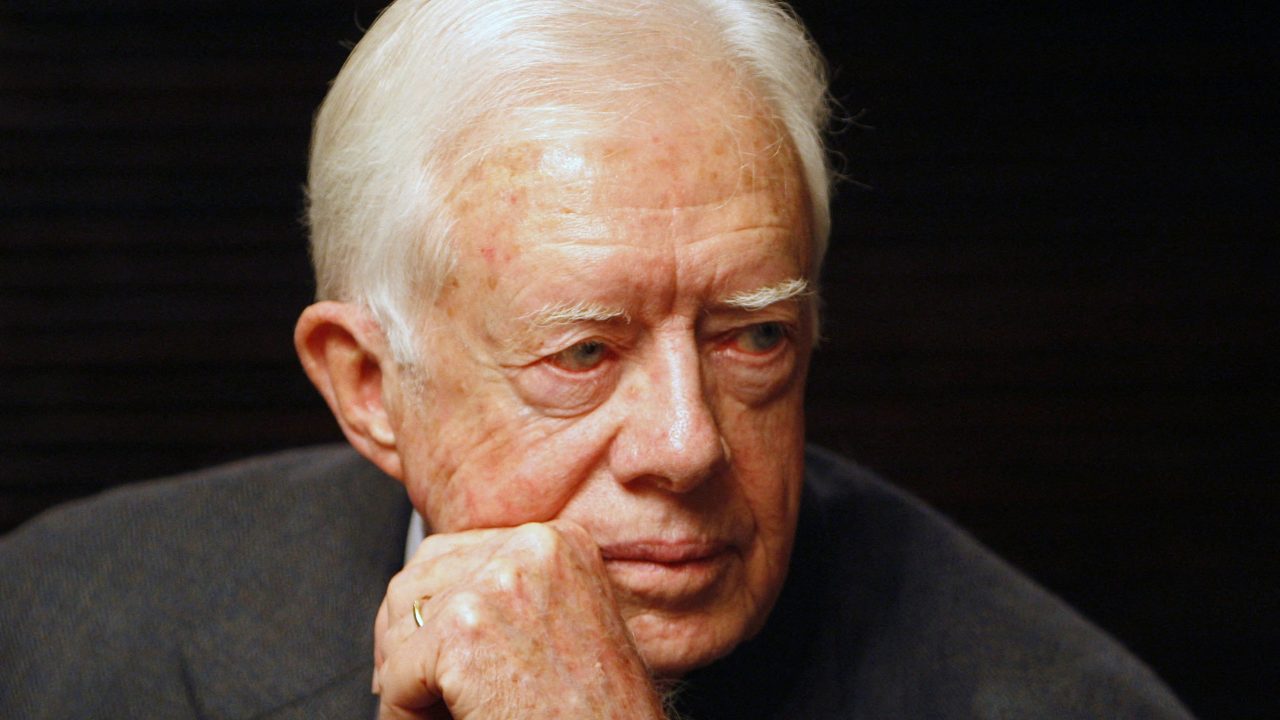
Jimmy Carter, the 39th U.S. president, passed away peacefully on December 29 at the age of 100. As the last remaining leader from the Cold War era, Carter set many records. He was the longest-living president, he became the first U.S. president to receive the Nobel Peace Prize after leaving office, he established diplomatic relations with China, and he visited North Korea the most times after leaving office.
Carter also established diplomatic relations with the People’s Republic of China (P.R.C.) and severed ties with the U.S.’s traditional ally, the Republic of China (R.O.C.), in a bid to counter the Soviet Union during the Cold War. Despite this, the Carter administration agreed to continue to unofficially support the R.O.C..
What happened afterward is well known to Taiwanese people: Congress passed the Taiwan Relations Act in 1979 to correct the executive branch’s abrupt severance of relations with the R.O.C., providing legal basis for U.S.-Taiwan relations and temporarily protecting Taiwan during turbulent times.
During a later visit to Taiwan in 1999, Carter said recognizing Beijing was key to Asian security and beneficial for the progress of human rights in Asia. In his view, the Chinese Nationalist Party (K.M.T.) was a dictatorship government under U.S. protection that transformed into a free and prosperous democracy after diplomatic ties were severed, while U.S.-China relations helped improve human rights in China and eased regional tensions.
In the Taiwanese point of view, though, Carter’s decision was shocking. Former foreign minister Chen Chien-jen (程建人), who was serving as a secretary at Taiwan’s representative office in the U.S. at the time, recalled in a 2019 interview that, when the Taiwanese government received the announcement, protests erupted, with crowds throwing eggs at the U.S. delegation’s vehicle. “The U.S. ambassador notified President Chiang Ching-kuo (蔣經國) at 2 a.m. That is when I realized how a country could treat its friends so mercilessly for its own interests.”
As an “old friend” to China who visited the country more than 10 times, Carter and his think tank, the Carter Center, continued to promote U.S.-China exchanges. During the 35th anniversary of the establishment of diplomatic relations in 2014, Carter said China would become the world’s largest economy and not a threat to the U.S. He later endorsed President Xi Jinping’s (習近平) statement that “the Pacific is big enough for both countries,” suggesting that peace and benefits could come from the two countries coexisting despite their differences. The Carter Center later even started a Weibo account as a way to reach out to the Chinese people.
While Carter promoted U.S.-China relations with events and reports like election monitoring and disease prevention, China often used these for publicity purposes. Carter’s name has even been used by various Chinese businesses, even when the business had no association with the former U.S. president.
Carter and his think tank referred to the events that unfolded in Tiananmen Square in 1989 as a “confrontation.” When the 2019 trade war between the U.S. and China started, Carter, who was 94 at the time, revealed that he had recently spoken with President Donald Trump about China. He said Trump was worried about China’s growing economy and expressed concern that “China is getting ahead of us.” Carter said he told Trump that much of China’s success was due to its peaceful foreign policy.
But when Carter visited China in 2014 to celebrate 35 years of Sino-U.S. relations, he faced numerous diplomatic snubs that revealed China’s changing attitude. This treatment illustrated China’s growing confidence and diminishing regard for even its “old friend,” according to Orville Schell, former director of the Asia Society’s Center on U.S.-China Relations. Despite his historic role in establishing diplomatic ties in 1979, neither President Xi nor Premier Li Keqiang (李克強) met with him. Chinese authorities undermined his visit by canceling events, banning a delegation member from speaking and limiting the former U.S. president to a brief talk at a routine business conference.

Leave a Reply