The number of days Taiwan has lived in democracy just surpassed the number of days it existed under martial law. On Tuesday at midnight, a group gathered at To-uat Books in the Zhongzheng District of Taipei to toast the occasion — with whiskey or wine for some, and tea for those who were driving home afterwards.
Since martial law, Taiwan has become an exemplary democracy, one that ranks highest in Asia for the strength of its government, democratic institutions, political participation and civil liberties. And yet, the tone of the event at To-uat Books, which consisted of over 12 hours of lectures and panel discussions preceding the midnight toast, was more prudent than celebratory.
Echo Lin (林仁惠), a shareholder at To-uat Books and chair of Amnesty International Taiwan, stressed the fragility of Taiwan’s young democracy. “Starting from tomorrow, I think what we will do will be the same as what we have been doing for the past 38 years and 56 days to move away from terror, repression … and to build up and reinforce our democracy,” Lin told Domino Theory.
In this bookstore, the tension in Taiwan’s history is palpable. Behind us, a banner strung across To-uat’s coffee bar reads, “Taiwan does not need a Dictator Memorial Hall.”
The memorial hall in question is, of course, the one containing the 25-ton bronze statue of Chiang Kai-Shek (蔣介石) that sits in the center of Taipei. Chiang was head of the Chinese Nationalist Party (KMT) when he and some 2 million mainlanders fled to Taiwan in the 1940s following their defeat by the People’s Republic of China. He was also the architect of authoritarian rule in Taiwan and the 38-year period of martial law now called the White Terror.
A Taiwanese news clipping from 1978 discussing the construction of the Chiang Kai-shek Memorial Hall described it as commemorating “President Chiang’s career as soldier, statesman and stalwart standard-bearer in the battle for human rights,” while also contributing to “the perpetuation and spread of Chinese culture.”
Today the statue carries a much different meaning. This shift reflects a more complicated historical memory of Chiang, as well as the rise of a distinct Taiwanese identity — 62.9% of people identify as Taiwanese today, compared to 17.6% in 1992, according to polling from the Election Study Center at National Chengchi University. The result is ongoing controversy about how he should be remembered and memorialized.
But the debate isn’t as simple as weighing Chiang’s historical record and deciding whether his statues should stay. Most of the people that Domino Theory spoke to, across the political spectrum, seemed to resent the role that this debate, and transitional justice efforts writ large, play in various political narratives. This politicization makes it difficult to disentangle transitional justice in a narrow sense — reckoning with history and restitution — and the broader “politics of memory” that shape Taiwan’s evolving identity and political culture.
“In Taiwan, when you talk about transitional justice, you have to understand which grand ideological narrative you embed those human rights violations into,” said Jimmy Chia-hsin Hsu (許家馨), a research professor at Academia Sinica who specializes in democratization and the theory of punishment.
Taiwan’s transitional justice efforts began in the 1990s, when the Taiwanese government, under KMT leadership, provided monetary reparations to victims of the White Terror and the 228 Incident, an uprising against the KMT in 1947 led to the massacre of thousands. But Hsu says that Taiwan didn’t fully confront its authoritarian past until the 2016 presidency of Tsai Ing-wen (蔡英文) from the Democratic Progressive Party (DPP). The Tsai administration established Taiwan’s first Transitional Justice Commission, and Tsai’s Ministry of Culture announced a competition in April 2022 to invite ideas on the potential redesign of the Chiang Kai-shek Memorial Hall. The stated goal of the competition, according to the Ministry of Justice, was “de-authoritarianization.”
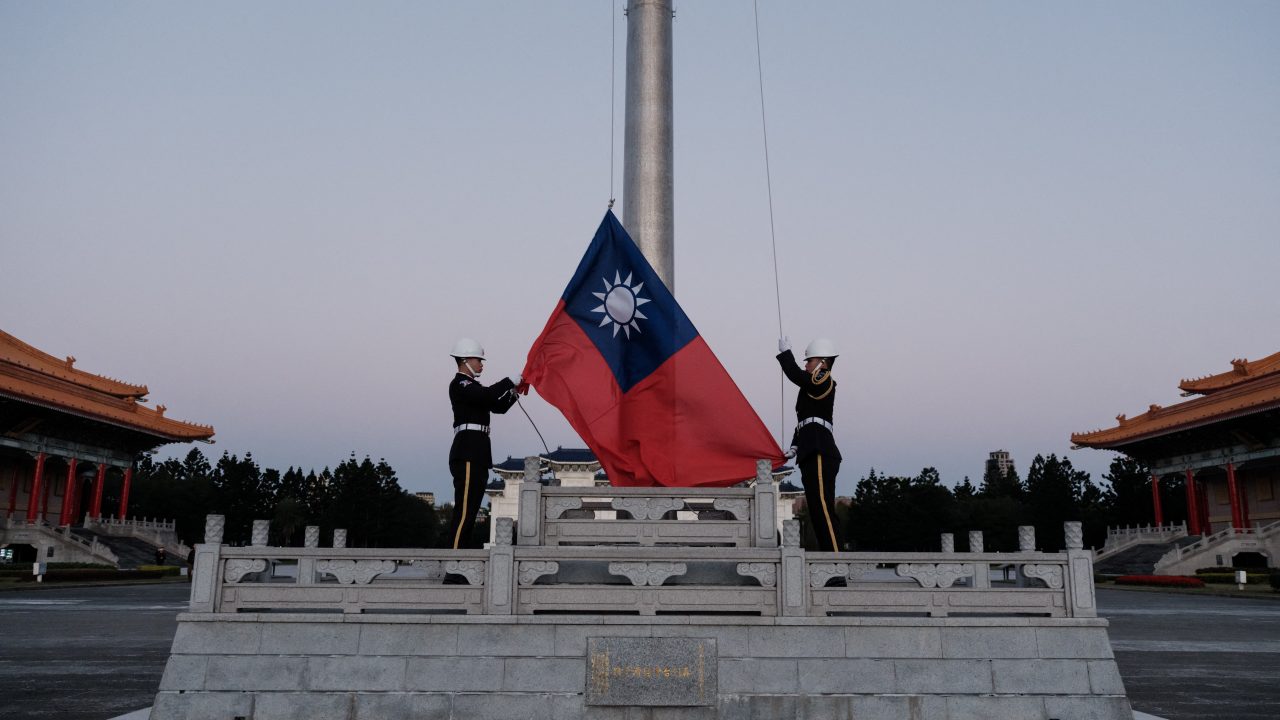
President Lai Ching-te’s (賴清德) administration has continued this effort to address authoritarian symbols in Taiwan. In July 2024, Taiwan’s Ministry of Justice announced that the changing of the guard ceremonies at the Chiang Kai-shek Memorial Hall would no longer take place around the statue, but outside the memorial. “Eliminating worshipping a cult of personality and eliminating worshipping authoritarianism is the current goal for promoting transitional justice,” the ministry said in a statement about the decision.
The Chiang Kai-shek Memorial Hall is one of the most controversial aspects of transitional justice in Taiwan because it deals with how Taiwan tells its story. “If the Taiwanese population had a clear consensus on how we view the past, then I don’t think it would be hard to remove the Chiang Kai-shek statue,” said Hsu. Though polling shows that nearly 80% of Taiwanese believe democracy is the best political system for Taiwan, the narrative framing around Chiang’s legacy still matters to many.
Hsu recalled the story of a gentleman who was interviewed after one of the memorial redesign competition events. He opposed the redesign, but not because he liked Chiang Kai-shek — his family was from a faction of the KMT based in Manchuria that had a tense relationship with Chiang. For him, the removal of Chiang’s memorial statue would mean getting rid of the historical memory of his family. “What he perceived was a very exclusive Taiwanese narrative, that viewed [him and his family] as outsiders who are the accomplices of oppressors,” said Hsu.
Kwei-bo Huang (黃奎博), a professor of diplomacy at National Chengchi University and the former deputy director of the KMT, also opposes the redesign of the memorial hall, but for different reasons. Huang thinks that DPP-led narratives fail to show more understanding for the political context Chiang had to contend with at the time and may even overstate the impact of the White Terror. He says there can be parallel truths: While Chiang certainly misstepped, he did not do everything wrong. “One of the most successful stories by Chiang Kai-shek is that he safeguarded Taiwan, Penghu, Jinmen and Matsu from the invasion of Chinese Communists,” Huang said.
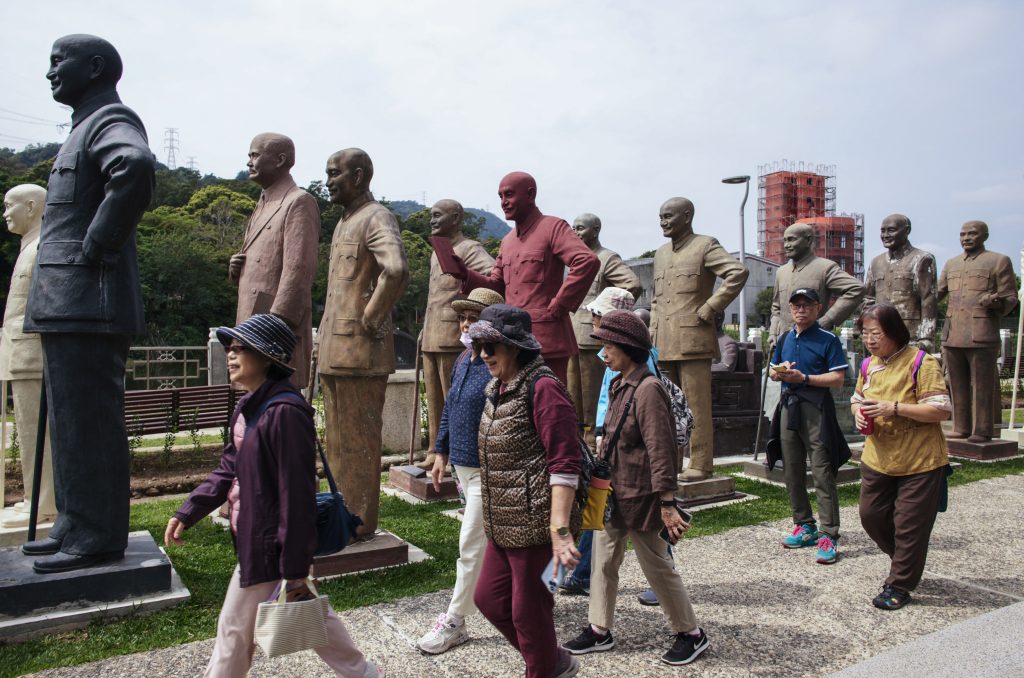
Huang also thinks that keeping a symbol of authoritarianism, while recognizing that it sits within a particular historical context, is not by definition problematic. He raised the example of Abraham Lincoln, who is now memorialized in the U.S. capital despite having expanded his executive powers during the Civil War. In fact, Huang thinks that the DPP is being “communist” and even “nazi-ist” by seeking to take down Chiang’s various statues around the island in an effort to generate political momentum. A Ministry of the Interior program launched in 2022 granted public universities and other institutions up to 100,000 New Taiwan Dollars ($3,300) to subsidize the removal of each statue of Chiang. At a memorial park south of Taipei, over 200 of Chiang’s ousted statues are gathered together.
Echo Lin from To-uat Books thinks that the general public does not care much about taking down the statues. Lin said that the civil society organizations she engages with in this space view symbols of authoritarianism like the Chiang Kai-shek Memorial Hall as “more like a joke” because of how outdated they are in the modern Taiwanese context.
Writer and activist Brian Hioe argued in New Bloom Magazine last year that the DPP is unlikely to expend its political capital on such a big ticket item like the Chiang Kai-shek Memorial Hall. Even though the Transitional Justice Commission recommended it be redesigned, this commission was dissolved in 2022. In March 2023, ten winners of the redesign competition were announced, but organizers said these plans were solely meant to spark public discussion.
Chun-ying Wu (吳俊瑩), assistant professor at National Taiwan Univesrity and expert in Taiwan’s political archives and legal history, told Domino Theory via email that negotiating the merits versus the faults of Chiang often draws attention away from the specific crimes he committed. Wu noted the important archival work the Transitional Justice Commission did to unearth the tools of repression used during martial law, but he worries that the commission’s dissolution will make it more difficult for Taiwan to address the most controversial topics in transitional justice, like removing symbols of authoritarianism and identifying the perpetrators of specific crimes.
Youlian Son (孫友聯), secretary general of the Taiwan Labor Front, wrote to Domino Theory in an email that the KMT has “manipulated the media to undermine the legitimacy of transitional justice, framing it merely as ‘political retribution,’ while ignoring the fact that countless victims have yet to have their names and reputations fully restored.” Even under DPP leadership, no one has yet been held responsible for prominent atrocities that occurred during the White Terror like the Lin family massacre or the death of Chen Wen-chen.
Lin is particularly focused on educating younger generations about the history of martial law in Taiwan. She cited the lack of knowledge among people who have no experience living in an authoritarian system as one of the greatest risks to Taiwan’s democracy.
New democracies might be fragile, but as Lin said, today Taiwan has paid back its time under martial law. “Now at least we have proved that the sustainability of Taiwan’s democracy is a real possibility.”






Leave a Reply