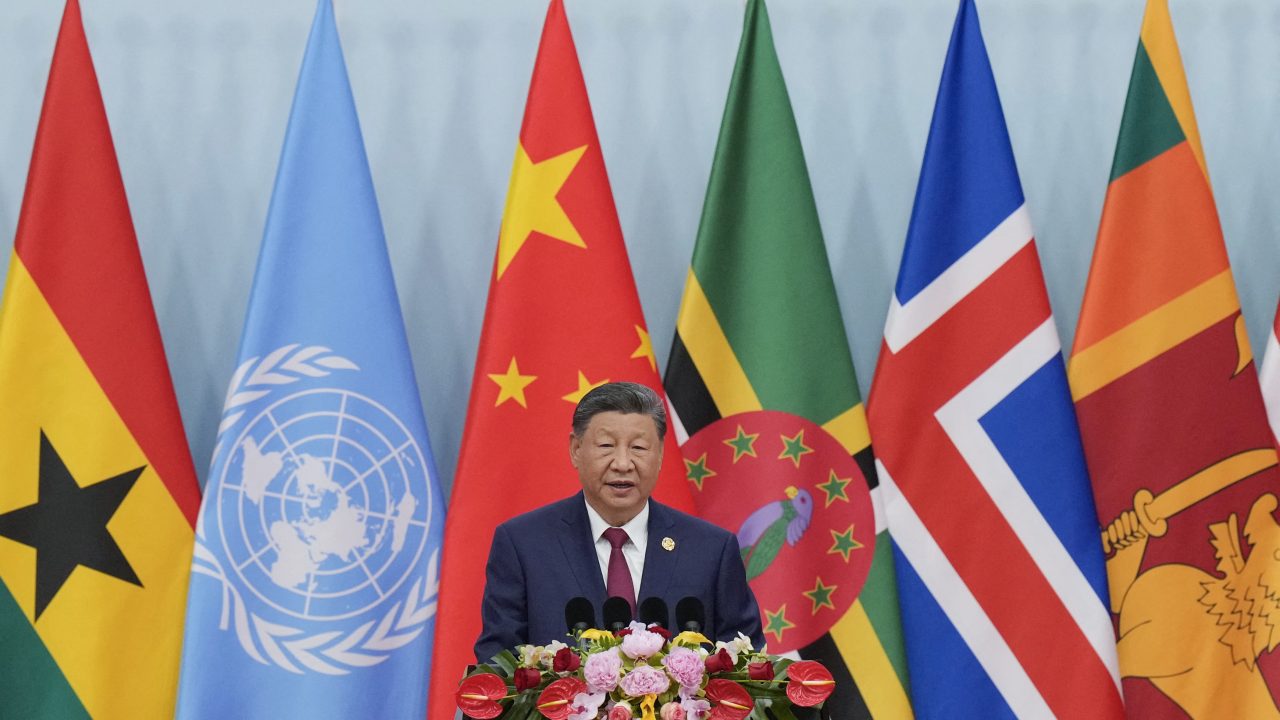
“On the new journey of Chinese modernization, every woman is a star,” Chinese president Xi Jinping (習近平) said during his keynote address at the Global Leaders’ Meeting on Women in Beijing on Monday. Can we get that last part embroidered on a pillow?
The current reality is that women are nowhere to be found at the highest political level in China. Women may “hold up half the sky,” as Chairman Mao originally said. But in Xi’s peculiar brand of feminism, while women appear to be important participants in economic development, they are not directing it.
When Hillary Clinton attended the 1995 Fourth World Conference on Women in Beijing, she delivered a line that became an “international rallying cry” for gender equality: Women’s rights are human rights. Beijing understood her remarks as a criticism of its own record and censored her speech within the conference and across the country. “It is a violation of human rights when women are denied the right to plan their own families,” Clinton said before the transmission was cut.
Thirty years later, Beijing is still grappling with this tension between demonstrating global leadership and asserting the party’s interests above all else. President Halla Tomasdottir of Iceland gave a keynote speech on Monday, warning that women’s rights “once considered secure are being challenged — even eroded — in many parts of the world.” One thing that was eroded was Tomasdottir’s presence at the meeting. The Chinese government’s news report for Monday featured a photo of her walking with Xi, but neglected to name her in the caption or indeed anywhere in the story.
“Women play an important role in creating, promoting and carrying forward human civilization,” Xi said in the opening lines of his speech, later elaborating on the many important jobs Chinese women have. Economic Information Daily, a state-run outlet, published an editorial yesterday which discussed women as astronauts, scientists, athletes and soldiers.
However, the broader political context indicates that Xi’s line about “creating” and “carrying forward” implicitly includes the biological duty to bear children. Since getting rid of the one-child policy in 2016, the CCP has implemented policies to discourage divorce and promote family planning in order to deal with demographic pressures from a rapidly aging population and declining birth rates. Some tactics are particularly invasive — imagine that you’ve recently gotten married when a local government official knocks on your door to ask if you’re pregnant yet.
In his speech, Xi also integrates the concept of “gender equality” into an oft-used CCP phrase for Chinese-style modernization: achieving “high-quality development of women’s causes” (婦女事業高品質發展). Similar language is used by the party to speak about economic growth, wealth redistribution and technological development. Is Xi elevating the strategic importance of gender equality to the level of economic growth? Or is the underlying message that women can create and inherit, but cannot steer?
“Today, women in China truly ‘hold up half the sky’ in economic and social development,” Xi said. He didn’t mention political development. He couldn’t, because China has no senior female leaders. The CCP’s Politburo Standing Committee, the group of seven individuals that includes Xi and is, under him, the most powerful political body in China, is all male. The Politburo itself, a wider group of 24, is all male.
Is there not one woman among the 690 million that Xi boasted of lifting out of poverty who is fit to lead?
The United Nations noted that when the new politburo was selected in 2022, it was the first time in 20 years that a woman had not been among its members. A report by the Committee on the Elimination of Discrimination against Women called for China to “adopt temporary special measures, such as statutory quotas and a gender parity system, to ensure the equal representation of women in the government.” In the National People’s Congress, China’s quasi-elected parliament, women hold only 26.54% of seats.
The Economic Information Daily editorial said that women are “alleyway premiers” (小巷總理 ), community leaders who focus on welfare issues. The woman who inspired the name, Tan Zhuqing (譚竹青), appears to have been an exemplary figure. But why not also encourage young women to aim for higher office?
Instead of alleyway premier, how about Premier of China? The current holder, Li Qiang (李強), won’t be there forever. Xi said that countries should “broaden the channels for women to participate in and deliberate on political affairs,” but this is a far cry from the 1995 Declaration’s goal of “gender balance in government bodies and committees.”
Addressing the audience yesterday, U.N. Deputy Secretary General Amina J. Mohammed said that “women’s leadership is the ultimate litmus test for a prosperous society.” Xi declared in 2021 that China had built a “moderately prosperous society.” That’s pretty close. Perhaps a chairwoman is needed to finish the job.




Leave a Reply