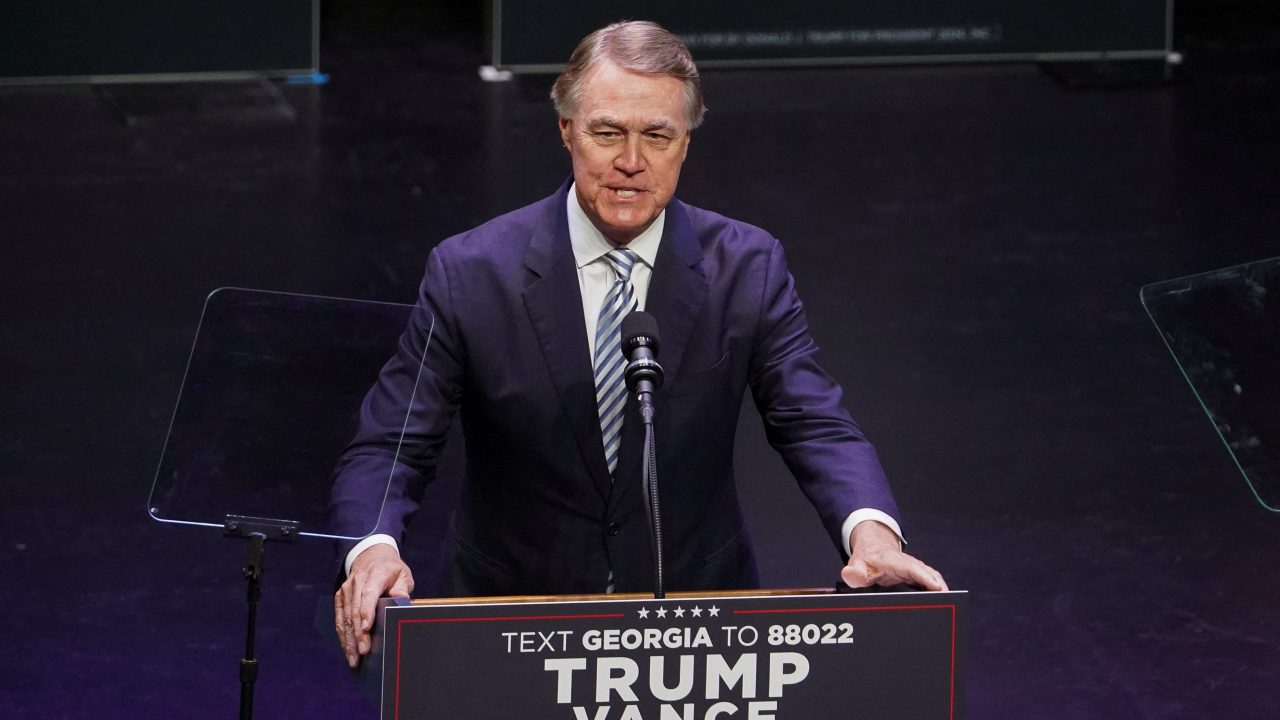
Trump has picked David Perdue to be the U.S.’s next Ambassador to China. Perdue was a senator from Georgia between 2015 and 2021, serving on the Foreign Relations and Armed Services committees. Perdue lost his reelection campaign in 2020 to Jon Ossoff and subsequently lost the Georgia gubernatorial race in 2022.
In his message announcing Perdue as his pick for Ambassador to China on Truth Social, Trump cited Perdue’s 40-year international business career. For a few years in the 1990s, Perdue lived in Asia, first in Singapore, while serving as managing director at Gitano Group Inc., and then in Hong Kong as a top executive for Sara Lee. But living in Hong Kong for a stint several decades ago does not a China expert make.
The China and Hong Kong of today are vastly different than in the 1990s, when many China watchers in the U.S. believed economic liberalization would lead to political reform. This assumption led to a willingness to downplay human rights issues in favor of developing robust economic ties. But China’s meteoric economic rise has coincided with increasing C.C.P. power, disproving this theory.
Perdue’s formative China experience was shaped by the U.S.’s initial optimism about trade liberalization and the economic benefits of engaging with China. During his first senatorial campaign in 2014, Perdue proudly reflected on how he built his fortune by outsourcing jobs to Asia. But Perdue’s traditional free trade framework became at odds with “America First” foreign policy.
Over the course of Perdue’s tenure in the Senate, he seemed to prefer fealty to Trump over personal consistency on China, flip-flopping a couple notable times. For example, while Perdue initially supported the Trans-Pacific Partnership — telling the Atlanta Journal-Constitution that it “goes a long way to allowing us to compete” — he later changed his mind when Trump pulled the U.S. out of the multilateral agreement in 2017. In 2018, Perdue reportedly met with Chief of Staff John Kelly to urge the Trump administration to take a more targeted approach to tariffs. Yet a year later, he preached the necessity of Trump’s tariffs to level the playing field with China. When Perdue ran for Senate again in 2020 — he ultimately lost to Jon Ossoff — his campaign ads were edited to remove references to his experience in China, possibly indicating a desire to deemphasize his business experience in Asia.
Still, Perdue remained committed to fostering trade with China while serving in the Senate. During a November 2019 interview on Fox Business, Perdue stated that the U.S.’s five goals in China are to curb IP theft, forced tech transfer and cyberwarfare, convince China to comply with WTO rules, and achieve equal access to the Chinese market for American businesses. He said that progress with China would be slow but persistent engagement is necessary. In an op-ed he wrote for CNBC in October 2019, Perdue argued in favor of Trump’s “Phase One” trade deal with China: “If both sides focus only on containing and surpassing each other, then the economies, businesses and citizens of the world would pay the price.”
In the same Fox interview, Perdue equivocated on human rights when asked about protests in Hong Kong, even parrotting official Chinese narratives. He said that “the concern” is a faction of protestors causing violence, which aligns with the Chinese media strategy of emphasizing instances of violence and extreme radicalism to delegitimize civil society action. Perdue also said that “They [the Chinese government] say this is an internal issue and I’m not sure they’re wrong.” Perdue might have taken this tact due to an impulse to prioritize trade relations over human rights concerns — the majority of the interview focuses on his efforts to promote the Phase One trade deal. But it is also possible that he heard the perspective of the Chinese officials he met during his recent trip to China and was convinced. Rex Tillerson, Trump’s first secretary of state, also didn’t have a background in Chinese politics and similarly began adopting some of China’s keystone phrases after his first visit to Beijing.
In an op-ed he wrote for the Washington Examiner this September, presumably in an effort to audition for ambassador, Perdue came across much more hawkish than he has in the past. He wrote, “China has moved from being a growing economic competitor to becoming a very aggressive adversary … To protect ourselves, Americans first have to realize the CCP actually is at war with us.” On Taiwan, Perdue called for greater strategic clarity. Perdue also mentioned China’s human rights record but did not specify whether or how the U.S. should respond. His enduring tepidness on human rights might be why one of his former congressional aides said he isn’t a “traditional hawk.”
Trump likely chose Perdue because he has demonstrated his loyalty. Research shows that during his first term, Trump replaced individuals who challenged his views on foreign policy and sought out opinions that would confirm his own. Officials who stuck around — like Mike Pompeo and Robert O’Brien — deferred to Trump and framed their policies in his terms. Likewise, Perdue was a staunch ally of Trump’s in the Senate, consistently aligning with Trump’s legislative agenda, even when it contradicted his previous positions.
Perdue is also a good fit for Trump’s goals in China. During his first term, Trump chose Terry Branstad as ambassador to China because he wanted someone who could facilitate diplomatic dialogue — Branstad was the governor of Iowa when Chinese President Xi Jinping (習近平) visited the U.S. for the first time in 1985 and they had maintained a relationship since. This time around, Trump already has a rapport with Xi. And Branstad’s tenure demonstrated that having a personal relationship with Xi does not guarantee diplomatic leverage. Trump’s pick of Perdue — a businessman with limited diplomatic experience — might signal a desire to focus on economic components of the U.S.-China relationship. Although Trump has suggested a more confrontational trade policy with China during his upcoming term, perhaps he is open to some sort of deal — like a renewed version of the Phase One trade deal — and wants a business-oriented person representing the U.S. in China.
Ultimately, Perdue’s loyalty to Trump was probably a more significant factor than his resume in his selection as ambassador, as Perdue likely will be more of an implementer than a decision-maker in China. While it is always the role of an ambassador to implement the president’s policies, some positions have historically been considered more substantive than others. China is one of them. However, recent ambassadors, including Branstad and Nicholas Burns, have had less room to maneuver as U.S.-China tensions have worsened. It is also Trump’s personal leadership style to rely on centralized, informal decision making. Perdue, being far away from the locus of decision making, will have more limited influence.
Though Perdue’s diplomatic experience and China background seems oddly meager for this role, Trump wants someone in China who will faithfully carry out what promises to be an unpredictable and confrontational China policy — and Perdue fits the bill.




Leave a Reply