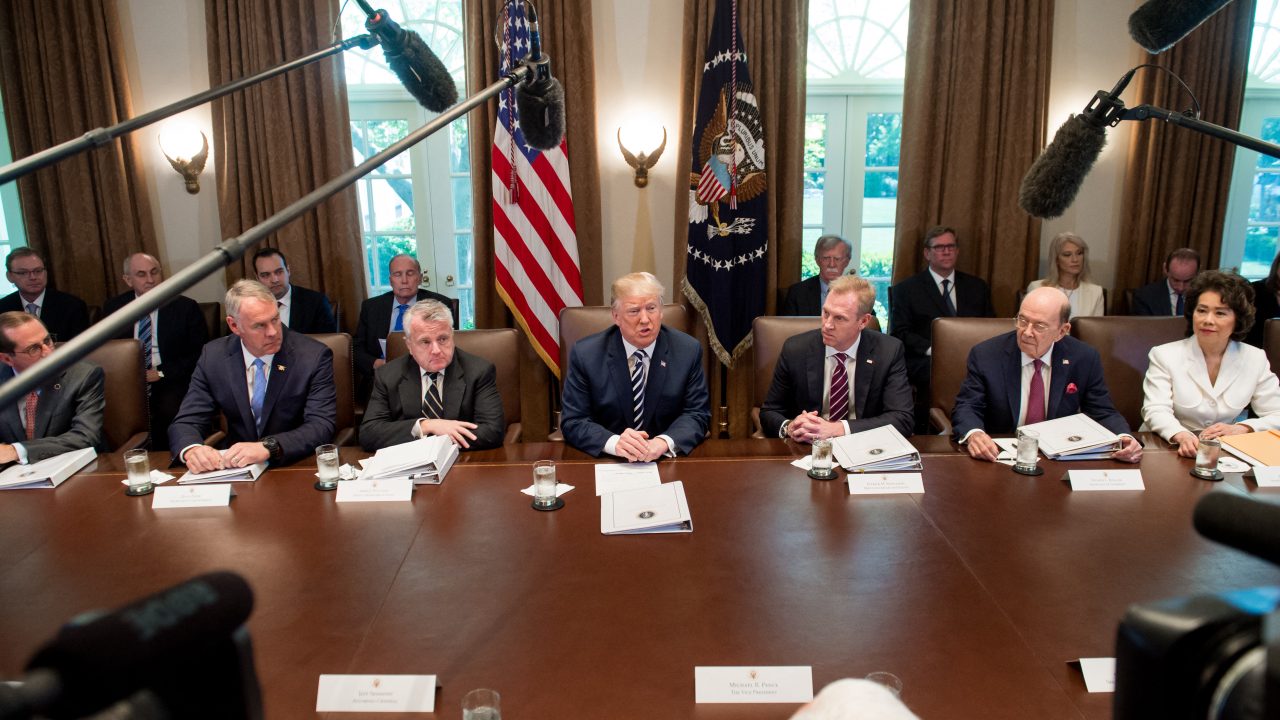
A fixture of Donald Trump’s foreign policy rhetoric is a throwback to the Reagan era motto “peace through strength.” Former national security advisor Robert O’Brien argued in Foreign Policy that during his first term, Trump effectively leveraged American strength to foster peace globally. This and other rhetoric that similarly espouses strong leadership is mentioned by Trump and his allies frequently. Trump knows how to sell himself — he was voted into office for a second term in large part due to his perceived ability to “bring change.” But an effective communication strategy does not equate to clear-cut ideology.
To be sure, Trump’s foreign policy has both historical and ideological motivations. America First is based on the nationalist and populist ideas that the U.S.’s political elite do not adequately prioritize improving the lives of ordinary Americans and have for decades made foreign policy decisions that aren’t in their best interest. As a result, the American political elite has entangled the U.S. in “endless wars,” overcommitted the U.S. to supporting allies who aren’t willing to support themselves, entered into multilateral agreements that don’t serve American interests, and unfairly positioned the U.S. in the global economy to the detriment of domestic industry and workers. By positioning himself in opposition to the “establishment,” Trump transcended party politics to appeal to anyone who is frustrated with how American policy — liberal or conservative — has failed to support them.
Much of Trump’s focus since the beginning of his first term has been on addressing these concerns. Trump leveraged tariffs, sanctions and other economic tools of coercion in an effort to gain foreign policy concessions, rebalance trade and protect American industry and technological supremacy. He recently announced his intention to institute a 25% tariff on Mexico if illegal migration and fentanyl trade are not stymied, and promised to impose similar tariffs for Canada and China.
Trump is skeptical of multilateral arrangements of all types and pulled out of several during his first term, including the Trans-Pacific Partnership, the Paris Agreement and the North American Free Trade Agreement, as well as the World Health Organization, UNESCO and the United Nations Human Rights Council. He also advocated for burden sharing among NATO allies, a demand that continues to this day.
Not as frequently highlighted were Trump’s efforts to invest in alliances and economic incentives to counter strategic competitors. Two examples are the revamping of the Quadrilateral Security Dialogue in 2017 — a quasi-alliance between the U.S., Japan, India and Australia aimed at promoting regional security — and the Blue Dot Network, which was formed as an alternative to China’s Belt and Road Initiative.
Trump is concerned about “deep state” influences in the State Department and during his first term, pursued an institutional overhaul that led to a drastic reduction in its workforce. Trump is now promising to restore the president’s authority to “fire rogue bureaucrats,” which could lead to the purging of thousands more in the State Department.
Finally, Trump invested in military strength by increasing military spending by 23% during his first few years in office and boosting arms sales to Taiwan. He also tried to reduce the U.S. military commitments abroad, exemplified by partial troop withdrawals from Syria and Afghanistan. During his 2024 campaign, Trump has been particularly focused on the U.S.’s commitments to Ukraine. Keith Kellogg, Trump’s new special envoy to Ukraine, labelled it another “endless war” that the U.S. needs to extract itself from.
However, there is a tension between Trump’s “America First” isolationist tendencies and the reality that he was heavily engaged in international security. For example, although Trump loudly and controversially pulled U.S. troops out of Syria and Afghanistan, he had previously quadrupled the number of troops in Syria and increased net American troop and defense personnel presence in the Middle East by 33%. Trump also presided over an unprecedented number of air strikes in Iraq and Syria. He instituted a “maximum pressure” campaign against Iran, pulling out of the Iran Nuclear Deal to the chagrin of many of his closest advisors. Trump plans to renew this campaign in his second term by increasing sanctions on Iran and curbing its oil sales. Trump has also supported Israel in numerous ways, including by relocating the U.S. embassy to Jerusalem and deciding that Israel’s West Bank settlements do not violate international law. In Asia, the Trump administration initiated a turn toward hawkishness on China, deepening strategic competition in trade, technology, security and human rights. Finally, Trump proudly develops relationships with global leaders, regularly boasting about his ability to personally wield influence through high-level bilateral engagement.
Trump’s arguably erratic activity abroad plays into a second tension, which is that Trump isn’t dogmatic. Even though there are broad themes and grievances that shape his foreign policy, his central approach seems to be one of ideological vagueness. In O’Brien’s words, Trump adheres “to his own instincts and to traditional American principles that run deeper than the globalist orthodoxies of recent decades.” In a less flattering evaluation, another one of Trump’s former national security advisors, John Bolton, said, “The man does not have a philosophy and if people try and draw lines between the dots of his decisions, they will fail.” This might be a result of his proclivity for dealmaking — Trump likes to keep people guessing (he regularly flip flops and acts unilaterally). For example, he has claimed that he will quickly end wars such as the Israel-Hamas war and the war in Ukraine by “making deals,” but is rarely forthcoming about how this would work. Trump’s nonideology has led some to believe that Trumpism is more of a style — “playing hardball” — and others to think Trumpism is merely whatever Trump does.
A final tension in Trump’s America First foreign policy is the fact that Trump is a Republican, which means he has to contend with traditionally conservative approaches to international relations. A significant foreign policy divide between the Republican establishment and the Make America Great Again movement is neoconservatism, a political ideology that contends that the U.S. has a moral imperative to promote democracy, human rights and free markets around the world. The MAGA line is that neoconservatives are too hawkish and interventionist, prioritizing “endless wars” over domestic interests. The issue for MAGA, though, is that Trump’s first Cabinet and his future one are stacked with people who were once or continue to have neoconservative beliefs. This led to discord between Trump and some of his advisors during his first term, and is part of the reason for historically high turnover in the White House. In particular, Trump found former national security advisor John Bolton too hawkish and ideologically rigid.
Since the end of Trump’s first term, Trumpism has become more institutionalized in the D.C. foreign policy community, and the members of Trump’s new Cabinet have had over eight years to learn about and adapt to Trump’s particular leadership style. But some of Trump’s picks — like Marco Rubio and Mike Waltz — are at risk of being too hawkish, and others — like Tulsi Gabbard — might not be hawkish enough for Trump. Ultimately, if his Cabinet members are too ideological, they won’t last. Some of Trump’s longest-running advisors during his first term — like O’Brien and Mike Pompeo — maintained a low profile, deferred to Trump and framed their policies in “America First” terms. Whoever can get on board with Trump’s unilateral and unpredictable nature, and whoever is willing to defer to Trumpism, whatever it might mean in that moment, will have a better chance at longevity in the White House.





Leave a Reply