
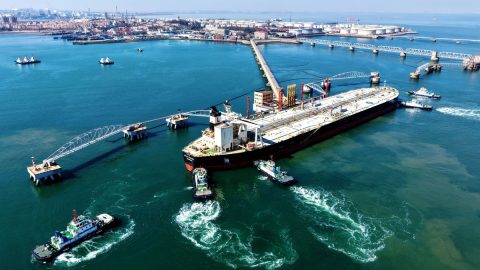
China has operated two more oil rigs in Taiwan’s exclusive economic zone than were previously known, Domino Theory has found. The vessels, both owned by the state-owned China National Offshore Oil Corporation, or CNOOC, were stationed in waters near Taiwan-controlled Pratas Island earlier this year.
Last week, the Jamestown Foundation reported that three Chinese-owned rigs, together with several support vessels, had been operating in the South China Sea near Taiwan-controlled Pratas Island.
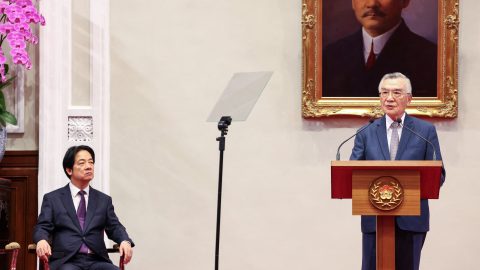
“China must explain its action to fellow country members, and must immediately terminate drilling activities and other illegal activity within Taiwan’s and other countries’ exclusive economic zones,” Taiwan’s Presidential Office said on Thursday in response to a Guardian article reporting the Jamestown Foundation’s findings.
The Jamestown report highlighted apparent challenges Taiwan faces when trying to monitor the waters around Pratas, including persistent cloud cover and a lack of satellite imagery in the area. “Monitoring these activities requires dedicated all-weather imaging resources to provide indications and warning,” the report concluded. (Jamestown conducted its investigation in partnership with ingeniSPACE, a Silicon Valley firm that sells geo-intelligence analytics.)
But a review of months’ worth of public notices posted on the website of China’s Maritime Safety Administration reveals that monitoring Chinese encroachment into Taiwan’s exclusive economic zone is often much easier.
Since January, the Guangdong branch of China’s Maritime Safety Agency (广东海事局) has issued 12 safety warnings that detail the towing of five Chinese-owned oil rigs within Taiwan’s exclusive economic zone. The warnings were usually published one to four days in advance of the towing operations, with exact coordinates indicating where the rig would be towed.
On February 13, they issued a warning that the Nanhai 2 (南海二號), which is also owned and operated by CNOOC, would be towed from the coordinates 21-47.7N, 114-57.4E (outside Taiwan’s exclusive economic zone) to the coordinates 21-36.4N, 116-33.5E (inside Taiwan’s exclusive economic zone). The towing wasn’t set to begin until at least two days later, from February 15 to February 17. “Tow length 250-500 meters, speed 3 knots,” the notice read. “Display the prescribed lights and shapes in a conspicuous area. Please give way.”
The Maritime Safety Administration’s website has published notices detailing the movements of each of the oil rigs revealed in the Jamestown report, including the Nanhai 2, the Haiyang Shiyou 982 (海洋石油982) and the Nanhai 6 (南海六號). On January 17, it published a notice announcing that the Nanhai 6 would be towed into Taiwan’s exclusive economic zone. The towing was scheduled to occur between January 20 and January 23.
In 2012, CNOOC’s then-Chairman Wang Yilin (王宜林) said that “large-scale deep-water rigs are our mobile national territory and a strategic weapon.” The Jamestown report found that many of the rigs’ support structures could be “more valuable for constraining Taiwan’s space than for their nominal commercial purpose of extracting oil.”
Taiwan’s coast guard told The Guardian on Thursday that it “maintains continuous monitoring of maritime targets within its surveillance area” but that this did not include oil drilling operations. The existence of China’s public announcements — sometimes days in advance of planned encroachments — suggests that the main difficulty facing Taiwan is not monitoring, but enforcement.
“China’s advance warnings are an integral part of its gray‑zone play that makes encroachment look routine while putting Taiwan in a bind — respond and be accused of escalation, or stay quiet and seem impotent,” Ray Powell, director of SeaLight, a maritime transparency project at Stanford University, told Domino Theory in an email.
Among the Chinese Maritime Safety Administration announcements reviewed by Domino Theory were notices detailing the locations of two Chinese oil rigs within Taiwan’s exclusive economic zone that have not been previously reported.
On March 7, Guangdong Navigation Alert 37/25 announced that the Nanhai 5 (南海五號), an oil rig also operated by CNOOC, would be towed between two locations both inside Taiwan’s exclusive economic zone. On May 13, the website issued a notice that the Nanhai 7 (南海七號) would be towed from within Taiwan’s exclusive economic zone to outside of it.
The Nanhai 7 is owned and operated by CNOOC, but unlike the other rigs that have been operating in Taiwan’s exclusive economic zone, it flies a Liberian flag. Flying a different flag of convenience is a tactic often used to obscure the origin of a vessel and make it more difficult to apprehend. On the high seas, a vessel’s flag state holds exclusive jurisdiction over the enforcement of maritime law.
In addition to towing and drilling operations, the Maritime Safety Administration’s website also publishes warnings about military exercises and shipwreck clean-ups so that mariners can adjust their navigation accordingly. The waters north of Pratas, where many of the Chinese vessels have been operating, are close to a busy shipping route connecting Hong Kong with the Taiwanese port of Kaohsiung.
“Our government has been closely monitoring the situation and conducting comprehensive assessments of these actions and the risks involved in order to prepare appropriate responses,” a spokesperson from Taiwan’s Presidential Office told Domino Theory by email.
In 2014, Vietnam protested the presence of a CNOOC-operated oil rig within its exclusive economic zone, despite China maintaining a sea barrier around the rig for nearly two months. The rig was later relocated ahead of schedule. But experts say that Taiwan’s maritime limitations will make it difficult for it to achieve a similar result.
“Taiwan has long neglected the importance of building up the capacity and capabilities of the coast guard,” said William Yang (楊皓暐), senior Northeast Asia analyst with the International Crisis Group. He continued: “Whenever China adopts new grey zone tactics to test Taiwan’s responses and capabilities, Taiwan often will be caught off guard and hence fail to respond in a timely fashion.”
On August 22, four days after the end of the period covered in the Jamestown report, the Maritime Safety Administration website posted an update on the Nanhai 2’s plans. “From August 26 to October 26,” the notice read, “the Nanhai 2 drilling platform will conduct drilling operations within a circular area centered at 21-49.3N and 116-54.3E with a radius of 1 nautical mile. No entry.” The location is within Taiwan’s exclusive economic zone.
On August 24, it published another notice, saying that starting the next day, the rig would be towed to that exact spot.




Leave a Reply