This week Chinese leader Xi Jinping used his new year’s address to reiterate that China will “surely be reunified” with Taiwan. With that as a backdrop, Taiwan has been gearing up for its presidential and parliamentary elections, held next Saturday. This is a short primer on the practical details of those elections.
The Voting System(s)
Since 2008, Taiwan has used a mixed-member majoritarian system made up of two ballots for its parliamentary elections, electing 113 members.
One ballot is for single-member districts: Using a first-past-the-post system, 73 members are elected in single-member constituencies. A second ballot is for party list seats: Using party lists, 34 members are elected through proportional representation (the higher a party’s percentage of the overall vote, the more candidates from their list are elected). Smaller parties like Taiwan’s Green Party target these seats. Separately to this, six members are elected by single non-transferable vote (multiple winners in a single “constituency,” which in this case covers the entirety of Taiwan.) These are exclusively to represent Taiwan’s indigenous people.
The presidential election functions more simply. Since presidential elections began in 1996, it’s a first-past-the-post, winner-takes-all system. There is no run-off election. Three candidates are on the ballot this time, Lai Ching-te (賴清德) of the Democratic Progressive Party (DPP), Hou Yu-ih (侯友宜) of the Chinese Nationalist Party (KMT) and Ko Wen-je (柯文哲) of the Taiwan’s People’s Party (TPP). This ballot is cast at the same time as the parliamentary ballots.
Election Day Rules
No campaigning activities are allowed on polling day.
The Practicalities of Voting
Voting starts at 8 a.m. and ends at 4 p.m., although voters who have already arrived at a polling station before that deadline are allowed to cast their ballots beyond that deadline.
Voters must vote in person, in the place where their household is registered, so people living or working overseas or in a different part of the country must travel back if they wish to participate.
On arrival at a polling station, voters must present their national identity card to be checked by a member of staff. Polling station staff are made up of a chief administrator, chief supervisor and administrators, 50% of whom must be active civil servants or public school teachers. Political parties and candidates can also nominate some poll workers.
Voters then sign their name or use their personal stamp in order to receive their ballot paper. They then use a seal provided by the Central Election Commission to mark their selections before placing them in the ballot box. (Presidential candidates publicly draw lots to decide the order their names are placed on the ballot.)
Phones and cameras are not allowed inside the polling station, and intentionally tearing ballots is not allowed.
Counting
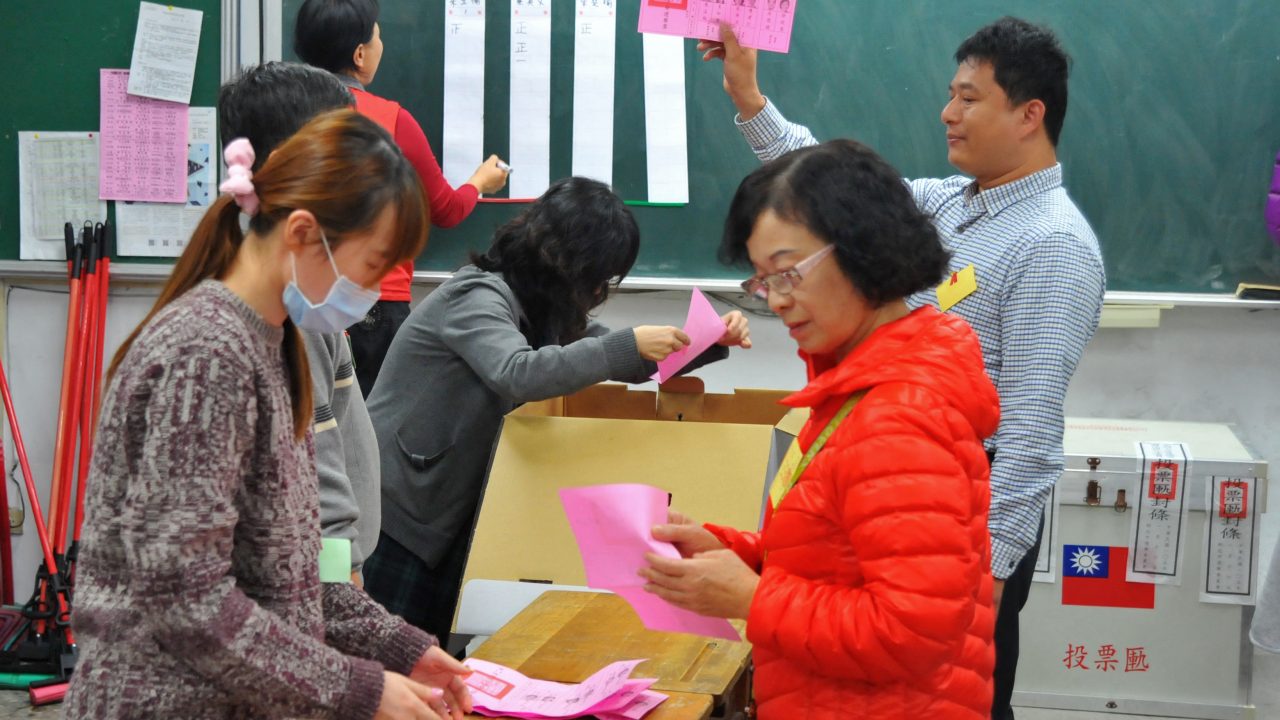
A manual count is done within the polling station, taking each ballot out of the ballot box one by one and displaying it to the public witnesses. These results are then sent up to Election Operation Centers and then on to the County or City Election Commissions. Results are announced by Taiwan’s Central Election Commission (CEC).
Leftover ballots are legally required to be kept for one month after the election. Both valid and invalid ballots that were actually cast must be kept for six months.
The Results
Results usually come out around 8 p.m.
Lawmakers entering parliament will be sworn in on February 1. The new president and vice president will take office May 20. So there is some overlap between the current president and the new parliament. Both serve a four-year term.
Photo: Sandy Cheng/AFP






Leave a Reply