
Almost a year on from the murders of three young girls in Southport that sparked race riots across the U.K., one bizarre aspect of the series of incidents remains largely unknown. As the riots raged, China’s government apparatus allegedly sought to draw Hong Kongers into generalized anti-immigrant sentiment in the U.K. by attaching inflammatory messages to far right social media posts.
According to a Guardian report that is part of an ongoing International Consortium of Investigative Journalists project, a series of fake online accounts sent messages to far right figures such as Tommy Robinson while attaching the addresses of a number of high-profile Hong Kong activists living in the U.K.
Two social media analysis companies told The Guardian that the campaign resembled known influence campaigns originating from China’s government, including from its ministry of public security.
The reason this story has not occupied the wider public imagination — it has not been well covered outside of the initial report — may be simple. It did not appear to directly impact more than a select few individuals who had their information leaked. The wider anti-immigrant violence and rhetoric did not notably shift toward targeting Hong Kongers.
This, too, may be readily explainable. “Hongkongers who emigrated to the UK under the [British National (Overseas)] visa scheme are generally living in better ABC1 areas across the UK (i.e. better socio-economic status areas),” former Hong Kong councillor and U.K.-based academic Michael Mo (巫堃泰) told Domino Theory by email. “They’re also spreading across the four nations (although fairly low % moved to Northern Ireland) where a Hongkonger dominant town is nowhere … .”
The flashpoints for violent outbursts last summer were in poorer areas, so Hong Kongers were less likely to be at the forefront of rioters’ thoughts. Hong Kongers are also spread out geographically, so they’re simply not all that noticeable as a group.
However, this is not to say that this influence campaign and those like it have no effect.
“[T]he best way to understand the aims of most of the [People’s Republic of China’s] foreign interference operations is to recognize their objectives are usually multi-fold,” Laura Harth, of Safeguard Defenders, told Domino Theory. “Their overarching strategy is to influence narratives and policies that align with CCP objectives on the one hand, all while silencing dissenting voices on the other,” she said, using the acronym for the Chinese Communist Party.
In this case, the overt aim of tying Hong Kongers to anti-immigrant sentiment during a crisis may not have had a clearcut impact on the events as they played out. But that doesn’t mean they didn’t help spread fear through the Hong Kong community in the U.K. — alongside other similar campaigns.
“[W]hile they do obviously seek to create channels of influence for the first focus area, any of these campaigns also have the secondary objective of instilling fear within non-CCP aligned diaspora groups. This means that even if in a given case the first is not necessarily effective, the latter may still produce the envisioned effect of dissuading alternative voices from speaking up,” Harth explained.
That assessment chimes with this reporter’s experience of speaking to Hong Kongers at the Chinese embassy protest on May 3. Almost all of them had mixed feelings about whether the U.K. would or could protect them from Chinese government influence.
Once an atmosphere of fear like that is in place, it can layer on top of tangible political developments inside the U.K. to create an even more intense sense of vulnerability.
Currently, a new immigration white paper’s proposal to increase the number of years before new immigrants are legally settled in the U.K. from five to 10 “casts doubts about Labour’s commitment to Hongkongers in the UK,” Mo pointed out. This is due to uncertainty spreading over how these rules will be applied to Hong Kongers, and it contributes to the sense from Mo that he is “more concerned about how the Labour Government reacts to the anti-immigrant sentiment more than the sentiment itself.”
So, what might be done to protect Hong Kongers?
On the visa front, a petition to secure their status has achieved over 100,000 signatures, and U.K. members of parliament with larger numbers of Hong Kongers in their constituencies have urged the government to clarify its position.
However, the response to influence operations is in flux.
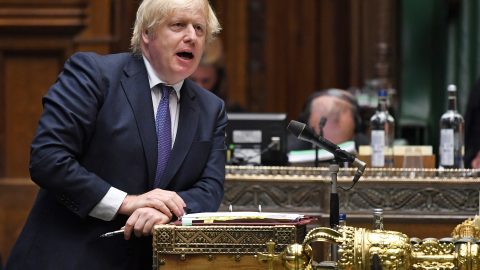
The Labour government’s China audit recognized the concept of “transnational repression,” and Foreign Secretary David Lammy told parliament that his government is “strengthening our response to transnational repression, introducing training for police and launching more online guidance to support victims.” But the audit was not made public and the practical counter measures remain vaguely outlined.
Into this policy void, Chatham House’s new report on the topic, published this week, recommended a “a zero-tolerance approach to Chinese malign influence operations in the UK.”
This included establishing a “‘dialogue on sovereign interests’ with China for addressing core issues of sovereignty, including human rights issues affecting the UK” and ensuring that “all known incidents of Chinese transnational repression in the UK are logged and raised with Beijing as a matter of the UK’s sovereign interests.”
Asked how influence operations channeled through social media might be approached specifically, report author William Matthews told Domino Theory by email that “malign influence operations via social media targeting the UK’s inhabitants should be considered a matter of British national security and an example of transnational repression to be raised directly with China.”
But there are challenges here, in part because social media platforms such as Telegram, Whatsapp and X are owned outside the U.K.
“The issue of malign social media use from foreign jurisdictions is complex due to issues of enforcement and attribution, and the potential to overreach in a way which harms civil liberties. The legal aspects of this will need to be carefully assessed by experts,” Matthews said. “However, developing workable countermeasures to this kind of operation should be considered a matter of urgency, including in dialogue with allies facing similar challenges.”
Evidently, there is work to be done here. And it will have to be done in internal circumstances that are far from ideal from a Hong Konger perspective.
“Anglo-Saxons seemingly recognise the contribution Hongkongers make in recent years,” said Mo, the former Hong Kong councillor, “but I’m worried about the diminishing positive perception given the general mood to blame the immigrants.”
Hong Kongers weren’t dragged into the Southport riots, but they remain subject to both the internal forces that caused them and external attempts to compound them.





Leave a Reply