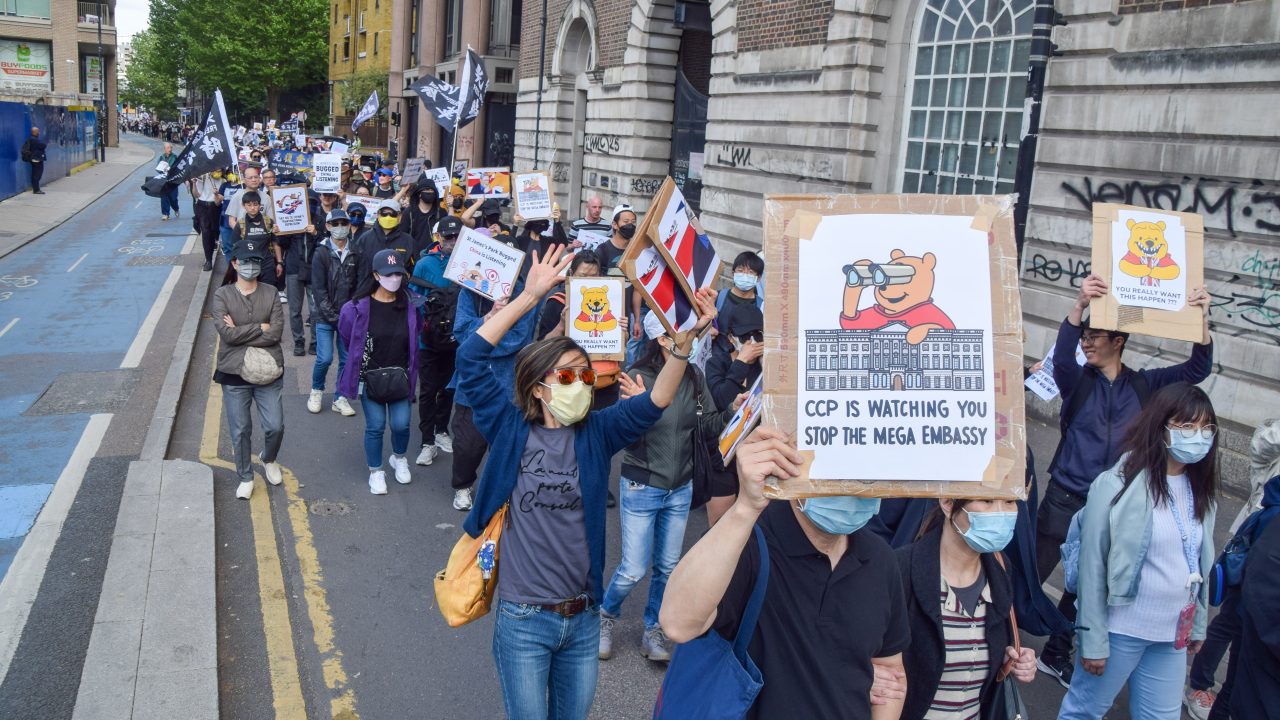
On May 3, around 2,000 protesters — mostly from Hong Kong, but also from mainland China and the U.K. — launched the third demonstration this year against the proposed new Chinese embassy in London. The embassy could become the largest in Europe, and those who are against it have labelled it a “mega embassy.” But it is not only its size that these protesters object to.
Should it be approved by the U.K. government this month, the protesters believe the Chinese embassy will act as a base for what they call “transnational repression.”
That relatively novel term refers to the pressure and control that forms a part of a “global campaign engineered by the Chinese government to coerce and intimidate members of its diaspora,” according to a recent report from the International Consortium of Investigative Journalists.
It is, broadly, an attempt to join up the experiences of Uyghurs and Hong Kongers who fled crackdowns in both Xinjiang and Hong Kong in recent years with others who either fear reprisals or have experienced them directly. It encapsulates orchestrated online harassment campaigns — like the attempt to channel far-right riots in the U.K. toward Hong Kongers last year. And it encapsulates overseas students in Europe and North America being reported on by classmates.
Individual Experiences
Speaking to protesters at the May 3 demonstration, Domino Theory asked them why they were concerned about Chinese government influence in the U.K. Their answers ranged from direct government surveillance efforts and physical interventions to non-government actors channeling government sentiment to commit individual acts of repression such as stalking and intimidation.
One protester in his 30s, who was involved in facilitating the demonstration, said he feared the proposed new Chinese embassy could be used for directing spy operations and disappearing members of the Chinese diaspora in the U.K. who spoke out against China. He cited the case of the Hong Kong protester who was dragged into the Chinese consulate grounds in Manchester in 2022 as the basis for this projection and said he himself had cut off all ties with his family in Hong Kong over safety concerns.
Another protester from mainland China, also in his 30s, had broader concerns about the embassy. He said if the U.K. government granted permission for the site to be turned into an embassy, would act as a message to Chinese diaspora communities that the Chinese government still had power over them.
The same protester said his personal experience of repression came at a U.K. university, where fellow Chinese students had “cyber-bullied” him in a group chat when he had expressed negative opinions about the Chinese government. He said that after reporting the bullying to his course leader, he had been told that nothing could be done.
An Atmosphere of Paranoia
However, what was also apparent from speaking to protesters for almost two hours was that any idea of transnational repression is also more than the sum of its parts.
Alongside personal experiences and literal concerns about the physical security infrastructure at the embassy site, the harsh treatment of high-profile Hong Kong activists was cited by almost everyone Domino Theory spoke to. In her opening speech, for instance, organizer Clara Cheung (張嘉莉) highlighted the fact that days before the demonstration, the father and brother of Anna Kwok (郭鳳儀) had been arrested in Hong Kong. Kwok is one of 19 overseas activists who has had a bounty placed on her head by Hong Kong authorities.
The experience of sustained harassment that those people have faced both online and in person serves as a focal point through which a wider atmosphere of fear and paranoia is experienced. “Just look at what they have done to them” was a sentiment repeated often at the demonstration, referring to the idea that it could be anyone else next.
Is the Pressure Real?
Creating that atmosphere is something China denies. Accusations of transnational repression are “groundless” and “fabricated by a handful of countries and organizations to slander China,” according to Liu Pengyu (劉鵬宇), a spokesperson for the Chinese Embassy in Washington. Liu told the International Consortium of Investigative Journalists “there is no such thing as ‘reaching beyond borders’ to target so-called dissidents and overseas Chinese.”
Many of the May 3 protesters disagreed. They felt a pressure being applied to them not to say or do the wrong thing.
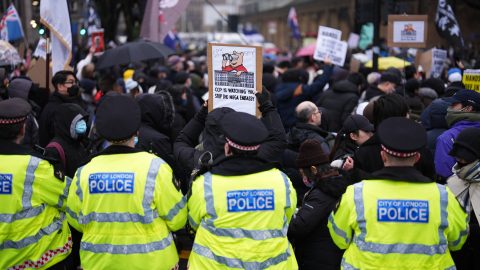
They had mixed feelings about whether the U.K. would or could protect them. They were skeptical about recent trade talks with China. Many wore face masks to protect their identities. Those who didn’t said it was because they were already known to the Chinese government. And when the Metropolitan Police in London changed the route of their march at late notice, there were many who questioned whether pressure had been applied by either the Chinese or U.K. governments — though the police told Domino Theory this was not the case.
Up close, the formation of doubts like these is the essence of what people really mean when they talk about “transnational repression.”


Leave a Reply