
Zhang Zhan Faces a Second Trial
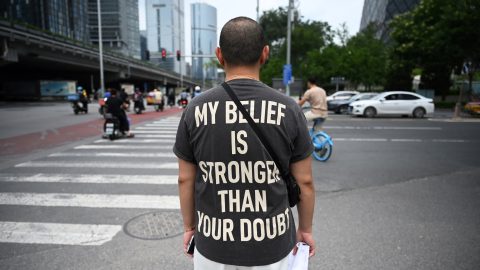
Chinese citizen journalist Zhang Zhan (張展) went on trial again today in Shanghai, this time for the catch-all offense of “picking quarrels and provoking trouble” (尋釁滋事罪).
Zhang, a 42-year-old former lawyer, was previously jailed for reporting on the Covid-19 outbreak.
The Guardian reports the indictments for her latest trial mentioned YouTube and X posts that “seriously damaged the country’s image.” Prosecutors are seeking a sentence of four to five years in prison.
“Zhang Zhan should be celebrated as an ‘information hero,’” said Antoine Bernard, a director of advocacy and assistance for Reporters Without Borders. “Instead, she is once again being prosecuted by the Chinese regime, fighting for her survival in prison.”
China Exports Maoist-Era Community Surveillance
China has introduced a surveillance-based community policing program to the Solomon Islands, raising concerns about the spread of China’s authoritarian model following Honiara’s 2019 switch of diplomatic ties from Taipei to Beijing.
The village surveillance program is based on Mao Zedong’s (毛澤東) “Fengqiao Experience” (楓橋經驗), a Cultural Revolution-era system that directed the masses to inform on each other and engage in struggle sessions with “class enemies.”
Chinese police visited several villages in the Solomon Islands this year to promote the program, acclimating children to surveillance drones and teaching villages about household registration, fingerprinting and data collection.
The Solomon Islands government said that the program was being piloted in a village on the outskirts of the capital Honiara, quoting a Chinese police inspector as saying the program “will be expanded to a larger area across the country in the future.”
Chinese police also promoted the Fengqiao system in 16 villages in Malaita, a province with strong ties to Taiwan.
NBA Brands Profiting From Forced Labor
An investigation by The Bureau of Investigative Journalism found that sportswear brands Li-Ning, Anta and 361 Degrees directly own production facilities that use forced labor obtained through a labor transfer scheme that sends ethnic minorities to work in Chinese factories.
The labor transfer scheme is part of a system of oppression designed to force ethnic minorities to assimilate into the majority Han Chinese culture.
NBA stars with sponsorship deals with the companies include Jimmy Butler and Fred VanVleet (Li-Ning), Kyrie Irving and Klay Thompson (Anta), and Nikola Jokic (361 Degrees).
Nike was also linked to the labor transfer scheme through Fulgent Sun, a Taiwanese footwear giant with a factory in Fujian Province.
Zambia Acid Spill
Zambians affected by an acid spill at a Chinese-owned mine that contaminated a major river are demanding $420 million in compensation.
A dam holding mining waste from Chinese mining company Sino-Metals Leach Zambia failed earlier this year, releasing acidic effluent into the Kafue River’s watershed.
Sino-Metals, a subsidiary of the Chinese government-owned China Nonferrous Metal Mining Group, estimated 50,000 tons of acidic waste laden with heavy metals were released in the accident.
But South African environmental company Drizit, which says it was contracted by Sino-Metals to investigate the accident, estimated that the disaster was 30 times worse than Sino-Metals’ estimate, with up to 1.5 million tonnes of toxic waste released into the environment.
Drizit said 900,000 cubic metres of toxic substances were still present in the environment, “posing significant long-term health risks, including organ damage, birth defects, and cancer.”
Sino-Metals disputes Drizit’s findings.
China is the world’s largest consumer of copper, and Zambia is one of the world’s top 10 copper-producing countries.
Silicon Valley Enabled Human Rights Abuses
An investigation of a massive trove of leaked information published by The Associated Press found that U.S. tech companies, including IBM, Cisco, Dell, Oracle, Nvidia and Microsoft, played an even greater role than previously known in the development of China’s vast censorship and surveillance state — and in facilitating the ensuing human rights abuses.
The cooperation between Silicon Valley and Chinese police, which helped build out the capabilities of domestic firms like Huadi and Landasoft, persisted despite rising awareness of the use of such tools to suppress dissent and persecute ethnic and religious minorities.
Dell bragged on WeChat in 2016 that its services helped Chinese internet police in “cracking down on rumormongers,” while Seagate posted on the Chinese social media platform in 2022 about selling hard drives “tailor made” for AI video systems for use by police in China to help “control key persons.”
“Everything was built on American tech,” Valentin Weber, a researcher at the German Council on Foreign Relations who studied the use of U.S. tech by Chinese police, told AP. “China’s capability was close to zero.”
Of particular note was a partnership by IBM with Shanghai-based Landasoft to sell IBM’s i2 police surveillance analysis software. After years of marketing the software in China on behalf of IBM, Landasoft replicated i2 to develop its own pre-crime detention program.
Evidence included classified government documents, blueprints, and accounting ledgers from a Chinese military contractor and IBM partner taken out of China by a whistleblower, leaked internal emails from Landasoft, and marketing materials from policing trade shows, websites and social media.
A woman from a family of farmers who had been caught up in China’s high-tech police dragnet over land petitions warned Americans they were next. “At the moment, it’s us Chinese that are suffering the consequences,” she told AP, “but sooner or later, Americans and others, too, will lose their freedoms.”
U.N. Fails to Make Progress on Xinjiang
Uyghurs and human rights advocates condemned the lack of global action following a 2022 U.N. report on abuses in China’s Xinjiang region.
The report, published in August 2022, detailed human rights violations against Uyghurs and other Muslim minorities in Xinjiang, including “credible” allegations of sexual and gender-based violence, including rape, and “the widespread arbitrary deprivation of liberty.”
It urged the Chinese government to take “prompt steps to release all individuals arbitrarily deprived of their liberty” in the Xinjiang Uygur Autonomous Region.
“Three years after the U.N. report concluded that China was responsible for grave human rights violations in Xinjiang, it is shameful that the international community has failed to act,” said Sarah Brooks, Amnesty International’s China Director.
Activists called the inaction since the report’s release a failure of international accountability and pressed U.N. rights chief Volker Turk for more decisive steps.
“In China, the progress we have sought for the protection of the rights of Uyghurs and other Muslim minorities in Xinjiang, as well as Tibetans in their regions, has yet to materialize,” Turk said in remarks before the Human Rights Council. “This is a priority for my office’s engagement.”
‘Freedom for Gao Zhisheng Act’
U.S. Representative Chris Smith on September 11 introduced the “Freedom for Gao Zhisheng Act,” a bill to require a coordinated U.S. strategy to free human rights defenders and political prisoners in China and Hong Kong.
The legislation would help ensure that cases like those of missing Chinese human rights lawyer Gao Zhisheng (高智晟) and Hong Kong pro-democracy media mogul Jimmy Lai (黎智英) “are not left behind in high-level negotiations,” according to a press release on the congressman’s website.






Leave a Reply