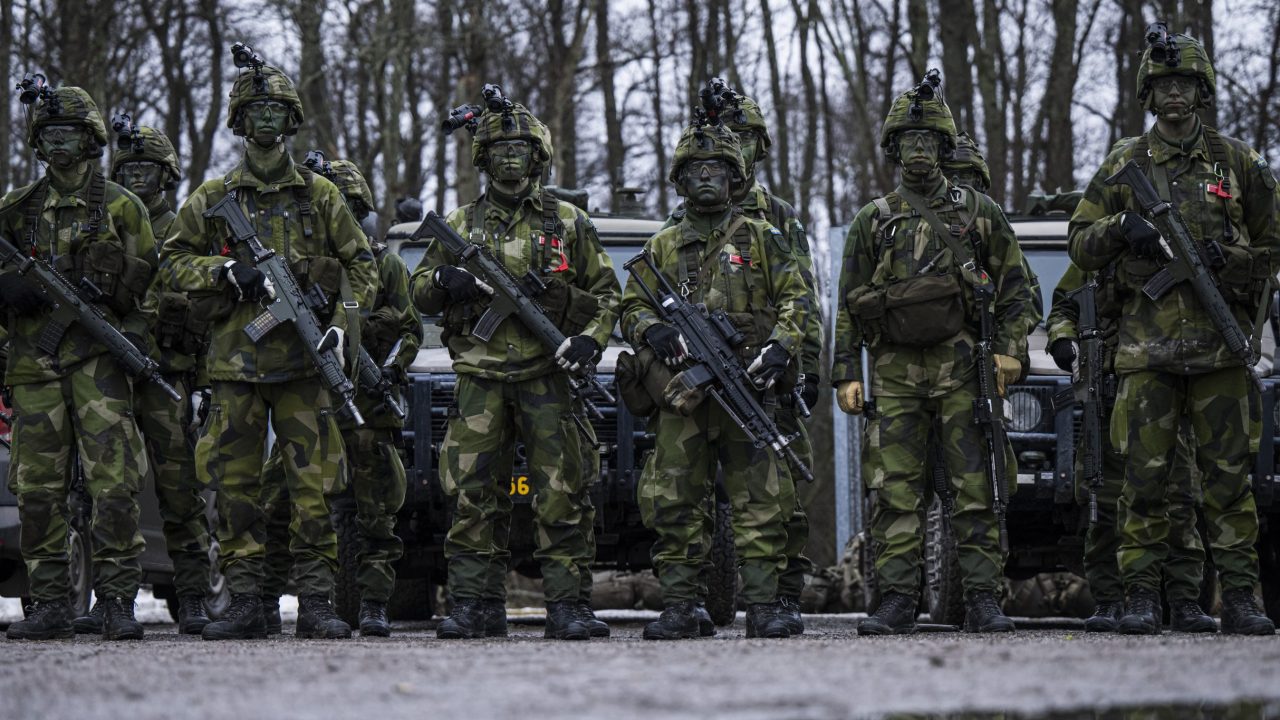
As U.S. President Donald Trump pulls back U.S. support from Ukraine, alongside many soft power projects, the signal has gone out to other countries that alternative international partnerships might be handy.
But what should new multipolar arrangements look like? And are they relevant to the Indo-Pacific and China, where the Trump administration’s positioning is not yet clear?
For anyone looking for answers, the relationship between India and Sweden could represent an instructive example of things to come.
Multipolar Buddies
Bilateral relations between the two countries have been improving for years. Trade in goods has increased from $3 billion in 2016 to $5 billion in 2022 and that has gone hand in hand with increasing military connections. Swedish manufacturer Saab, for instance, already has a major presence in India, beginning construction of a production unit for the shoulder-launched iconic Carl-Gustaf M4 weapon systems there in March 2024.
This already impacts the Indo-Pacific.
On the one hand, Sweden joined NATO last year, and shortly after that its government said it sees security in the Indo-Pacific and Euro-Atlantic regions as “increasingly interlinked.”
On the other hand, India’s geographic location in the Indian Ocean positions it as an Indo-Pacific powerhouse. In November, Sweden’s new Minister for Foreign Affairs Maria Malmer Stenergard emphasized India’s “essential role” as a “defender of democracy, multilateralism, and the U.N. Charter.”
But now, there are those who believe there remains far more scope for direct cooperation — with eyes ultimately on China.
A New Seriousness
“I can see from the Swedish side but also from the Indian side that now we will really see what friendship is about because now we’ll be tested — all of us will be tested — to see what is real [and] what is not real, what is serious [and] what is not serious,” Lena Backer, former enforcement director in the Swedish government, told an Institute for Security and Development Policy event co-hosted by the Embassy of India in Sweden this week.
“Seriousness” could take a number of forms if it is transposed over to the Indo-Pacific.
Sweden could support India with cost-effective technologies, joint manufacturing of defense equipment — particularly in the maritime domain — and knowledge sharing on best practices, Pooja Bhatt, an Associate Professor at Jindal School of International Affairs, said at the same event as Backer.
Additionally, Sweden’s expertise in resilient coastal infrastructure could help India assist Indian Ocean nations facing climate change threats, while both countries collaborate on building capacity for marine and scientific research.
Bhatt also said Nordic countries could support India’s Arctic research, enhancing its understanding of how the Himalayas (known as the “Third Pole”) influence temperatures, sea waters, and the global environment.
Lars Vargo, the former Swedish Ambassador to Japan, spoke along similar lines. Alongside considering whether to take part in NATO exercises through the Taiwan Strait or “cooperating” with QUAD countries, he pitched further environmental cooperation.
“When I was ambassador to Japan, I was also ambassador to Palao, Micronesia and the Marshall Islands and we also recognize that … rising sea levels is a real threat to the Pacific island countries and we could do more together there,” Vargo said.
End Goals
These might seem like slightly sporadic demands. But beneath the surface they’re connected by a laser-focus on China.
China is buying up ports around the Indian Ocean “just because no other country is trying to help them in port development and investments and [research and development]” Bhatt told Domino Theory. At the same time, Chinese research vessels and undersea unmanned underwater vehicles are suspected of conducting espionage around the Indian Ocean.
“That’s why I brought about this point that we need to have more and better maritime domain awareness for the region and that is where the India-Sweden collaboration in AI and technologies in the maritime domain is important.”
“The port and infrastructure development is important. The green energy and technologies which are required for these port developments and clean energies: that is important. So I think they all come together for the common cause in the region if both the countries come together.”
The point about the Arctic may also reference the ongoing battle for supremacy there.
Vargo was explicit. These efforts would be aimed at a “China challenge” where “One of the most important elements is that we have to be there. We have to show ourselves interested … [and] we cannot do it alone.”
Why Now?
Three major forces are pushing together these kinds of odd-couple partnerships that few outside of the professional political sphere have substantial knowledge of.
First, many of these areas of potential cooperation would be building upon existing ties.
The India-Sweden Green Industrial Transition Partnership, for instance, launched in 2024, matching Swedish expertise with heavy industry in India. This is already a green partnership.
Second, China’s power has increased in the Indo-Pacific region and many of these countries don’t like it. This might include investing in ports, or it might involve demonstrations of sheer military power.
“Recently, the Chinese navy performed some live fire exercises in the Tasman Sea between Australia and New Zealand without notifying the countries involved,” Lars Vargo said in answer to a question from Domino Theory about why Sweden and India were coming together now.
“[T]his type of behavior can be interpreted in no other way than that they would like to send the signal that they are able to act whenever and however [they want.]”
And finally, the U.S.’s withdrawal and threats of withdrawal from existing multilateral arrangements begets a search for more “reliable” partners.
“There is no predictability in this kind of situation so now every other country is looking for new partners which are more reliable, which are more transparent,” Bhatt told Domino Theory, adding that the demographics and ability to buy and make products made Indo-Pacific countries highly sought after partners.
Where Now?
This does, though, still leave open the question of who this suits.
All of Lena Backer, Vargo and Bhatt talked about a Sweden-India partnership — and those like it — as a way to avoid following the “whims” of great powers. They talked about being “tired” of great power politics. But it would be strange not to add that the U.S. will likely be very happy with these challenges to Chinese hegemony in the Indo-Pacific, whether it is directly involved or not.






Leave a Reply