
The Inter-Parliamentary Alliance on China (IPAC) Summit in Taipei has gotten underway, but not without some final hitches.
IPAC delegates flew in over the weekend, and met with Vice President Hsiao Bi-khim (蕭美琴) on Monday, but there was drama in the preceding days as China reportedly tried to dissuade legislators from attending.
Tuesday July 30 will be the main event of the summit, with meetings and discussion between delegates and a press conference to follow. Taiwanese security is expected to be high on the agenda.
IPAC, the Inter-Parliamentary Alliance on China, is a group of legislators from parliaments all around the world. The alliance focuses on the challenges that China poses to democracies. IPAC is voluntary to join and individuals represent themselves, not speaking in an official capacity for their parties, governments or countries.
Chinese diplomats contacted legislators from several countries, asking them about their travel plans, or directly telling them not to come to Taiwan, the Associated Press reported on Sunday July 28. “Bolivia, Colombia, Slovakia, North Macedonia, Bosnia and one Asian country that declined to be named” were listed as those countries whose delegates were contacted, although of course other nations’ attendees may also have been pressured. The above list doesn’t contain any delegates from the larger economic powers in IPAC, although without more information it’s impossible to know if this common denominator is significant.
“They contacted the president of my political party, they asked him to stop me traveling to Taiwan.” This is a quote from Bosnian Member of Parliament Sanela Klaric in the Associated Press article. It shows how such a conversation and interaction would take place on a second, indirect, level.
IPAC released a statement accompanying the Associated Press report. It contained a list of all the legislators who have come to Taipei. From that list the information of which IPAC countries’ parliamentarians are not attending can be obtained. They are: Albania, Belgium, Italy, Kenya, Montenegro, New Zealand, Norway, the Philippines, Switzerland, Uganda, Ukraine and the U.S.A. It’s quite likely that some of these countries’ delegates were also spoken to by Chinese diplomats and that this influenced their decision not to attend.
The most notable, even shocking, absence is that of the U.S. However, the Philippines is also an interesting no-show. No explanations have yet been given.
The Japanese contingent is the largest, which given geographic proximity and geopolitical interest may be no surprise. Conversely, the U.K. group is comfortably the second most numerous and this may raise some eyebrows.
IPAC also announced that legislators from six new countries are joining the alliance: Colombia, Iraq, Malawi, Solomon Islands, Gambia and Uruguay. Of those, delegates from Colombia, Solomon Islands and Uruguay are in Taipei. There was still no mention of Taiwanese membership from IPAC. IPAC requires that delegates from multiple parties in a country’s parliament join to foster cross-party consensus on China.
There are certainly many questions to be asked just about the delegate list. Answers should be forthcoming at the press conference on Tuesday.
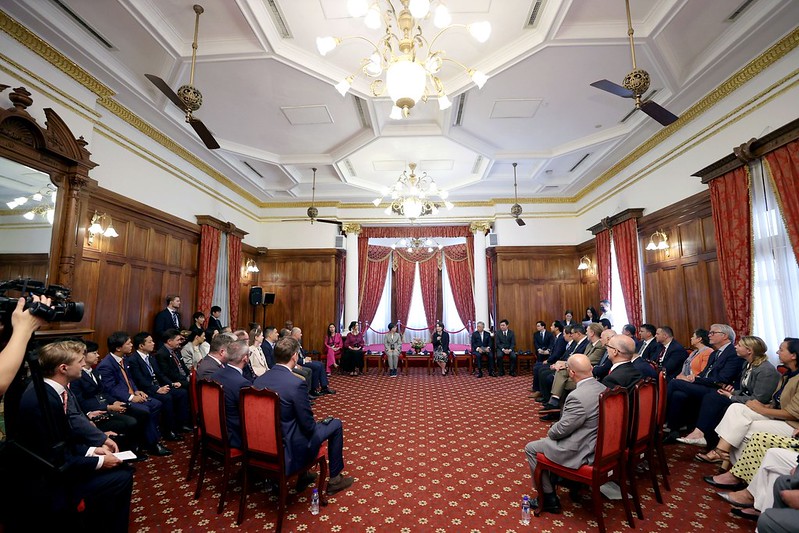
On Monday the attendees went to the Taipei Guest House to meet with Vice President Hsiao Bi-khim. In her remarks Hsiao said the following:
“In Taiwan, we face significant challenges in all of these areas, particularly, the geopolitical situation where Beijing is aggressively expanding their military presence as well as other gray zone hybrid tactics of coercion in the Taiwan Strait and toward the people of Taiwan. So your presence here is at a very important moment as we strive to make Taiwan much more resilient in our own self defense, but also resilient in our democracy and resilient in our society and resilient in our economy.”
No doubt Hsiao will be hoping that when the delegates return to their home parliaments, they can persuade them to be a part of this resilient striving. That is something we should hear more about on Tuesday.
Main image: Simon Liu/Office of the President, Republic of China (Taiwan), CC BY 2.0




Leave a Reply