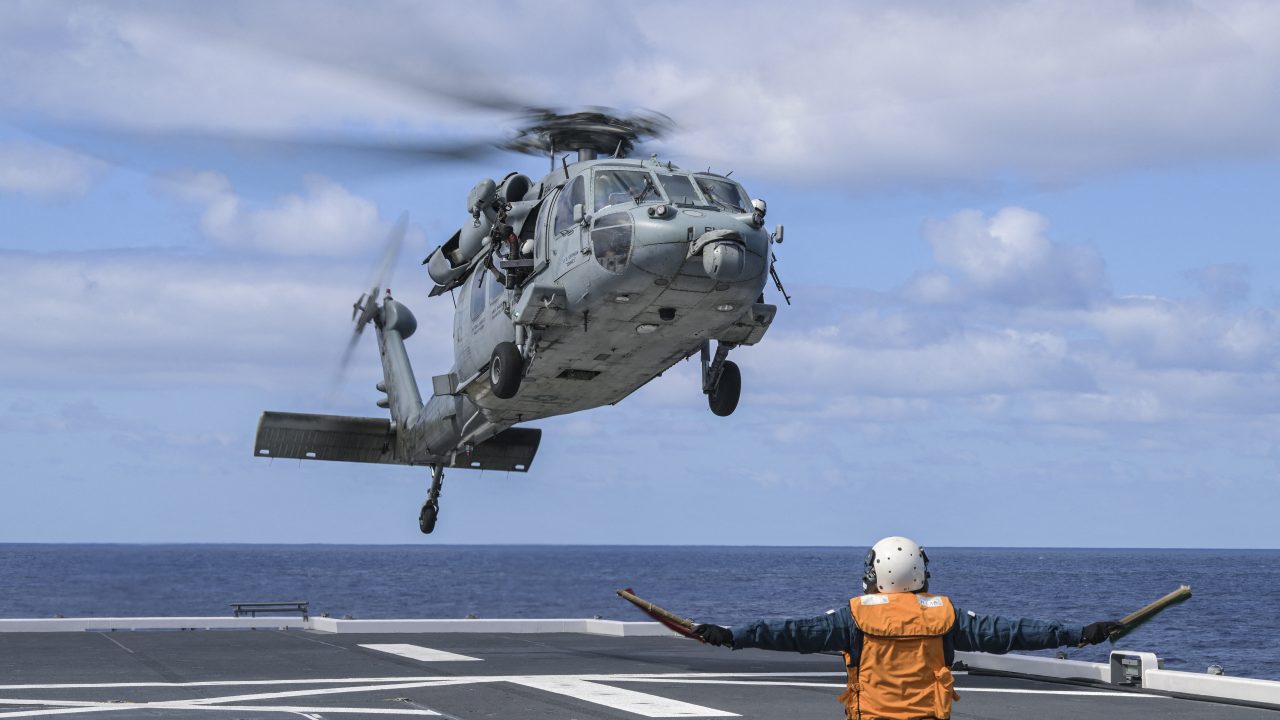
Japan’s Ministry of Defense last week said it was establishing a permanent Joint Operations Command to improve rapid response capabilities for major disasters and security threats.
The 240-personnel unit is also tasked with improving coordination with U.S. forces and integrates all branches of the Self-Defense Forces, along with the Cyber Defense and Space Operations Groups.
The announcement marks a significant shift in Japan’s military strategy, enhancing the country’s rapid response capabilities for large-scale disasters and regional security threats, including potential crises related to Taiwan.
Satoru Nagao, a defense scholar and nonresident fellow at the Hudson Institute, told Domino Theory that while the Joint Operations Command is not explicitly designed for Taiwan’s defense, “the reality is that establishing [it] is closely linked to a potential Taiwan emergency.”
“Japan has been stepping up its involvement in the Taiwan issue,” Nagao said, citing as an example the U.S.-Japan Joint Leaders’ statement at the U.S.-Japan summit in February, which expressed support for Taiwan’s meaningful participation in international organizations.
Legislator Chen Kuan-ting (陳冠廷) of Taiwan’s Democratic Progressive Party (DPP), said that while the Joint Operations Command is a major step for regional security and U.S.-Japan coordination, it does not necessarily mean Japan has formally included Taiwan in its security strategy.
Instead, Chen advocates gradual Taiwan-Japan cooperation, particularly in non-military areas like intelligence sharing and coast guard operations, to build trust and address gray-zone threats.
Chen pointed out that due to constitutional constraints — specifically Article 9 of Japan’s constitution — Japan’s Self-Defense Forces operate under tight legal and political restrictions. For example, even in previous U.S.-led military efforts such as the Iraq War, Japan’s involvement was carefully circumscribed and heavily monitored by its legislature.
Yesterday in Tokyo, U.S. Defense Secretary Pete Hegseth said the Defense Department has started phase one of upgrading U.S. Forces Japan to a Joint Force Headquarters that will be better able to work with the new Japanese Joint Operations Command.
Hegseth emphasized Japan’s role in countering Chinese aggression, stating that its support is essential for Washington to establish a credible deterrence in the region, including across the Taiwan Strait.
Hegseth and Japanese Defense Minister Gen Nakatani also announced plans to co-produce AMRAAM missiles and explored expanding defense cooperation on other weapons.
But recent reports have indicated that the administration of U.S. President Donald Trump is reconsidering plans to expand the U.S. military presence in Japan as part of broader government spending cuts.
The expansion was first announced in July under former U.S. president Joe Biden and includes locating a four-star flag officer in Japan who would be the counterpart of the head of the new Japanese Joint Operations Command.
On these developments, Yoshiyuki Ogasawara, a Japanese professor who teaches Taiwanese elections and politics at National Tsinghua University in Hsinchu, told Domino Theory that Japan and its armed forces are very cautious, as they have no intention to expand their presence in the region or to form an alliance with Taiwan.
However, Ogasawara pointed out that “China must count Japan’s ‘rear support’ as [a] real obstacle to achieve military unification of Taiwan.”
While Japan’s security policy remains cautious, direct Taiwan-Japan cooperation is increasing. Both sides have expanded coast guard coordination, particularly in the East China Sea, where Taiwan and Japan face pressure from China’s maritime forces.
In 2023, Taiwanese and Japanese coast guard officials held their first high-level talks, signaling deeper security ties outside of traditional military cooperation.
On March 27, Japan’s chief cabinet secretary, Yoshimasa Hayashi, announced that the Japanese government has developed evacuation plans to remove 120,000 residents from Okinawa’s remote islands within six days in response to a potential emergency in the Taiwan Strait.




Leave a Reply