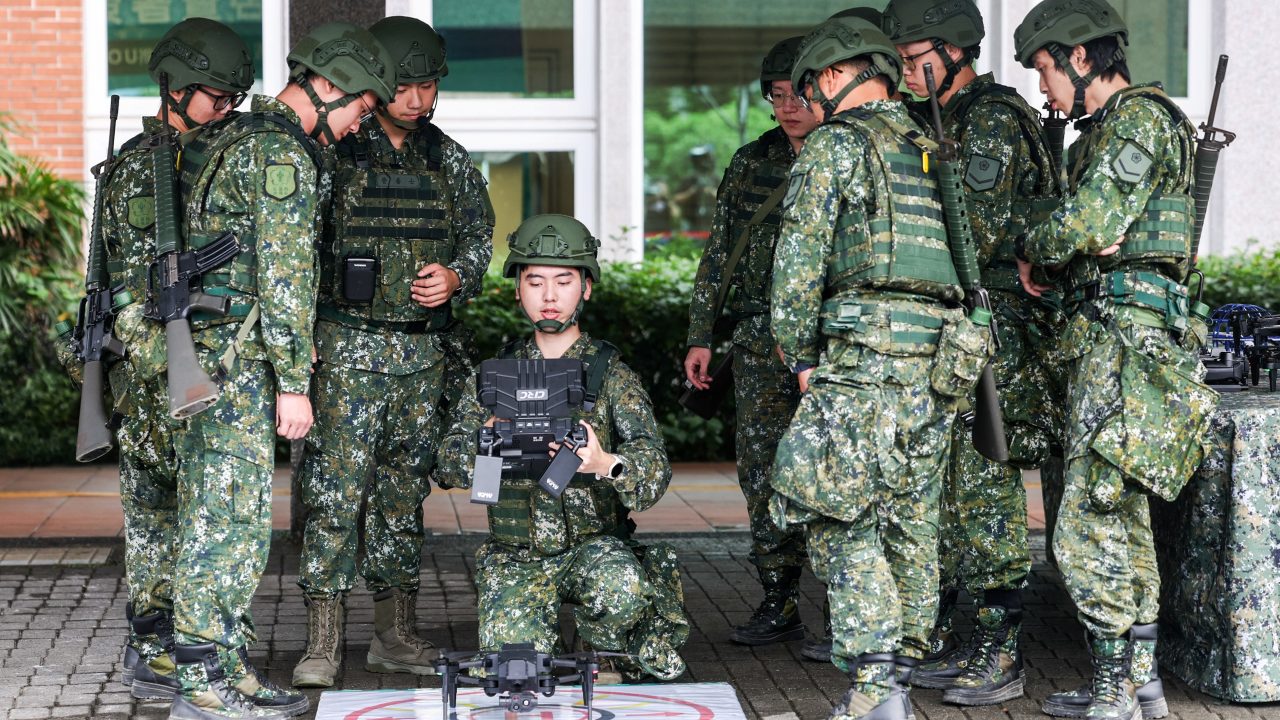
For years, defense experts have called on Taiwan to ramp up its drone production to prepare for a Chinese invasion. The island’s government has made some progress on its own. Last month, it launched the tendering process for its drone procurement program, which calls for the military to purchase nearly 50,000 indigenous drones over the next two years.
Now, Taiwan is poised to get a boost from the U.S.
The National Defense Authorization Act, the U.S. government’s annual defense spending bill, passed the House of Representatives this week. The bill includes a provision calling on the Pentagon to establish a new joint drone program with Taiwanese officials.
Under the bill, which President Donald Trump is expected to sign into law before the end of the year, Secretary of Defense Pete Hegseth would be required to brief Congress on the status of the program before next summer.
The new drone initiative “is clearly intended to push cooperation forward quickly to help Taiwan learn the lessons of Ukraine and put them into practice alongside the United States,” said Zack Cooper, a senior fellow at the American Enterprise Institute, in response to an email query.
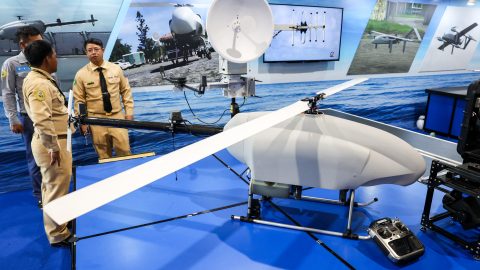
Drone cooperation between the U.S. and Taiwan has until now been driven mostly by the private sector. In September, U.S. firms including Anduril and Shield AI brought their latest tech to Taipei for the country’s premier defense expo. Local champions Tron Future and Thunder Tiger were also on hand.
Anduril has set up an office in Taipei and announced plans to manufacture its Barracuda cruise missile on the island. But the engagement goes both ways. On Tuesday, Thunder Tiger announced that it would join the running for military contracts under the Pentagon’s Drone Dominance Program, which aims to procure 200,000 uncrewed vehicles by 2027.
“Co-development and co-production of drones are clearly issue areas that are ripe for greater levels of cooperation and coordination,” said Michael Hunzeker, a professor at George Mason University’s Schar School of Policy and Government and director of the Taiwan Security Monitor, by email.
But Hunzeker stressed that a large stockpile of drones alone won’t be sufficient if Taiwan wants to defend itself. “The MND needs to pair these drones with a logical and coherent doctrine and associated warfighting concepts for using them effectively on the battlefield,” Hunzeker added, referring to Taiwan’s Ministry of National Defense.
The National Defense Authorization Act also allocates up to $1 billion for security cooperation initiatives with Taiwan, on areas such as medical equipment and “combat casualty-care capabilities.”
Gerrit van der Wees, a former Dutch diplomat and longtime Taiwan resident who now teaches at George Mason, called the bill “a good move forward in integrating Taiwan in the defense planning of the United States, and developing further means for the U.S. and Taiwan to jointly develop the means to defend Taiwan.”
Taiwan’s Foreign Minister Lin Chia-lung (林佳龍) also welcomed the bill, saying Tuesday that it “demonstrates the consensus between the executive and legislative branches of [the] U.S. government to strengthen Taiwan’s security.”
But Hunzeker cautioned that parts of the defense bill are short on specifics. The Taiwan provisions “really only [require] that the Department of Defense submit reports about its plans,” Hunzeker said. “Submitting a plan is obviously useful and important, but it also shouldn’t lead us to conclude that the effort is anything close to a ‘done deal.’”
Correction: This article was updated on December 15, 2025 to correct the misstatement that the National Defense Authorization Act had already been passed by both houses of Congress. It had already passed the House of Representatives, but not yet the Senate.



Leave a Reply