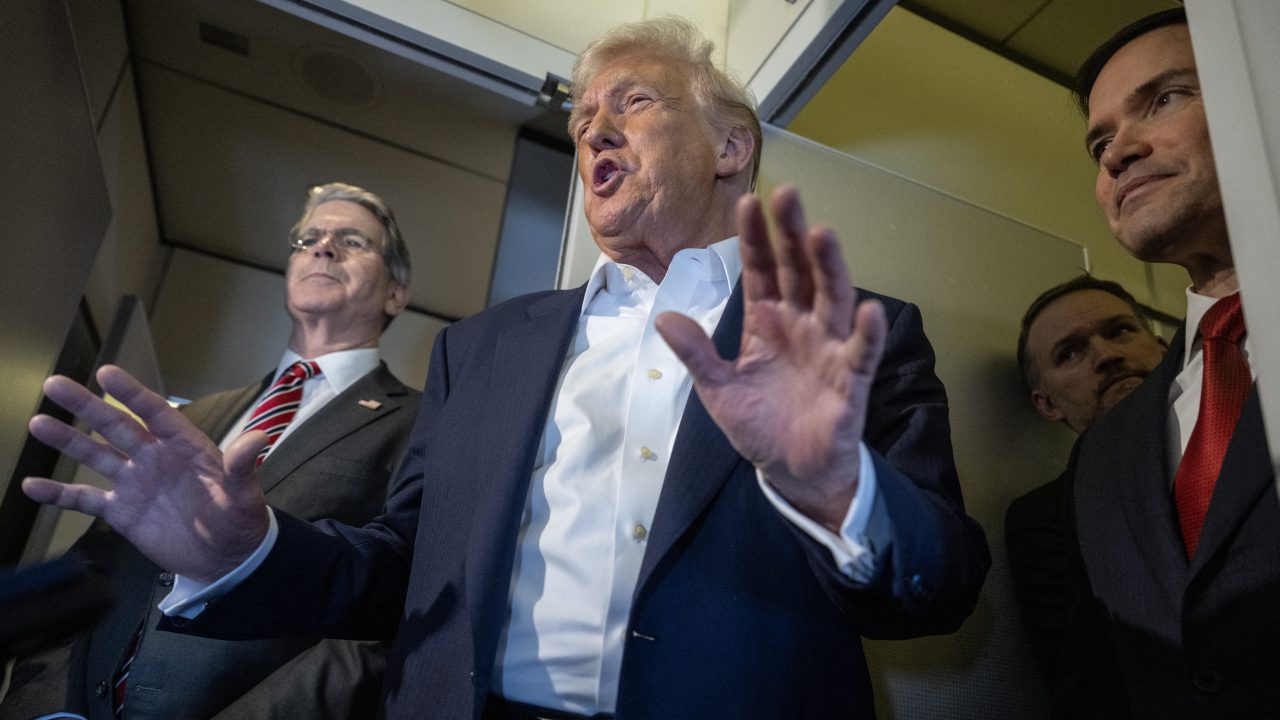
For almost every issue that could come up when Donald Trump meets with Chinese president Xi Jinping (習近平) at the APEC summit in South Korea on Thursday, it is clear which side has the leverage. Trump will dangle lower tariffs, looser export controls on high-tech equipment, and a stronger endorsement of the “One China” policy. Xi can offer to free up rare earth exports, crack down on fentanyl precursor chemicals and buy more soybeans.
There’s one issue, however, that confounds this dynamic: Nvidia chips. Analysts expect the company’s modified Blackwell architecture model, tentatively called the B30A, to be part of the discussion during Trump and Xi’s high-stakes meeting in Seoul, but it’s not clear who will be pressing whom.
“Trump may dangle approval of the B30A since he knows it is something Xi wants, even if the administration decides on its own to export B30A in an attempt to gain chip market share in China,” said Saif Khan, former director of Technology and National Security in the Biden White House. “On the other hand, Xi may try to make it appear like he’s dangling approval even though he actually wants the B30A, as a negotiating ploy.”
Just a year ago, Xi using Nvidia as a bargaining chip would have been unthinkable. That’s because AI chips were once a clear-cut issue in the U.S.-China rivalry. The U.S. had them, and China wanted them. Trump’s first administration pioneered a series of export controls meant to hamstring China’s ability to manufacture the most advanced AI chips. The Biden administration built on these measures with rules that specifically targeted total computing power, a key metric in the AI race.
But Trump’s second term has muddied the waters. In July, his administration removed export controls on Nvidia’s H20, a pared-down Hopper architecture chip that the company had designed specifically for the Chinese market. The move came at the behest of Nvidia’s CEO Jensen Huang, who expected the H20 to be a hit with the Chinese market. But Chinese regulators urged tech firms not to purchase the chip, and to favor domestic offerings instead.
“It’s pretty ironic that we’ve gone within the space of three years from the U.S. banning chip exports to China to slow their tech development, to China now telling its companies to avoid those same U.S. chips in favor of domestic alternatives — which now exist because of those U.S. export controls,” wrote Arnaud Bertrand, a pro-China blogger with a large social media following, in a post on X at the time.
Threatening to ban Chinese tech firms from buying the B30A could frustrate Trump, who has developed a close relationship with Huang. The move would also align with Xi’s desire to develop China’s domestic chip-making industry.
In a written extrapolation of China’s new five-year plan, which Chinese state media published on Tuesday, Xi emphasized the need for Chinese technology to sustain itself. “The most important task is to accelerate high-level technological self-sufficiency and self-strengthening, actively foster new quality productive forces, and achieve substantial and breakthrough progress in promoting scientific and technological innovation, accelerating the cultivation of new drivers of growth, and optimizing and upgrading the economic structure,” Xi wrote.
Robin Xing (邢自强), chief China economist at Morgan Stanley, told The Associated Press last week that high-tech sectors central to Xi’s push include quantum technology, biomanufacturing and nuclear fusion energy. But the sector where China has the most room to improve is still high-end chip manufacturing.
Khan, the former Biden official, thinks that even if China’s long-term goal is to make high-end chips, in the short term, they still need Nvidia. “China’s AI industry will not be competitive with the U.S. AI industry in the next few years if it cannot get access to U.S. AI chips and U.S. and allied chipmaking tools,” he said. “The most likely way for China to build a thriving frontier AI industry is to convince the U.S. government to loosen controls on chips and tools.”
A report from the Institute for Progress published earlier this week finds that letting China buy B30As would shrink the U.S. computing power advantage from 31 times to less than four times. With the B30A in hand, the authors write, Chinese companies could operate their data centers at a cost just 20% greater than American counterparts using Nvidia’s flagship B300 chip.



Leave a Reply