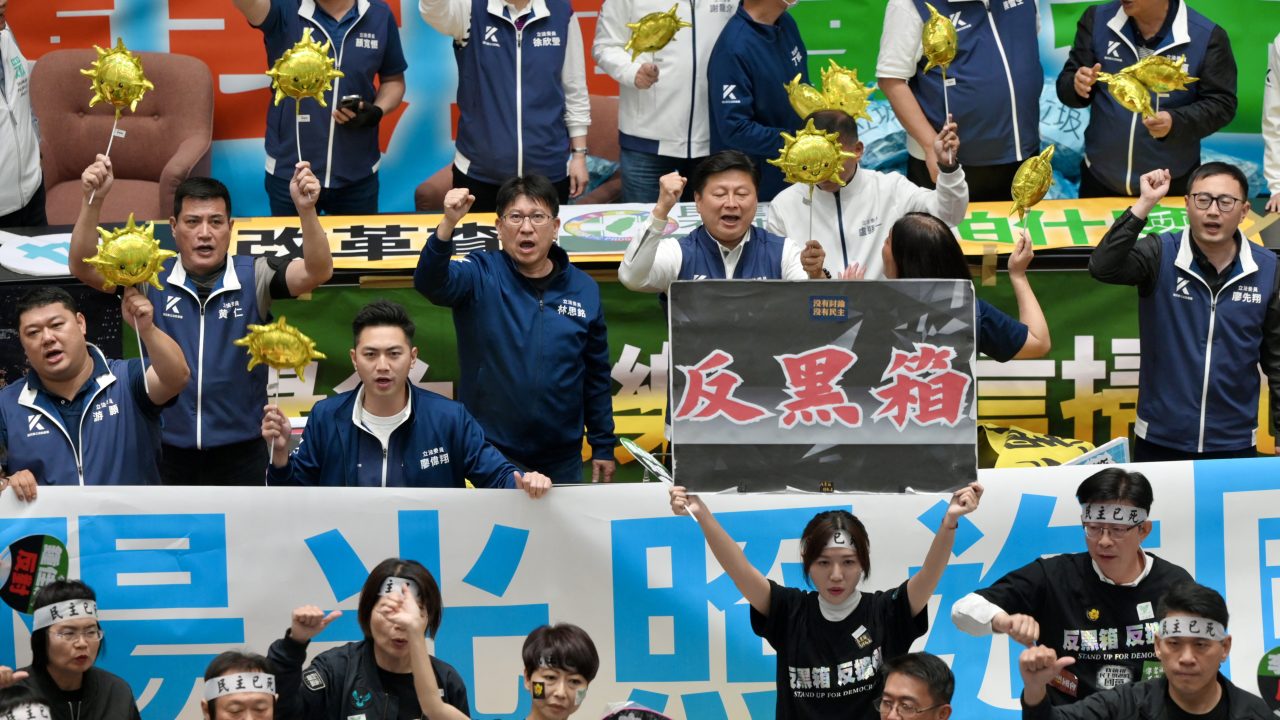
A recent attempt by the Chinese Nationalist Party (KMT) and Taiwan People’s Party (TPP) to expand the Legislative Yuan’s oversight powers with a series of amendments has hit a roadblock. In a significant development, Taiwan’s Constitutional Court has temporarily suspended key provisions of the revisions to the Law Governing the Legislative Yuan’s Power (立法院職權行使法).
The amendments, which were passed in May and came into effect in June, strengthened legislative powers in the following areas: “hearing national intelligence reports,” “receiving reports and questioning,” “exercising consent for appointments,” “exercising investigative powers,” “holding hearings,” and “contempt of the legislature.”
The KMT-TPP opposition alliance argues that the amendments are needed to establish legislative powers in investigations and hearings, and penalties for those who refuse to comply. The ruling Democratic Progressive Party (DPP) believes these amendments would give Taiwan’s legislature more power than other government branches.
As expected, both sides of the aisle engaged in heated debates in an oral argument in the Constitutional Court that took place on August 6. Presidential Office Secretary-General Pan Meng-an (潘孟安), Executive Yuan Secretary-General Kung Ming-hsin (龔明鑫) and Control Yuan Secretary-General Lee Chun-yi (李俊俋) all presented arguments, the first time secretaries general from three government branches appeared together in front of the Constitutional Court.
The justices also raised questions about the possibility of reconciliation between the president and the Legislative Yuan. Chief Justice Hsu Tzong-li (許宗力) announced that a ruling would be made within three months, with a possible two-month extension if necessary.
DPP caucus whip Ker Chien-ming (柯建銘) stated after the hearing, “Justice will prevail, and the constitution must not be reduced to ashes,” criticizing the opposition for going against the constitution. Chinese Nationalist Party (KMT) Legislator Weng Hsiao-ling (翁曉玲) reiterated that the constitutional interpretation requests from the DPP caucus, Executive Yuan, Presidential Office and Control Yuan do not comply with regulations and should not be accepted by the Constitutional Court.
TPP legislator Huang Kuo-chang (黃國昌) argued that the petitioners’ accusations lack concrete evidence. He cited Judicial Yuan Interpretation No. 342 and a paper by Chief Justice Hsu, stating that the Legislative Yuan’s agenda, speaking order and time, voting methods and exercise of interpellation and consent rights are all to be decided by the Legislative Yuan itself.
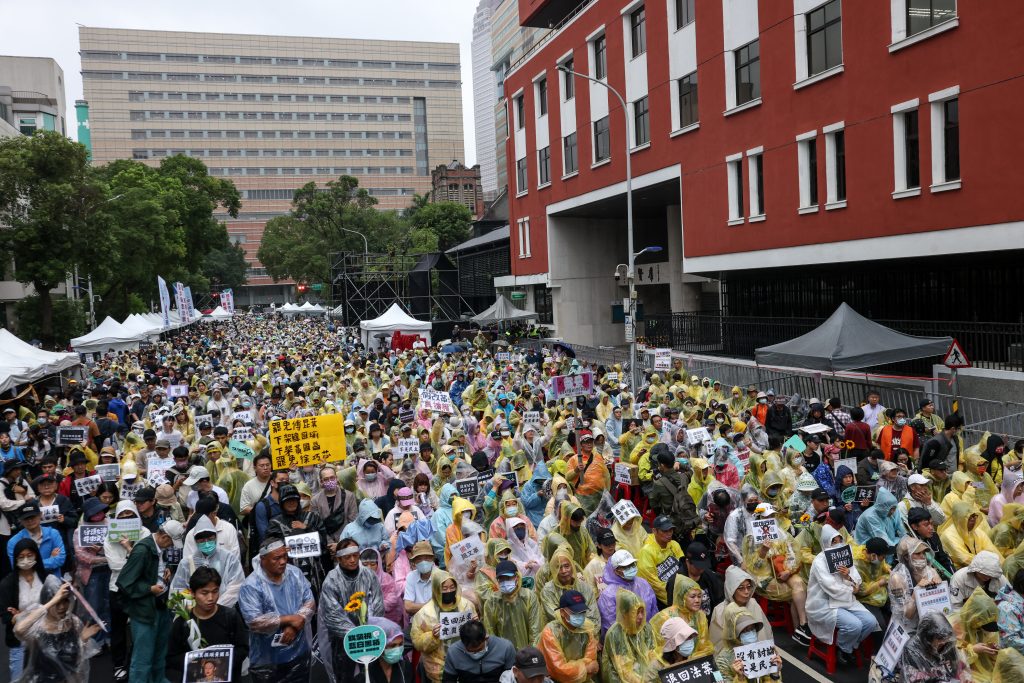
Four scholars presented varying viewpoints. Lin Chia-ho (林佳和), an associate professor at National Chengchi University Law School, suggested that the legislator’s new investigative powers might infringe on private negative freedom of expression.
Tung Pao-cheng (董保城), chair professor of law and vice president of Soochow University, argued for sanctions against those who do not cooperate with investigations and protection of the rights of minority legislators and smaller political parties.
Chang Wen-chen (張文貞) of National Taiwan University College of Law said the Legislative Yuan has the power under the constitution to conduct investigations. But amending the law to allow “committees” to establish investigative task forces could lead to constitutional disputes, and procedural safeguards for those under investigation were lacking.
Huang Ming-hui (黃銘輝), associate professor of law at National Taipei University, pointed out that the justices should not conduct a high-level review of this case to avoid being labeled as “politicizing the judiciary.” He suggested a lenient constitutional interpretation or an implicit partial unconstitutionality declaration as a reasonable compromise.
However, based on the Constitutional Court’s July 19 decision to temporarily suspend the implementation of the amendments, observers in Taiwan’s media believe the justices are not only considering the three requirements for temporary injunctions (severe damages that are hard to reverse, an urgent need for action, no other methods to prevent harm) but also conducting a “summary examination” and “balancing of interests” similar to what is seen in administrative litigation practices.
The court also weighed in on the benefits versus the drawbacks of granting a temporary injunction, considering whether continuing to implement the disputed clauses or temporarily suspending them would have a lesser impact.
The July 19 decision to grant a temporary injunction stated that suspending the implementation of the amendments would be “more beneficial than harmful.” This covered various controversial provisions, including the president’s state of the nation sessions at the Legislative Yuan, personnel appointment consent rights, official reports and interpellations, obligations for citizens to provide information and testimony, parliamentary disciplinary powers, hearing rights, and contempt of parliament offenses.
Given these indications, observers believe the justices have conducted a semi-substantive review of the amendments and may have preliminarily determined a possibility of them being unconstitutional. They likely assessed that the implementation of the amendments could lead to significant constitutional conflicts and potentially adverse consequences if allowed to continue.
The court’s decision will have a significant impact on the development of Taiwan’s rule of law. On August 7, DPP Legislator Wu Szu-yao (吳思瑤) emphasized that she supports legislative reform and respects the court’s decision on this matter. She also accused the KMT-TPP alliance of treating the Constitutional Court like a political panel to push their agenda. KMT Chairman Eric Chu (朱立倫) pleaded with the justices to use their wisdom, conscience, historical perspective of their place in Taiwan’s history, and sense of responsibility to make a final ruling that best weighs the public interest and democracy.
This article was updated on August 15, 2024 with two revised translations of Taiwanese legal terms. “Act Governing the Legislative Yuan’s Power” for 立法院職權行使法 was changed to “Law Governing the Legislative Yuan’s Power,” as the latter is the official English translation of the oversight law. “Preliminary review” for 略式審查 was changed to “summary examination,” the English translation of the German civil law term “summarische pruefung,” from which the Taiwanese legal term is derived.





Leave a Reply