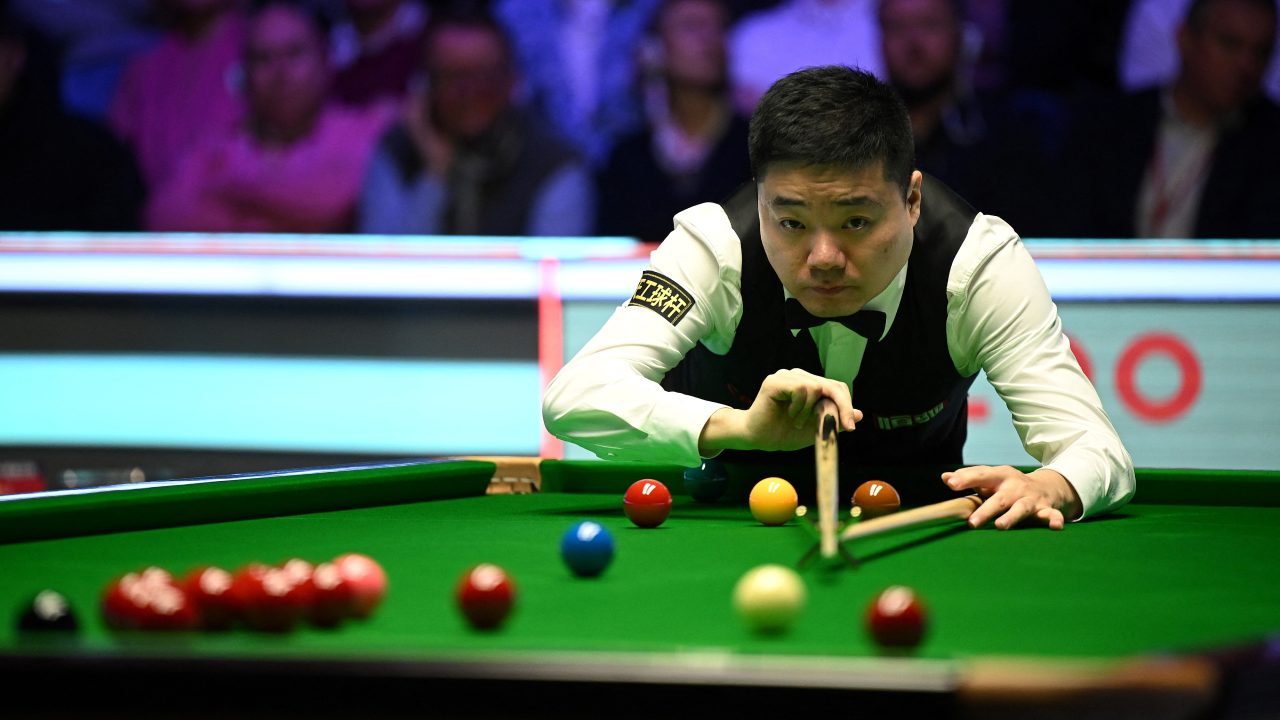
China’s soft power game is a regular subject of critique. The argument goes that for a country of its size and economic power, its cultural impact outside of its own borders is relatively small compared to, say, South Korea or Japan, and this is reflected in an overall lack of popularity.
In one sport, though, things are changing.
Ask a random person in the U.K. to name a Chinese sportsperson and there is a good chance they will name a snooker player. This is because in the past two decades the sport has transformed from one dominated by players from Britain, Canada and Australia, to one in which around 20 of the world’s current top 100 players are from China, plus several from Hong Kong.
And now Chinese snooker players look set to take the next step: from populating the world rankings lists, to dominating them.
Five Chinese players have made ranking event finals in the last year. Six of the top 20 players on the One Year List — counting prize money from the past twelve months — are Chinese. And the sport’s two most recognizable talents, Ronnie O’Sulivan and Judd Trump, have just moved to Hong Kong — a telling symbol of the game’s new center of gravity.
This is no accident. The Chinese government is trying to get cue sports included in the Olympics. Sixty million people in China regularly play snooker, according to some estimates, and at academies like the World Snooker College in Beijing, students train eight hours a day.
The lingering question is this: In terms of sheer volume of players, one might think China would already have a World Championship winner. And yet so far it hasn’t happened. What’s more, predictions of Chinese dominance have bounced around since at least 2005, when Ding Junhui (丁俊暉), China’s most famous player, won both the China Open and the U.K Championship. But they have gone unfulfilled. Why?
The Opinion of a Seven-Time World Champion
There are various theories. And one put forward by seven-time world snooker champion Stephen Hendry, who has traveled to China extensively to both commentate on and play in matches there, revolves around the Chinese academy system.
“I think a lot of the Chinese players are quite technical players,” Hendry told Domino Theory at a recent online Q and A session. “And when things go wrong, it’s kind of… they don’t understand why. So there’s that aspect of the more ‘business’ players, with flair and stuff … they react differently when things go wrong.”
“If you’re very highly coached, then you tend to have to go back to the drawing board if things are not going well.”
Initial Barriers
There are also other structural factors to look at.
For one, there are the simple logistics of dominating a sport. “The number of available places to become a professional on the World Snooker Tour each season is limited, so it first took several years for Chinese participants to swell,” David Caulfield, editor of SnookerHQ, told Domino Theory.
“For context, no player from mainland China was ranked inside the world’s top 64 when Ding won in Beijing 20 years ago.” This is already a very fast rise.
On top of that, two further issues may have slowed progress until now.
First, the three “majors” in snooker are all played in the U.K. and young Chinese players have had to move to the U.K. to train. These players have “often struggled to cope with having to move thousands of miles away to base themselves in a foreign country,” Caulfield said.
Then there are the events of 2021. In a major setback, ten top Chinese players were banned from playing in World Snooker events over a max-fixing scandal. That included the likes of U.K. champion Zhao Xintong (趙心童), Masters champion Yan Bingtao (顏丙濤) and former world number 11 Liang Wenbo (梁文博). That “didn’t help matters much,” Caulfield said.
Remaining Factors
Now, some of these barriers are fading into the distance. Zhao Xintong has just returned to the tour. And Chinese players are more established in the U.K. with, for example, a number of Chinese-owned snooker clubs in Sheffield — the home of the world championships.
But even that doesn’t mean it will be plain sailing from here.
“Winning at the [World Championships] is completely different to winning a week-long ranking event. The mindset is different — you know you are not going to be at your best all the time and you have to battle hard when things go against you. It is a test of mental endurance for 17 days,” Nigel Slater, editor at Snooker Chat, told Domino Theory.
The World Championship involves longer games, with more frames. At the moment, that seems to suit a group of older players with a lot of experience of that specific format. “It took snooker’s greatest Ronnie O’Sullivan a while to win his first world title,” Slater added.
Predictions
So, when will Chinese dominance arrive? And is it inevitable?
“We could be talking six weeks or even six years,” Slater said of the chances of a Chinese world champion — the first plank in any definition of the d-word. He pointed out that Chinese players are already consistently winning major events located in China, and if the World Championships moved there, Chinese players may be more likely to win.
“In terms of the wider dominance — more young players are coming through from Asia than the UK at the moment. The breakthroughs of Wu Yize (吳宜澤) and Si Jiahui (斯佳輝) and the return of Zhao Xintong show China has a great future in snooker,” Slater added.
“It is a fair shout to say in a few years that half of the Top 16 could herald from China. But only time will tell.”
The Trend
The trend, though, is clear. More and more of the highest ranking spots are being populated by Chinese players, and the “cueists on the World Snooker Tour who are managing to break through at an early age — most who are still in their teens or early-twenties — are almost entirely coming from China,” Caulfield pointed out.
“Add that to the fact that some of the players from the initial wave are finally finding their feet — Zhang Anda (張安達) and Xiao Guodong (蕭國棟) both regulars at the business end of events recently — and it’s becoming increasingly clear that China will have a long-lasting impact at the very pinnacle of snooker.”
Soft Power Gains?
How big a win is this for China? With snooker watched by about half a billion people globally (and around half of that viewership coming from outside of China), at the very least it’s a significant piece of good PR outside of its borders.








Leave a Reply