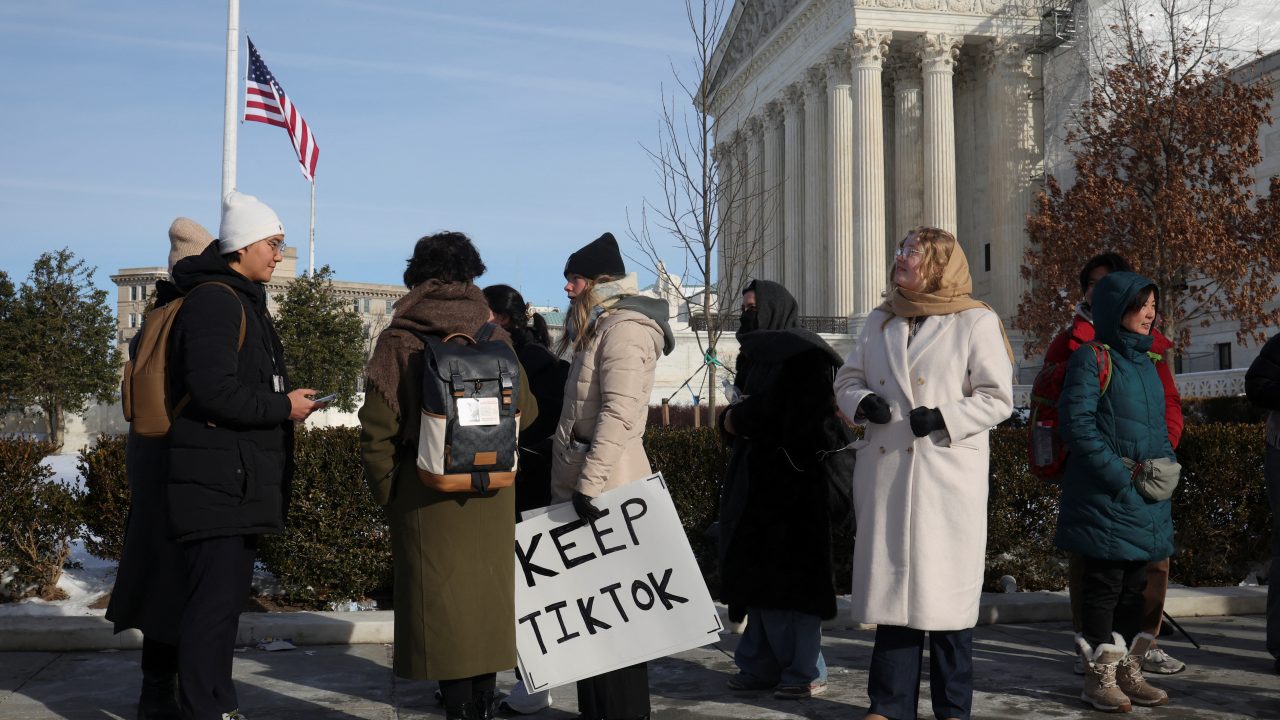
This week the Supreme Court is likely to release a decision on the TikTok vs. Garland case. Whether the court makes a final ruling or decides to defer and grant TikTok temporary relief, we can expect the court to do something in advance of the fast-approaching divest or be banned deadline, January 19. While only guesses can be made as to what the court will rule, the justices’ discourse during oral arguments on January 10 provides some insight into how they will resolve this conflict between free speech and national security.
Is the Government Trying to Censor Americans?
A large part of this debate came down to whether the Protecting Americans from Foreign Adversary Controlled Applications Act was motivated by a concern about the particular content that could appear on TikTok. Content-based speech restrictions enter the realm of government censorship and thus require higher levels of scrutiny for a potential violation of First Amendment Rights.
Chief Justice John Roberts and Justice Amy Coney Barrett both seemed to appreciate the government’s reasoning that there is a difference between not wanting particular content to show up on TikTok (this would be a content-based restriction) and what the act aims to do, which is to prevent covert content manipulation. “[Congress is] not saying TikTok has to stop. They’re saying that the Chinese have to stop controlling TikTok. So it’s not a direct burden on the expression at all,” Roberts said.
Justices Elena Kagan and Ketanji Brown Jackson seemed more hesitant. “Isn’t the whole point of the divestiture requirement that the content on TikTok would be different if it was owned by a different company? I’m still struggling with your [Solicitor General Elizabeth Prelogar’s] insistence that this is content-neutral versus content-based when we have that kind of circumstance,” said Jackson.
Chinese Influence and the Right to Be Influenced
The justices were skeptical of TikTok lawyer Noel Francisco’s arguments that TikTok is sufficiently separate from ByteDance and the influence of the Chinese government. Roberts accused Francisco of “ignoring the major concern” that China is manipulating content and harvesting data.
The justices were also skeptical of TikTok’s argument that it has First Amendment rights as an American corporation, despite the possibility of Chinese influence. Justice Samuel Alito drove toward the argument that if Chinese influence over TikTok is merely hidden in a “contrived corporate structure,” then TikTok may not have the same speech rights as a typical American company. Jackson indicated that the case is not so much an issue of speech as it is an issue of TikTok’s association with ByteDance. “[The act] doesn’t say, ‘TikTok, you can’t speak,’” Jackson said, adding that, “I thought we had cases about Congress prohibiting association with terrorist organizations, prohibiting association with foreign adversaries. And so why doesn’t this fall into that kind of group of our jurisprudence?”
Data Privacy vs. Content Manipulation
The government raised two national security concerns: data privacy and content manipulation. The justices appeared to view the data concern as more clear cut and possibly stronger. Justice Brett Kavanaugh said the data rationale “seems to me at least very strong,” while the covert content manipulation rationale “raise[s] much more challenging questions for you about how far that goes.”
Multiple justices grilled Prelogar about what “covert” really means in the context of content manipulation. Justice Neil Gorsuch seemed to be the most skeptical of the government’s arguments. He asked Prelogar, “that’s your best argument, is that the average American won’t be able to figure out that the cat feed he’s getting on TikTok could be manipulated even though there’s a disclosure saying it could be manipulated?” Gorsuch called this line of reasoning “a pretty paternalistic point of view.” If the decision is split, it seems likely that Gorsuch dissents.
Looking Ahead
The justices, as well as the lawyers, seemed as confused as the rest of the world about what exactly happens to TikTok if the ban is upheld. Francisco’s answer to a question posed by Kavanaugh on this topic was muddled. At one point, Francisco said that it would be “extraordinarily difficult” for TikTok to ever divest from ByteDance, while at another point he said that it would take a team of engineers some number of years to replicate ByteDance’s coveted algorithm.
Later on in the hearing, Prelogar said, “when push comes to shove and these restrictions take effect, I think it will fundamentally change the landscape with respect to what ByteDance is willing to consider, and it might be just the jolt that Congress expected the company would need to actually move forward with the divestiture process.”
Even if it turns out to be the case that TikTok doesn’t get access to ByteDance’s algorithm following divestment, Alito remarked, “is there some reason to think that only ByteDance … has devised this magical algorithm that all of the geniuses at Meta and all of these other social media companies, they couldn’t … come up with?”
It seems that both the justices and the lawyers are unclear about how exactly Trump could influence TikTok’s fate during his second term. In the meantime, ByteDance is fielding several offers to buy TikTok — including reportedly from Elon Musk and Project Liberty. We can expect more clarity this coming week.





Leave a Reply