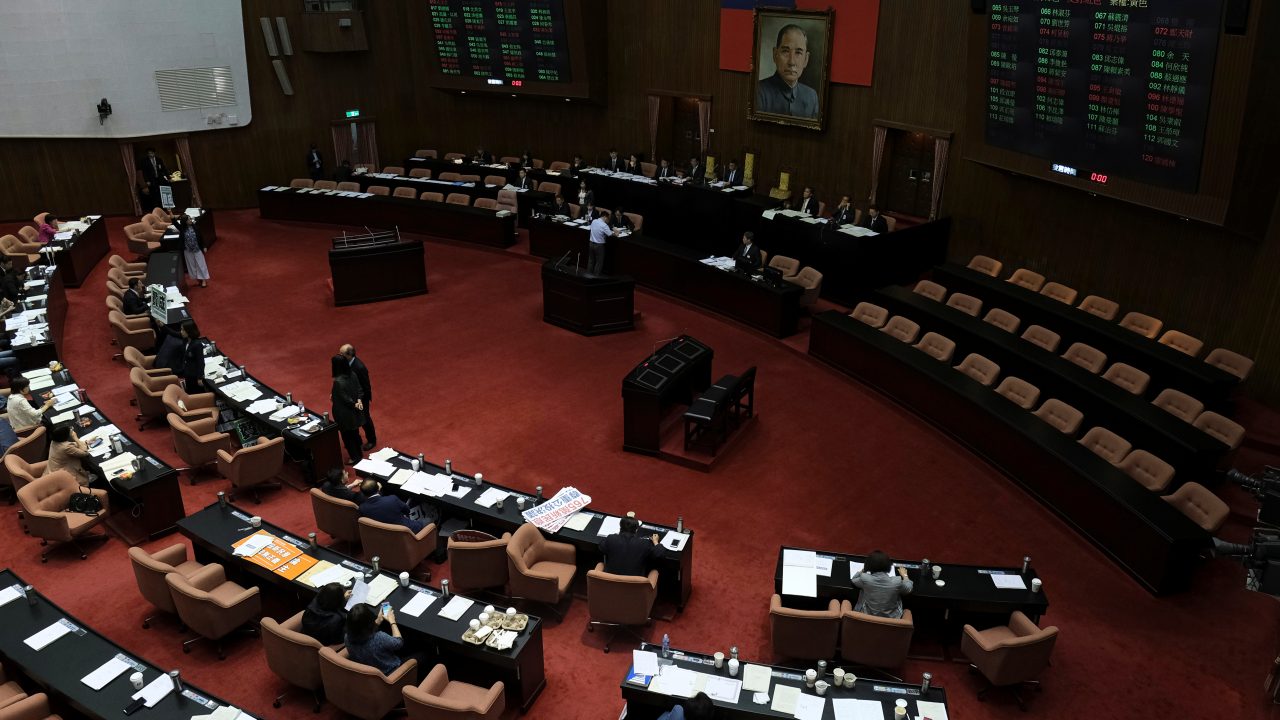
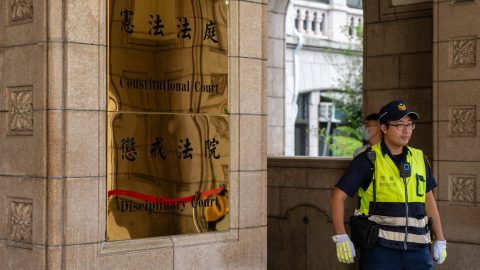
Taiwan’s Constitutional Court on Friday ruled that most of the amendments passed by the Chinese Nationalist Party (KMT) and Taiwan People’s Party (TPP) to expand the Legislative Yuan’s oversight powers are unconstitutional.
The amendments to the Law Governing the Legislative Yuan’s Power (立法院職權行使法) and Article 141-1 of the Criminal Code were passed by the opposition KMT and TPP on May 28. The laws triggered a series of protests known as the Bluebird Movement (青鳥運動).
Speaking on behalf of the Constitutional Court justices, Chief Justice Hsu Tzong-li (許宗力) explained that some of the amendments violated the separation of powers as written in the constitution.
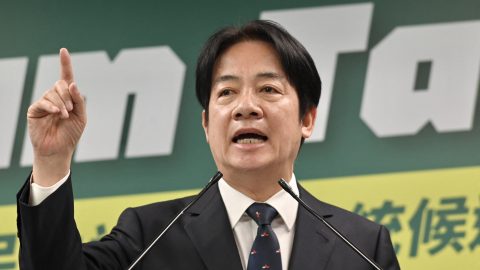
The Constitutional Court took up the case at the end of June after receiving requests from President Lai Ching-te (賴清德), the Executive Yuan, the Control Yuan and the Democratic Progressive Party’s (DPP) legislative caucus, all of them seeking to challenge the revisions.
Measures the court ruled against included contempt of court penalties for failing to answer legislators’ questions, and compelling the president to give a state of the nation address before the Legislative Yuan and subsequently answer questions from legislators.
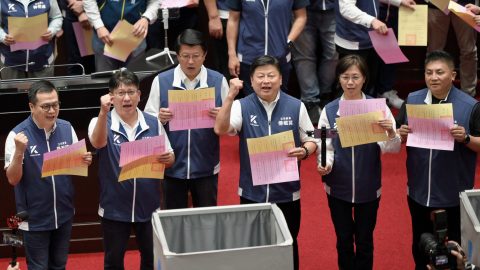
The ruling frustrated the KMT and the TPP, who hold a majority of seats in the Legislative Yuan and who together pushed for the new amendments to be passed.
The ruling will help the DPP, which holds the presidency, break a deadlock in the legislature as the party has been pushing to resolve a stalemate over next year’s budget, which covers critical areas like defense and healthcare.
KMT legislative caucus Secretary-General Lin Szu-ming (林思銘) criticized the decision in a press conference, saying “Today’s verdict marks as a day of shame in the history of the constitution” and that “judicial independence is dead.”
TPP caucus whip Huang Kuo-chang (黃國昌) said the ruling gives too much protection to government officials, as they can lie when being questioned by the legislature without fear of legal consequences.
Taiwan’s Ministry of Justice told the press it “respects the judgment of the Constitutional Court.”
This story will be updated.





Leave a Reply